
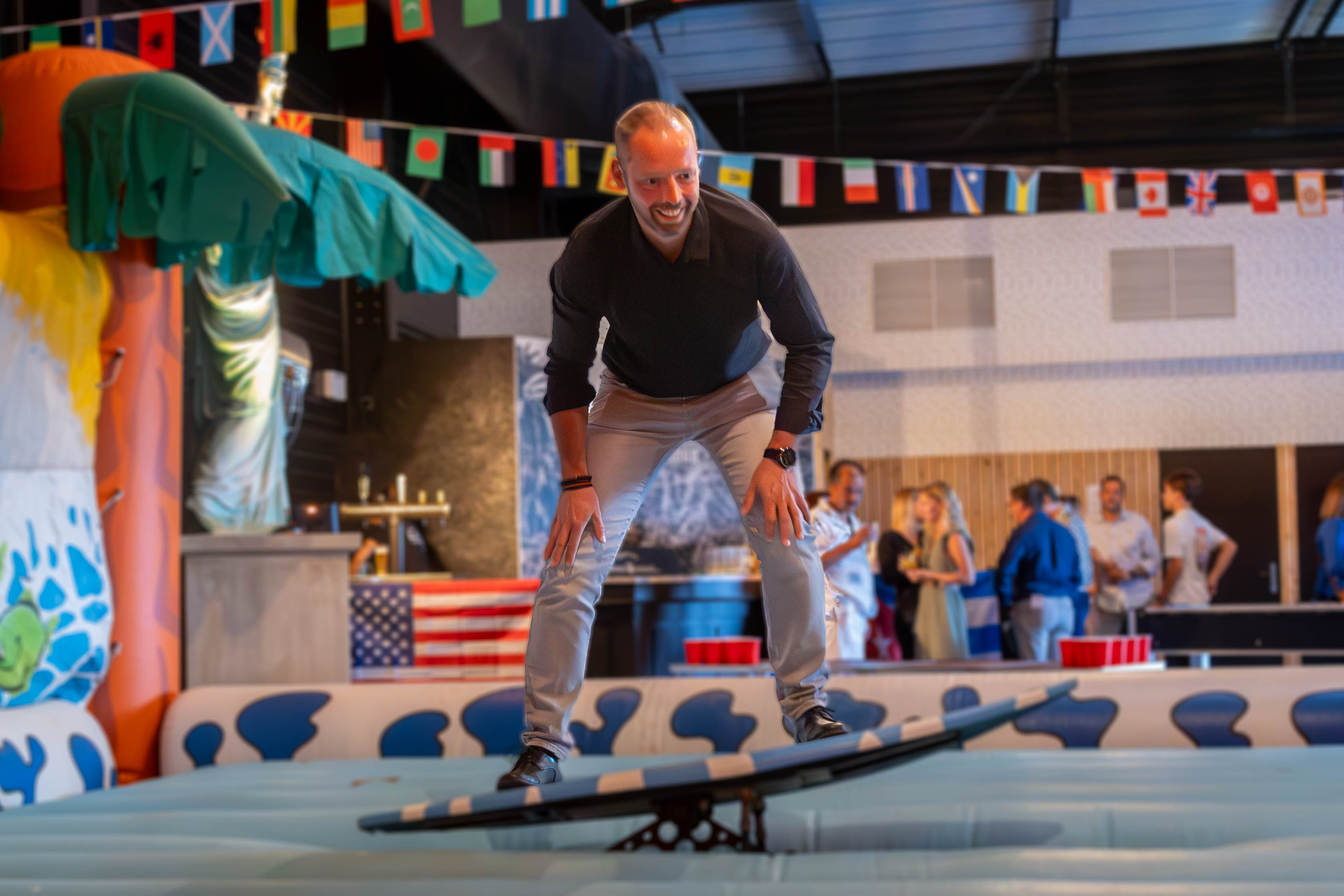
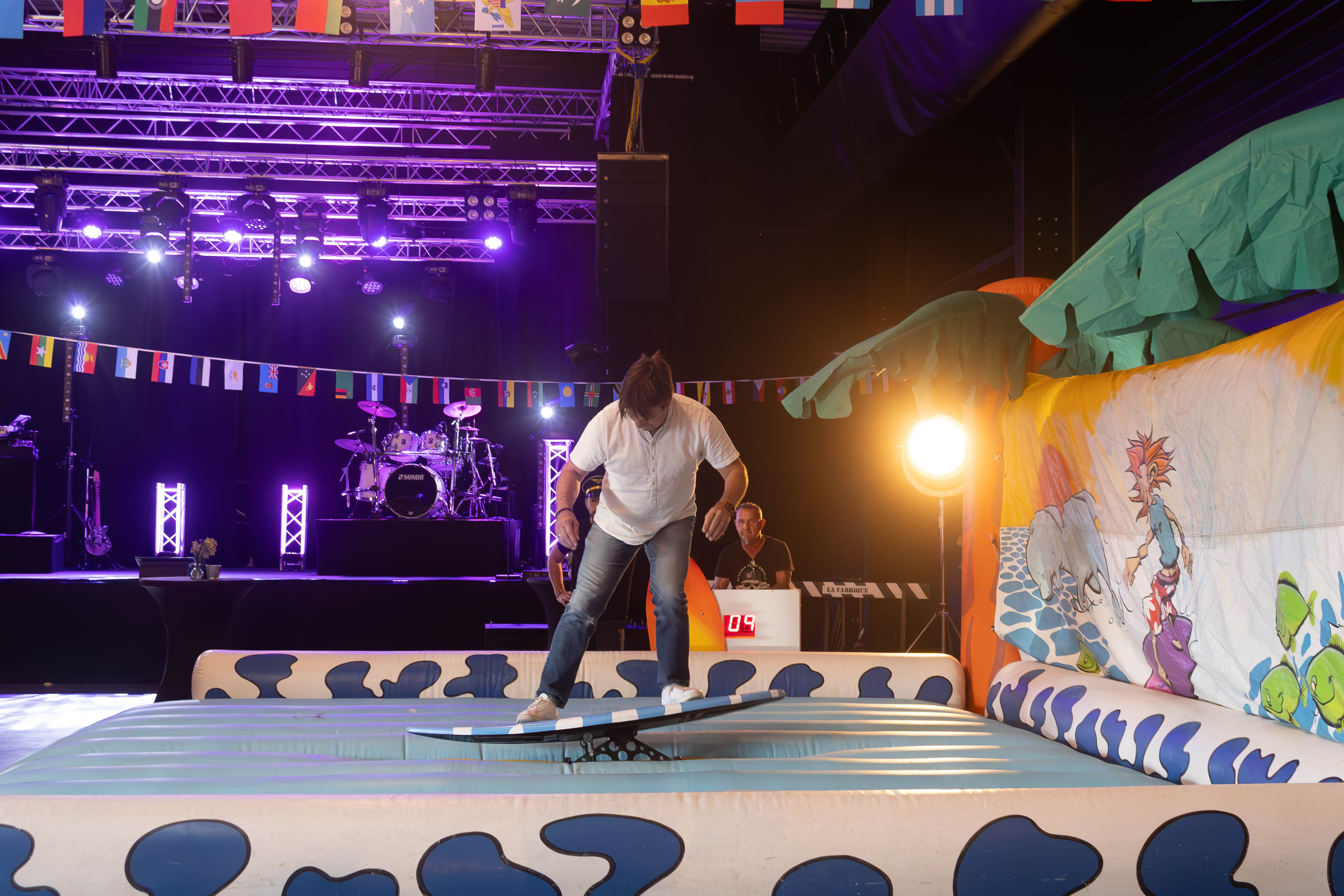
Surfsimulator in Brussel for corporate events that need energy and control
INNOV'events delivers and operates a Surfsimulator in Brussel for corporate audiences, from leadership offsites to large internal celebrations. We typically run it for 30 to 1,000 attendees, with professional supervision, queue management and full technical coordination.
You get one accountable partner for delivery, installation, safety briefings, operator staffing, and on-the-day flow—so your teams focus on guests, not logistics.
Sommaire
Entertainment is not a “nice extra” in a corporate agenda in Brussel: it is a tool to reset attention, create informal connections across departments, and give HR and Comms a visible lever for employer brand—without extending speeches or increasing meeting time.
Local organisations expect predictable timing, clear risk control, and a premium guest journey: multilingual hosting, smooth access in dense areas of Brussel, and a setup that looks as professional as the rest of the event production.
As an events team based around Brussel, we plan like people who have to deliver on site: freight lifts, loading slots, noise constraints, power availability, and venue rules. That operational reality is what makes a Surfsimulator in Brussel feel effortless to your guests.
Brussel decision-makers: quick numbers that de-risk your choice
10+ years coordinating corporate entertainment formats across Belgium, with repeated delivery in Brussel venues and office locations.
150+ corporate event days/year managed through our network (operators, riggers, AV partners, safety leads), including peak season constraints.
30–1,000 participants typical attendance range for our entertainment modules, with scalable staffing and throughput planning.
2 operators minimum per Surfsimulator (plus optional host) to keep safety, pace and guest experience consistent.
48h target for a first structured quote and feasibility feedback once we have venue address, timings and guest profile.
Surfsimulator projects in Brussel: the type of clients who trust us
We support organisations that operate in Brussel and need partners who understand corporate constraints: board-level expectations, brand guidelines, and the reality of event-day pressure. Many of our clients rebook year after year because they want a supplier who remembers how their stakeholders react and what their internal process requires (procurement, insurance checks, HSE validation, legal approvals for visuals and data capture).
You did not provide specific company names to cite as references. If you share 5–10 names (or sectors), we will integrate them in this section in a compliant way (e.g., “EU-affiliated bodies”, “national banks”, “consulting groups in the European Quarter”, “HQs around Louise and the North District”) while respecting confidentiality and approval requirements.
What we can already confirm: we are used to working with mixed audiences common in Brussel (multilingual, international profiles, partners and suppliers invited), and we design the guest journey accordingly: clear signage, time-slot logic, and staff that can brief participants efficiently.
 Besoin d’un devis rapide ?
Nous vous envoyons une première proposition sous 24h.
Why book a Surfsimulator in Brussel for an HR or Comms agenda?
A Surfsimulator in Brussel works when you want high engagement without turning your event into a “funfair”. Executives appreciate it because it is measurable: you can control duration, throughput, safety, and the level of showmanship. HR values it because it creates real cross-team interaction—people cheer, coach, and laugh together even if they do not work in the same division.
In practice, we often integrate the simulator as a structured engagement pillar between two content blocks (e.g., after a strategy keynote and before a networking dinner). That timing is not random: it helps release tension, resets attention, and produces organic conversation starters for the rest of the evening.
Predictable engagement: a clear flow (briefing → ride → photo moment → exit) avoids the “people watching but not participating” issue that HR teams often fear.
Inclusive by design: guests can participate at different intensity levels. We set ride modes (beginner/intermediate) and coach on posture and balance so first-timers are not embarrassed.
Brand control: the simulator zone can be visually aligned (backdrop, LED, floor marking, host script) so it supports corporate image rather than feeling like a rented gadget.
Team dynamics you can observe: leaders can literally see collaboration and encouragement happening—useful for internal communication narratives and post-event reporting.
Time-boxed and agenda-friendly: unlike some entertainment that drifts, the simulator supports strict time slots, ideal for programmes with VIP arrivals or staged content.
Content capture with governance: if you need photos/short clips, we can set a capture point that respects privacy expectations and approvals common in Brussel corporate environments.
Brussel is a city where many organisations operate under scrutiny—internal (works council), external (stakeholders), and reputational (international guests). A well-managed Surfsimulator format gives you energy and human moments while keeping production standards consistent with a professional corporate culture.
What Brussel venues and HQs typically require for a Surfsimulator
Running a Surfsimulator in Brussel is primarily an operations exercise. Many venues around the European Quarter, the North District, and central areas have strict loading and access constraints. We plan around realities that directly affect your schedule: limited loading bays, timed delivery windows, mandatory floor protection, lift dimensions, and security procedures for external suppliers.
On the client side, we see consistent expectations from executives, HR and Comms teams in Brussel:
- Clear risk ownership: who briefs participants, who stops the machine, who manages a fall, and who has authority to pause the activity if crowding increases.
- Professional staffing: operators who can manage guest behaviour politely but firmly (no “friends running the show”).
- Multilingual hosting: at minimum French/Dutch, often English, because guests and colleagues mix.
- Noise and space control: the zone must not interfere with speeches or a seated dinner; we propose placement and time slots accordingly.
- Compliance mindset: insurance certificates, venue approvals, and a written method statement when needed—common in corporate Brussel procurement processes.
We design the setup to match these expectations: a clearly delimited zone, visible rules, and an operational lead who coordinates with your venue manager and your internal event owner.
What to pair with a Surfsimulator in Brussel to keep executives engaged
Entertainment creates engagement when it is designed around behaviour: how people arrive, how they circulate, what makes them stop, and what they will talk about after. In Brussel corporate settings, pairing formats is often smarter than increasing spectacle—because you want controlled energy and predictable timing.
Below are proven add-ons we use around a Surfsimulator in Brussel, depending on your objective (networking, employer brand, celebration, product messaging).
Animations Interactives à Brussel
Leaderboard challenge with time slots: we run a “best balance time” or “best score” logic with scheduled windows (e.g., department vs department). This avoids crowding and keeps it fair.
Hosted mini-interviews: a bilingual host captures 10–15 second reactions right after the ride. Useful for internal Comms recap videos, without turning the event into a TV set.
Photo corner with branded backdrop: placed at the exit, not near the queue. This prevents bottlenecks and gives Comms predictable visuals.
Animations Artistiques à Brussel
DJ or live percussion timed to peaks: we keep sound levels consistent with venue constraints and pause during speeches—common requirement in Brussel conference venues.
Ambient performers (walk-about): used to distribute attention across the room so the simulator does not absorb all guests at once.
Animations Innovantes à Brussel
Mocktail or isotonic bar: works well with the “sport” narrative, and it is inclusive for guests who do not drink alcohol. We position it to support flow, not compete with the main bar.
Late snack station: keeps energy stable when you run the simulator after dinner; avoids guests leaving early—useful near public transport cutoffs in Brussel.
Animations Gourmandes à Brussel
RFID/QR participation tracking: optional for internal challenges. We only implement if your legal/privacy framework allows it (typical consideration for corporate groups in Brussel).
Short-form highlight edit delivered fast: if you need next-day internal comms, we structure capture points and permissions beforehand so editing is not blocked by approvals.
Whatever you add, alignment with brand image is the filter: the Surfsimulator zone should match your tone (premium, playful, tech, sustainable). We ensure visual integration (materials, colours, signage language) so the animation strengthens your corporate narrative rather than distracting from it.
Which Brussel venue types work best for a Surfsimulator setup?
The venue determines whether a Surfsimulator in Brussel is seamless or stressful. Ceiling height, floor resistance, access routes, and where guests naturally gather matter more than “beautiful rooms”. We assess feasibility early to protect your timeline and your reputation on the day.
| Venue type | For which objective? | Main strengths | Possible constraints |
|---|---|---|---|
Conference hotel ballroom in Brussel | After-conference activation, gala evening, end-of-year celebrations | Predictable access procedures, strong power availability, professional staffing on site; easy to time-box between agenda blocks | Loading windows can be strict; noise limits during speeches; floor protection often mandatory |
Corporate HQ atrium / lobby in the Brussels-Capital area | Employer brand, open day, internal milestone celebration | High visibility, strong internal attendance, easy to integrate with comms and leadership presence | Security checks, lift dimensions, and building rules; circulation must remain safe for non-participants |
Industrial/event hall (high ceilings) around Brussel | Large-scale staff party, multi-activity zones, high throughput | Space to build a controlled zone, strong spectator experience, flexible layouts | Acoustics and heating can be challenging; additional décor needed to match premium brand expectations |
We strongly recommend a site visit (or at least a technical call with photos and measurements) before confirming. In Brussel, the difference between a smooth delivery and a last-minute replan is often one detail: a tight corridor, a restricted loading bay, or a venue rule that changes the installation schedule.
What does a Surfsimulator cost in Brussel for corporate use?
Pricing for a Surfsimulator in Brussel depends less on the machine itself than on operational parameters: duration, staffing, access complexity, and how you want the experience to look and flow. For executive stakeholders, the right question is not “cheapest option” but “what level of control and brand fit do we need for this audience?”.
As a working reference for corporate events, budgets are typically in the range of €1,800 to €4,500 ex. VAT for standard deployments, and can increase for long durations, complex access, or high-end branding/hosting requirements.
Event duration: half-day vs full-day vs evening (and whether you need standby time during speeches).
Staffing level: minimum 2 operators; optional bilingual host for scripting, crowd tone and brand consistency.
Venue access complexity in Brussel: loading bay distance, lift size, restricted hours, security screening, permits for street access when required.
Branding and scenic integration: backdrop, floor markings, lighting, and how the zone integrates with your overall event design.
Throughput/queue design: time-slot system, barriers, signage, and whether you need a digital scoreboard.
Insurance and compliance documents: some clients require specific certificates and method statements; we plan this into lead times.
ROI is usually visible in three places: participation rate (how many guests actually engage), quality of content captured for internal/external communication, and stakeholder satisfaction (fewer complaints about waiting, noise, or safety). We price to protect those outcomes—because on event day in Brussel, a “small saving” can become a reputational cost fast.
Why choose a Brussel team to manage your Surfsimulator day?
For corporate clients, local execution is not about proximity as a slogan—it is about speed, accountability, and knowing the operational ecosystem of Brussel. When your venue changes a loading slot or security asks for documentation, you need a partner who can react without improvisation.
Working with INNOV'events means you are not coordinating separate vendors yourself. As your event agency in Brussel, we handle supplier alignment, venue interface, and the run-of-show so your internal owner is not stuck making technical decisions during the event.
- Faster feasibility checks in Brussel: we know typical venue constraints and what to ask early (access routes, power points, noise rules).
- On-site authority: one production lead who can take decisions with your approval framework, reducing last-minute escalations to executives.
- Supplier reliability: operators and technical partners used to corporate codes of conduct (punctuality, dress code, discretion).
- Better guest experience: multilingual staffing and queue discipline aligned with the expectations of international audiences common in Brussel.
ROI is usually visible in three places: participation rate (how many guests actually engage), quality of content captured for internal/external communication, and stakeholder satisfaction (fewer complaints about waiting, noise, or safety). We price to protect those outcomes—because on event day in Brussel, a “small saving” can become a reputational cost fast.










Examples of Surfsimulator formats delivered in Brussel contexts
We adapt the Surfsimulator to the event’s real objective, not the other way around. In Brussel, that often means designing for mixed audiences and strict timing.
- Post-townhall activation (300–600 staff): installed in a secondary space so the main plenary remains clean for speeches. We ran time slots by department to avoid the “first come, first served” frustration and to keep executives available for conversations.
- Client & partner evening (120–200 guests): the simulator was positioned as a networking catalyst, with a host driving light participation without pressuring VIPs. Branding was kept subtle and premium to match a formal dress code.
- Recruitment/employer branding day: used as an “approachability tool” for managers. Candidates interacted with team leads in a natural way while watching colleagues ride, creating an informal but controlled atmosphere.
Across these formats, the constant is operational discipline: safe zone design, predictable throughput, and integration into the run-of-show. That is what protects your brand when stakeholders are watching.
Common mistakes when booking a Surfsimulator in Brussel
Underestimating access and timing: a 30-minute delay at loading can cascade into a programme shift. We plan buffer time and confirm constraints in writing with the venue.
Insufficient staffing: one operator cannot safely manage riders and a queue during peaks. We plan at least 2 operators and add a host when the audience is large or VIP-heavy.
Wrong placement in the room: putting the simulator near the stage or service routes creates noise conflicts and safety issues. We design the layout around circulation, not aesthetics.
No throughput plan: without time slots or queue rules, you get long waits and low participation—HR then hears “it looked fun but I didn’t try”.
Brand mismatch: a poorly dressed zone, cheap signage, or inconsistent staff behaviour can undermine a premium corporate event in Brussel.
Unclear photo/video governance: filming without consent or without internal approvals can create immediate complaints, especially in regulated environments.
Our job is to prevent these risks before they reach your leadership team. We do that with structured pre-production (checklists, venue interface, run-of-show) and disciplined on-site management of the Surfsimulator in Brussel.
Why Brussel clients rebook INNOV'events for corporate entertainment
Repeat business comes from operational confidence. HR and Comms teams come back when the event is not only “successful”, but also easy to own internally: procurement is satisfied, stakeholders are calm, and the day runs without surprises.
We work in a way that reduces internal workload: one point of contact, clear documentation, realistic timing, and transparent constraints.
70–80% of our corporate clients typically re-engage us within 18 months for another format or location (rate varies by year and organisational cycles).
90%+ of projects run with a documented run-of-show and technical checklist validated before event day.
0 tolerance policy for unsafe operation: we pause the activity if the zone cannot be controlled.

Loyalty is the most practical proof in this market: it means the project survived real-world constraints—venue rules, timing pressure, executive scrutiny—and still delivered. That is the standard we bring to every Surfsimulator deployment in Brussel.
How we deliver a Surfsimulator in Brussel from brief to event day
👉 Step 1 (Brussel): scope the objective and constraints
We start with a 20–30 minute call focused on what matters for executives: why the animation exists, what success looks like, and what cannot fail (timings, VIP experience, brand image, safety). We confirm audience size, schedule, languages required, and whether you need content capture. We also identify internal approvals (procurement, HSE, legal, communications).
👉 Step 2 (1000): venue feasibility and access validation
We request venue specs (access route, lift dimensions, loading slot, power availability, ceiling height, floor type) and confirm placement options. If needed, we organise a site visit in Brussel to avoid assumptions. This step prevents last-minute compromises that harm guest experience.
👉 Step 3 (Brussel): design the guest journey and throughput
We define ride duration, briefing script, queue method (free flow vs time slots), and staffing levels. For larger crowds, we propose a clear rotation system (e.g., by teams) so HR can communicate it internally. We also define what the non-participants do nearby so the zone feels lively without congestion.
👉 Step 4 (1000): production, documentation and brand integration
We lock delivery times, operator call times, and installation plan. We provide required documents (insurance, method statement if requested) and align the look: signage language, host tone, and any branding elements. If you need photo/video, we define capture points and approval logic beforehand.
👉 Step 5 (Brussel): on-site delivery, operation and debrief
We arrive within the agreed window, install with floor protection, test the unit, and run a pre-opening safety check. During the event, our lead manages the zone, coordinates with venue staff, and adjusts pacing to match the programme. After the event, we debrief with you on participation, flow issues, and improvements for the next edition.
FAQ sur l'organisation Surfsimulator à Brussel
How much space is needed for a Surfsimulator in Brussel?
Plan for 25–40 m² including safety clearance and queue area. The exact footprint depends on the model and whether you add barriers, branding, or a photo exit point. We confirm after venue photos and a placement plan.
How many participants per hour in Brussel corporate events?
Typically 25–50 riders/hour depending on ride length (usually 1–2 minutes), briefing time, and how strict you want the progression to be. For large groups, time slots and an extra host keep throughput stable.
Can a Surfsimulator run indoors in Brussel venues?
Yes, most deployments are indoor. We verify ceiling height, floor protection requirements, power supply, and venue rules (noise, emergency exits). Indoor setups are common in Brussel hotels, conference venues and corporate atriums.
What is the typical budget for a Surfsimulator in Brussel?
Most corporate bookings fall between €1,800 and €4,500 ex. VAT, depending on duration, staffing, access complexity, and branding/hosting options. We provide a line-by-line quote once the venue and timing are confirmed.
How early should we book a Surfsimulator in Brussel?
For peak months (May–June and September–December), we recommend 4–8 weeks. For simple setups with flexible timing, 2–3 weeks can work, but venue approvals and loading slots in Brussel can extend lead times.
Request a Brussel quote with a realistic operating plan
If you want a Surfsimulator in Brussel that looks professional, runs safely, and fits a corporate programme, send us your date, venue (or shortlist), guest count, and timing constraints. We will come back with a feasibility confirmation, a clear budget range, and the staffing/throughput approach—so you can validate internally without guesswork.
Planning early is the easiest way to protect your agenda and your brand on event day, especially in high-demand periods in Brussel.
Agence INNOV'events Brussel
Justin JACOB est le responsable de l'agence événementielle Brussel. Contactez-le directement par mail via l'adresse belgique@innov-events.be ou par formulaire.
Contacter l'agence BrusselToutes nos prestations & animations Brussel, Belgique
Découvrez nos prestations événementielles
Découvrez nos animations événementielles disponibles au Belgique
- Hôtesse événementielle à Brussel
- Escape Game à Brussel
- Cours de cuisine type MasterChef à Brussel
- Magicien à Brussel
- Location de chapiteau à Brussel
- Atelier colorimétrie à Brussel
- Jeux gonflables à Brussel
- Service de voiturier à Brussel
- Simulateur de football à Brussel
- Location de mobilier lumineux à Brussel
- Flocage lumineux à Brussel
- Repas insolite à Brussel
- Light Painting à Brussel
- Murder Party à Brussel
- Jeu concours à Brussel
- PLV événementielle à Brussel
- Réalité virtuelle à Brussel
- Cuisine moléculaire à Brussel
- Animation Halloween à Brussel
- Feu d’artifice à Brussel
- Jeux géants à Brussel
- Animateur événementiel à Brussel
- Animation photo à Brussel
- Père Noël à Brussel
- Animation enfants à Brussel
- Visite guidée à Brussel
- Rallye urbain à Brussel
- Piscine à balles à Brussel
- Simulateur de vol à Brussel
- Location de food truck à Brussel
- Record du monde à Brussel
- Simulateur de surf à Brussel
- Casino du vin à Brussel
- Atelier relooking à Brussel
- Atelier création de parfum à Brussel
- Atelier acting à Brussel
- Animations RSE à Brussel
- Tir à l’arc à Brussel
- Agent de sécurité à Brussel
- Œnologie à Brussel
- Mime à Brussel
- Jeu télévisé à Brussel
- Fête foraine à Brussel
- Atelier gestion de crise à Brussel
- Atelier négociation de crise à Brussel
- Jeux d’arcade à Brussel
- Simulateur de chute libre à Brussel
- Simulateur de ski à Brussel
- Simulation circuit automobile à Brussel
- Baptême de l’air à Brussel
- Dégustation à Brussel
- Création de baby-foot à Brussel
- Rallye 2CV à Brussel
- Challenge LEGO à Brussel
- Animation casino à Brussel
- Interprète / traducteur à Brussel
- Goodies à Brussel
- Bus / transfert à Brussel