
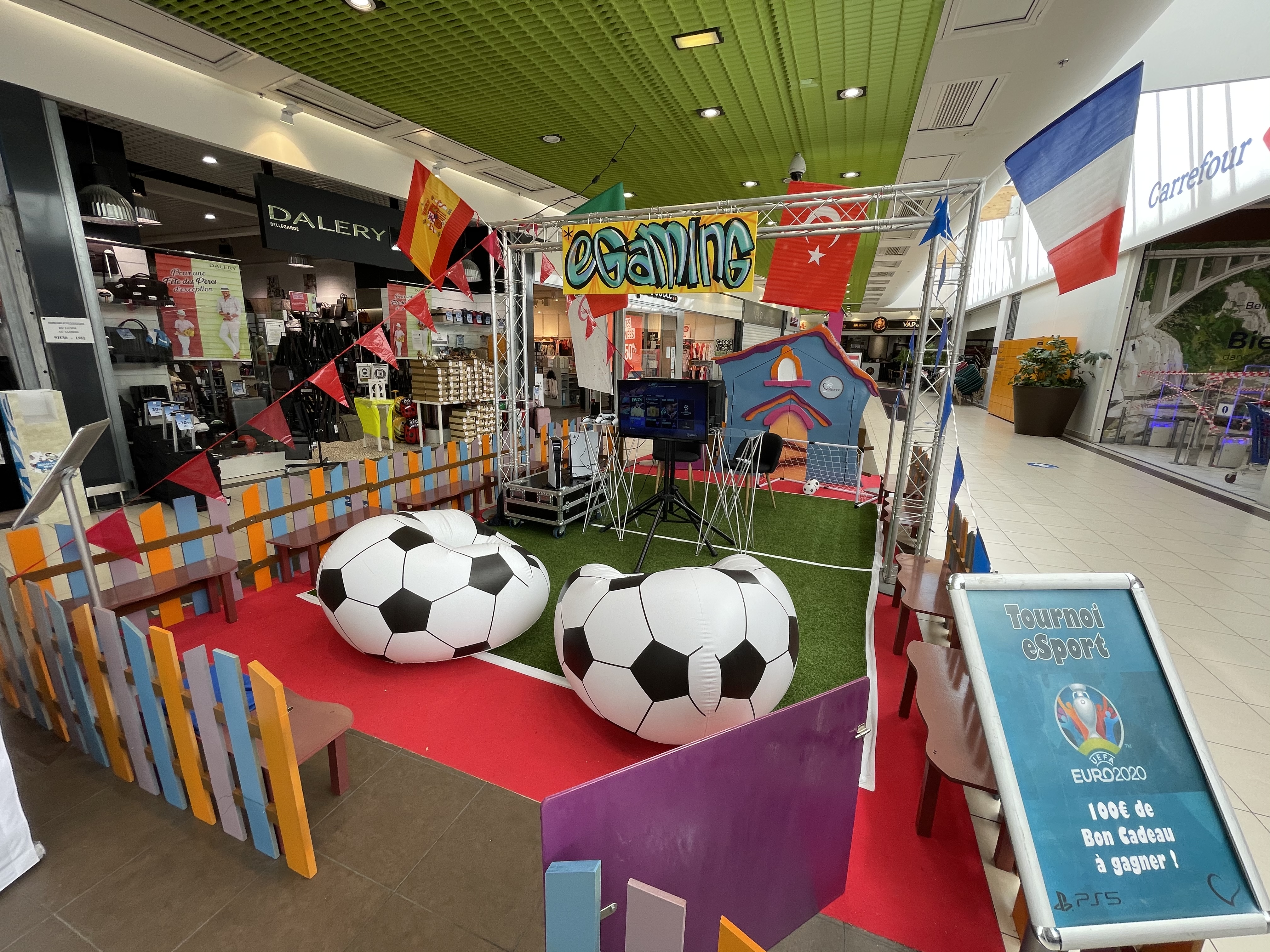
Voetbalsimulator in Brussel that keeps your event on schedule
INNOV'events delivers a Voetbalsimulator in Brussel for corporate events from 30 to 500 attendees: delivery, installation, facilitation, and dismantling included.
We handle venue coordination (access, power, timing), participant flow, and a competition format that fits your agenda—whether it’s a lunch activation, an afterwork, or a full-company event.
Sommaire
In a corporate agenda, entertainment only works if it supports business goals: attendance, energy in the room, and a reason for teams to actually mingle. A Voetbalsimulator creates structured interaction in short cycles, which is exactly what you need when time is limited and attention is fragmented.
Organizations in Brussel typically expect three things: professional timing (no delays between sessions), inclusive participation (not only the “football crowd”), and clean operational execution compatible with premium venues, building rules, and brand standards.
We are Brussels-based and run these activations in office towers, conference venues, and historic locations across the region. Our role is to make the entertainment feel effortless for your teams—because on event day, your HR or Comms lead cannot be troubleshooting cables, queues, or safety concerns.
Operational facts you can rely on in Brussel
10+ years producing corporate events and activations across Belgium, with recurring clients in Brussels and its business districts.
30–500 participants supported on a single Voetbalsimulator depending on time slots, format, and facilitation (typical throughput: 20–40 players/hour).
15–90 minutes standard deployment window on site (varies by access, elevators, and venue constraints). We always plan for real building conditions in Brussel.
1–2 facilitators included per station to manage flow, explain rules, and keep the activity inclusive—especially important for mixed seniority and mixed language groups.
Who we support in Brussel year after year
In Brussel, our projects are rarely “one-off entertainment buys”. They are usually part of a broader internal or external communication sequence: onboarding days, employer branding events, leadership offsites, end-of-year moments, or client hospitality.
We regularly work with organizations located around the European Quarter, the North district, and the business corridors towards Zaventem and Woluwe. Some clients renew annually because the operational model is predictable: we brief your team, coordinate with the venue, arrive on time, run the activity with a facilitator who understands corporate etiquette, and leave the space clean and compliant.
If you share your sector and venue shortlist, we will provide references aligned with your context (office building vs. hotel vs. event venue), including practical feedback on flow, noise, and timing—because in Brussels, the difference between “fun” and “chaos” is usually logistics.
 Besoin d’un devis rapide ?
Nous vous envoyons une première proposition sous 24h.
What a Voetbalsimulator changes for HR teams in Brussel
When you organize a corporate event in Brussel, you compete with hybrid work habits, heavy calendars, and diverse employee profiles. A Voetbalsimulator is effective because it creates a neutral, short, repeatable interaction that helps people join without needing to “perform” socially for a long time.
Improves participation without forcing networking: the activity provides a natural conversation starter and reduces the pressure of small talk—useful for new hires, introverted profiles, and cross-department groups.
Gives structure to a reception: instead of a single “peak moment”, you get constant micro-peaks. This keeps energy stable and helps you avoid the classic issue of clusters forming and not mixing.
Creates measurable engagement: we can run a scoreboard, mini-leagues, or a “department challenge” and deliver participation figures (players per hour, top scores, team rankings) that HR/Comms can reuse internally.
Fits executive time constraints: leadership can participate in a 3–5 minute session and still contribute to the atmosphere. It’s a practical solution when executives are present but cannot stay for long.
Supports employer branding: done properly, it looks professional (clean setup, branded scoreboard, controlled queueing) and signals that the company invests in quality moments, not improvised animations.
Brussel is a dense, international business environment. Activities that work here are those that respect time, space, and diversity—while still producing genuine human interaction. A well-run Voetbalsimulator checks those boxes.
What Brussels venues and corporate policies require in 1000–1210
Brussels events are often hosted in spaces with strict operational rules: limited delivery windows, shared loading bays, specific elevator dimensions, and security procedures that require named technicians. For a Voetbalsimulator in Brussel, this matters as much as the activity itself.
We plan around typical constraints we see in Brussel office buildings and hotels:
- Access & security: check-in procedures, badge requirements, vehicle access restrictions, and time-limited unloading.
- Noise management: ensuring the activation does not disrupt plenary sessions, VIP areas, or neighboring tenants—especially in mixed-use buildings.
- Multilingual facilitation: Dutch/French/English instructions are not “nice to have” in Brussels; they prevent friction and keep queues moving.
- Space realism: a simulator needs more than its footprint; you also need a safe buffer zone and a queue lane that does not block catering or emergency exits.
From an executive perspective, the expectation is simple: the entertainment must be visible and engaging, without creating operational risk or reputational noise. Our job is to absorb that complexity for you.
Which corporate event entertainment works best in Brussel today
Entertainment creates engagement when it gives people a role: player, supporter, team captain, or challenger. In Brussel corporate environments, the best results come from formats that are quick to understand, inclusive across cultures, and easy to integrate into a professional schedule.
Animations Interactives à Brussel
Voetbalsimulator challenge ladder: employees play short rounds (e.g., 3 shots) and climb a live ranking. Works well during receptions because it creates continuous movement.
Inter-department mini-cup: each team represents a department (HR, Finance, Sales, Operations). You get a playful rivalry without excluding non-athletes because the skill curve is manageable.
Client hospitality “beat the executive”: a short, controlled challenge that lets your leadership participate briefly and creates memorable content for internal comms.
Animations Artistiques à Brussel
Live caricaturist or digital portrait station near the simulator: keeps non-players engaged and reduces dead time in the queue area.
MC / host with a light script (not a loud show): ideal in Brussels venues where you need energy without disturbing other spaces.
Animations Innovantes à Brussel
Belgian tasting corner (chocolates, waffles, or craft beer pairing) positioned to manage flow: people can wait comfortably without forming a static crowd.
Premium coffee bar for daytime events: it pairs well with a Voetbalsimulator in an office setting and supports informal conversations between rounds.
Animations Gourmandes à Brussel
Branded scoreboard + QR registration: participants opt in, see rankings, and you capture participation metrics. Useful for HR reporting and internal storytelling.
Content capture pack: short video clips of top shots (with consent) for your intranet/Teams channel—practical for companies that need proof of engagement, not just “vibes”.
Whatever the mix, we align the activation with your brand image: tone of voice, visibility, and crowd behavior. In Brussel, where many events involve external guests or international colleagues, that alignment is what keeps the experience professional.
Which venues in Brussel fit a Voetbalsimulator setup
The venue shapes perception. A Voetbalsimulator in Brussel can feel like a premium corporate activation or like a messy corner game—depending on ceiling height, circulation, and how the activity integrates with catering and speeches.
| Venue type | For which objective? | Main strengths | Possible constraints |
|---|---|---|---|
| Hotel conference spaces (Brussels center / EU quarter) | Afterwork, client event, seminar break activation | Professional staffing, predictable room layouts, easy integration with catering | Delivery windows, noise limits, and strict schedules between plenary sessions |
| Corporate offices & atriums (North district / Louise / Woluwe) | Internal engagement, employer branding, onboarding days | High attendance potential, easy participation, strong internal visibility | Security access, elevator dimensions, power distribution, tenant restrictions |
| Event venues / industrial spaces (canal area and larger Brussels venues) | Large-scale staff party, family day, multi-activity village | Space for queue lanes + multiple stations, stronger staging possibilities | Higher logistics effort, need for clear zoning and crowd management |
We strongly recommend a site visit or at least a technical call with photos and a floor plan. In Brussel, two rooms with the same square meters can behave very differently once you add catering islands, a stage, and fire-safety corridors.
What a Voetbalsimulator costs in Brussel (real ranges)
Pricing for a Voetbalsimulator in Brussel depends less on the simulator itself than on operational realities: staffing, duration, access constraints, and the level of brand integration you expect. For corporate buyers, the key is to budget for a solution that protects your schedule and reduces day-of risk.
Duration: half-day vs. full-day vs. evening activation. More hours often require facilitator rotation and impacts throughput planning.
Staffing level: 1 facilitator can run a simple flow; 2 facilitators improves pace, bilingual coverage, and queue experience—important for 100+ guest formats.
Venue access constraints in Brussel: long walking distances from loading to room, limited elevators, strict unloading slots, or security escort requirements can add labor time.
Branding & reporting: branded backdrops, scoreboard visuals, QR registration, or post-event participation stats.
Event timing complexity: if you need multiple start/stop moments around speeches or plenary sessions, we plan for it with additional coordination and buffering.
As a practical reference, corporate clients typically invest from €900 to €2,500 for a professionally facilitated simulator activation in Brussel (depending on duration and options). The ROI is not theoretical: higher participation and better flow reduce the “dead zones” of your event and improve how employees and guests talk about it afterwards—internally and externally.
Why choose a local partner in Brussel for this activation
A Voetbalsimulator looks simple on paper, but the delivery in Brussel is often the real challenge: traffic and access windows, multilingual audiences, and venues with strict technical rules. A local agency reduces friction because we know the operational pattern of Brussels buildings and the expectations of corporate stakeholders.
As your event agency in Brussel, INNOV'events is accountable for the full chain: pre-checks, vendor coordination, facilitator briefing, and contingency planning. For executive and HR buyers, that means fewer emails to chase and fewer unknowns on the day.
- Faster coordination with Brussels venues: we speak the language of venue managers and security teams, and we anticipate their documentation requests.
- On-site reactivity: if a room layout changes or a schedule shifts, we adapt immediately without escalating to remote teams.
- Better risk control: we plan for queueing, noise, and safety so your event does not generate complaints or negative internal feedback.
- More credible facilitation: corporate tone, multilingual guidance, and the ability to include executives without making it awkward.
As a practical reference, corporate clients typically invest from €900 to €2,500 for a professionally facilitated simulator activation in Brussel (depending on duration and options). The ROI is not theoretical: higher participation and better flow reduce the “dead zones” of your event and improve how employees and guests talk about it afterwards—internally and externally.







Examples of Voetbalsimulator formats delivered in 1000+
In Brussels, we rarely deploy a simulator as a standalone attraction. We integrate it into an event scenario with clear participation mechanics and tight timing. Typical real-world formats we deliver include:
- Onboarding & culture days: a “meet your team” ladder where new hires are paired with experienced colleagues for quick rounds—effective in companies where teams rarely meet in person.
- End-of-year receptions: a high-throughput challenge during arrival and cocktail hour, then a finals moment after speeches—so the activation supports the agenda rather than competing with it.
- Client hospitality: controlled 1:1 or 2:2 challenges with short cycles and a clean branded backdrop, enabling photos and conversation without crowd pressure.
- Multi-activity villages: simulator + quiz + photo station, with zoning and “rotation tickets” to avoid bottlenecks when attendance is high.
What these projects have in common is operational discipline: defined playtime, a queue plan, and facilitation that keeps participation inclusive. That is what makes the activation work for demanding corporate audiences in Brussel.
What goes wrong with a Voetbalsimulator in Brussel (and how we prevent it)
Underestimating queueing: the simulator becomes a spectator-only activity. We prevent this with throughput planning (format, attempts, time per player) and active queue management.
Ignoring venue constraints: access, elevators, and loading bays delay installation. We collect technical info early and confirm logistics with the venue before event day.
Wrong positioning in the room: placed near speeches or service corridors, it creates noise or traffic conflicts. We propose a layout that respects both the experience and the venue’s operational flow.
Excluding non-players: the activity becomes “for the sporty ones”. We script facilitator prompts, team formats, and supporter roles so everyone can participate.
No brand control: mismatched visuals, messy cabling, or unclear signage. We keep the setup clean and can align visuals with your internal comms standards.
Your internal stakeholders should not have to manage these risks on the day. Our role in Brussel is to anticipate them, document decisions, and run the activation with professional discipline.
Why Brussels clients renew with INNOV'events
Renewal happens when the event day is calm for the client team. HR and Comms leaders come back when they know the activation will be delivered on time, with the right tone, and without operational surprises.
60–70% of our Brussels activations are repeat or referral-driven (typical over the last seasons, depending on event cycles).
Average lead time we see for corporate bookings in Brussel: 3–8 weeks. For peak periods (June, September–December), we recommend earlier to secure the best time slots and staffing.
Typical satisfaction drivers cited by clients: punctual setup, queue control, multilingual facilitation, and clean teardown.

Loyalty is the best indicator in corporate events: teams do not rebook suppliers that create stress. In Brussel, where schedules are tight and venues are demanding, reliability is what makes the difference.
How we deliver a Voetbalsimulator project in Brussel
👉 Step 1 — Brussel needs assessment and constraints capture
We start with your objectives (HR engagement, client hospitality, internal comms), expected headcount, agenda, and audience profile. Then we capture constraints specific to Brussel: venue access, loading rules, security, multilingual needs, and noise limitations.
👉 Step 2 — Format design and throughput planning
We propose a play format matched to your time window: number of shots, solo vs. team mode, ladder vs. tournament, and whether a finals moment is needed. We translate that into a realistic throughput estimate (players/hour) so you know what participation rate to expect.
👉 Step 3 — Technical coordination with the venue
We confirm power needs, floor protection, cable routing, buffer zones, and exact placement. If required, we provide risk and safety notes for the venue and coordinate delivery timing with their teams to avoid last-minute friction.
👉 Step 4 — On-site execution and facilitation
We arrive within the agreed access window, install, test, and run the activation with trained facilitators. They manage the queue, explain rules in Dutch/French/English as needed, and maintain a corporate-appropriate tone—especially when executives participate.
👉 Step 5 — Teardown, handover, and optional reporting
We dismantle cleanly and respect the venue’s departure rules. If you opt in, we provide participation data (numbers of players, top scores, team rankings) and a short debrief to improve future editions—useful for HR and Comms reporting.
FAQ sur l'organisation Voetbalsimulator à Brussel
How much space is needed for a Voetbalsimulator in Brussel?
Plan a minimum of 4 m x 6 m for the setup plus a safe buffer, and add a queue lane of 1–2 m width. With receptions in Brussel, we typically recommend 30–45 m² total so circulation stays comfortable.
How many guests can play per hour in Brussel events?
With a short format (e.g., 3 shots per person) and active facilitation, expect 20–40 players/hour per simulator. For 200+ guests in Brussel, we often propose a ladder format and/or additional stations to avoid long waits.
Do you provide staff to run the Voetbalsimulator in Brussel?
Yes. We include 1–2 facilitators depending on attendance and timing. In Brussel, bilingual or trilingual facilitation is common to keep flow smooth and avoid repeated explanations.
Can the Voetbalsimulator be branded for a Brussel corporate event?
Yes. Options range from a branded scoreboard screen to backdrop branding and QR registration. Branding is most effective when it supports clarity (who’s next, rankings) rather than adding visual clutter—especially in premium Brussels venues.
What lead time should we plan for a Voetbalsimulator in Brussel?
Standard corporate lead time is 3–8 weeks. For peak dates (June, September–December in Brussel), secure the booking earlier to lock staffing and venue coordination, particularly if your building has strict access rules.
Request a quote for a Voetbalsimulator in Brussel
Send us your date, venue area (or shortlist), time window, and estimated headcount. We will reply with a clear proposal: recommended format, expected throughput, staffing, and a realistic budget range for your Voetbalsimulator in Brussel.
If you are still selecting a venue, we can validate feasibility from a floor plan and advise on placement to protect your agenda and the guest experience. Early planning is the simplest way to avoid queues and last-minute technical surprises.
Agence INNOV'events Brussel
Justin JACOB est le responsable de l'agence événementielle Brussel. Contactez-le directement par mail via l'adresse belgique@innov-events.be ou par formulaire.
Contacter l'agence BrusselToutes nos prestations & animations Brussel, Belgique
Découvrez nos prestations événementielles
Découvrez nos animations événementielles disponibles au Belgique
- Hôtesse événementielle à Brussel
- Escape Game à Brussel
- Cours de cuisine type MasterChef à Brussel
- Magicien à Brussel
- Location de chapiteau à Brussel
- Atelier colorimétrie à Brussel
- Jeux gonflables à Brussel
- Service de voiturier à Brussel
- Simulateur de football à Brussel
- Location de mobilier lumineux à Brussel
- Flocage lumineux à Brussel
- Repas insolite à Brussel
- Light Painting à Brussel
- Murder Party à Brussel
- Jeu concours à Brussel
- PLV événementielle à Brussel
- Réalité virtuelle à Brussel
- Cuisine moléculaire à Brussel
- Animation Halloween à Brussel
- Feu d’artifice à Brussel
- Jeux géants à Brussel
- Animateur événementiel à Brussel
- Animation photo à Brussel
- Père Noël à Brussel
- Animation enfants à Brussel
- Visite guidée à Brussel
- Rallye urbain à Brussel
- Piscine à balles à Brussel
- Simulateur de vol à Brussel
- Location de food truck à Brussel
- Record du monde à Brussel
- Simulateur de surf à Brussel
- Casino du vin à Brussel
- Atelier relooking à Brussel
- Atelier création de parfum à Brussel
- Atelier acting à Brussel
- Animations RSE à Brussel
- Tir à l’arc à Brussel
- Agent de sécurité à Brussel
- Œnologie à Brussel
- Mime à Brussel
- Jeu télévisé à Brussel
- Fête foraine à Brussel
- Atelier gestion de crise à Brussel
- Atelier négociation de crise à Brussel
- Jeux d’arcade à Brussel
- Simulateur de chute libre à Brussel
- Simulateur de ski à Brussel
- Simulation circuit automobile à Brussel
- Baptême de l’air à Brussel
- Dégustation à Brussel
- Création de baby-foot à Brussel
- Rallye 2CV à Brussel
- Challenge LEGO à Brussel
- Animation casino à Brussel
- Interprète / traducteur à Brussel
- Goodies à Brussel
- Bus / transfert à Brussel