
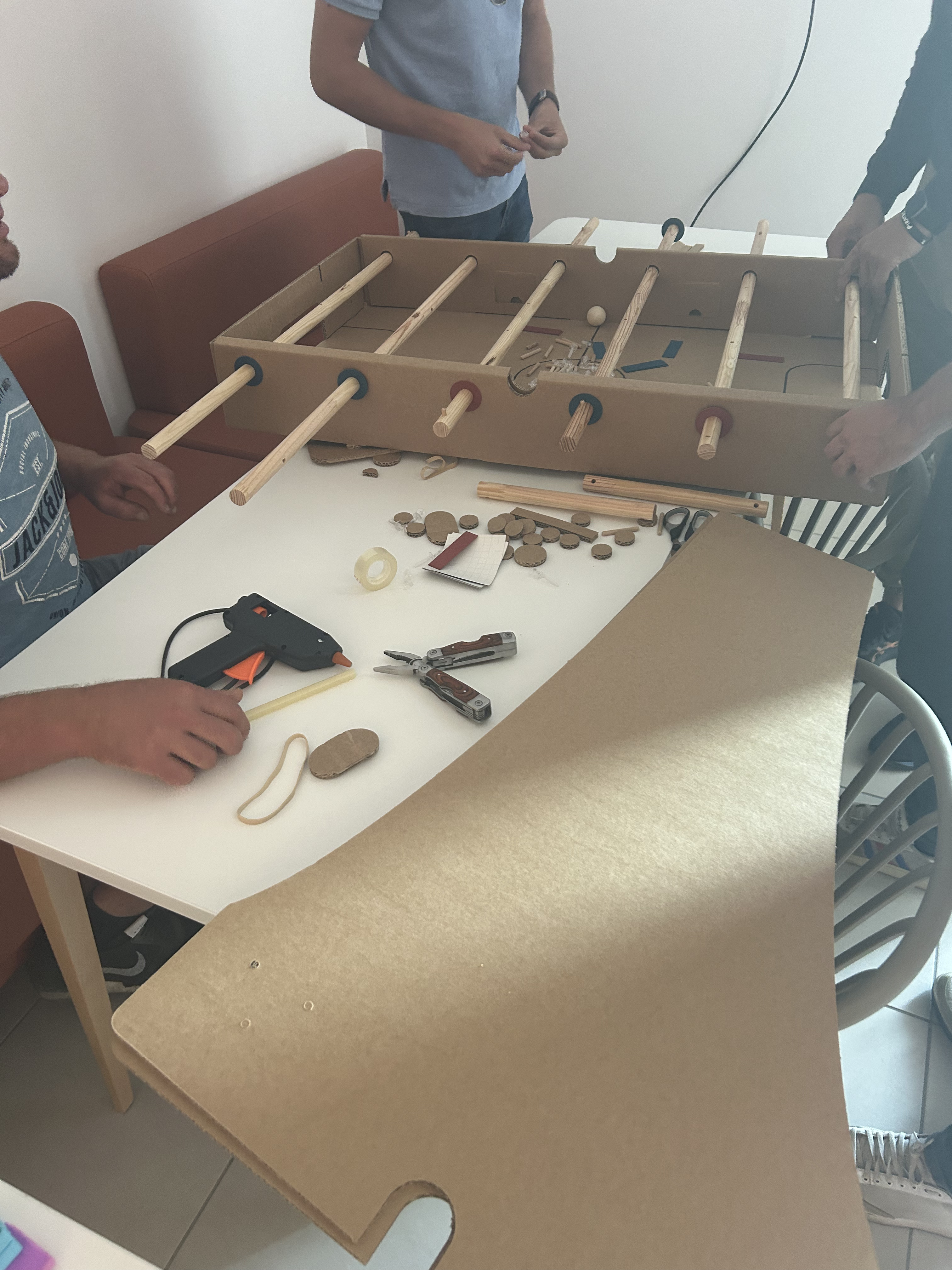
Babyfoot bouwen workshop in Antwerpen that delivers real team alignment
INNOV'events (Brussels) delivers a Babyfoot bouwen workshop in Antwerpen for 10 to 200 participants, designed for companies who need a practical, measurable team moment—not a passive activity. We handle the full setup: materials, facilitation, timing, risk checks, and onsite coordination.
The output is tangible (a playable table), and the process is structured to support collaboration under time constraints—useful for leadership teams, HR, and internal comms who need an activity that stands up to scrutiny.
Sommaire
In a corporate agenda, entertainment only makes sense if it serves a management objective: cross-team cooperation, a shared achievement, and a narrative your internal communication team can credibly reuse. A build format creates visible progress and practical problem-solving, which is far more valuable than “having fun” alone.
Organizations in Antwerpen typically expect operational reliability: strict timeboxing between meetings, multilingual facilitation (NL/FR/EN), venues with access constraints, and a result that looks professional enough for photos and stakeholder reporting. The workshop must run on rails, even when schedules move.
We operate in Belgium weekly and know Antwerp realities: loading slots, city-center parking limits, unionized venue rules when relevant, and the expectations of executive sponsors who need a clean run-of-show. Our facilitators focus on group dynamics while our production team protects timing, safety, and brand image.
INNOV'events figures companies in Antwerpen ask for
10+ years delivering corporate workshops across Belgium, with repeat programs for HR and internal communications.
30–180 minutes typical facilitation formats, enabling integration into half-day or evening programs without overrunning speeches or plenaries.
10–200 participants supported through parallel build stations and a controlled final assembly and play-test phase.
3-layer delivery: facilitation (people), production (materials/transport), and event management (timing/safety), so your team is not juggling suppliers.
Antwerpen delivery grounded in real corporate constraints
We regularly support companies operating in and around Antwerpen, including HQ teams who bring colleagues from Mechelen, Kontich, Wilrijk, Berchem and the port area for a single internal moment. Many clients come back year after year because they need predictable delivery: same quality, new angle, and no operational surprises.
In practice, the Antwerp pattern is often the same: a tight agenda, a venue with strict access windows, and a senior sponsor who wants a clear rationale (“what did this improve?”). Our role is to protect your credibility in front of that sponsor—by turning the workshop into a structured team exercise with a visible output and a clean communication storyline.
 Besoin d’un devis rapide ?
Nous vous envoyons une première proposition sous 24h.
Why leaders choose a babyfoot build in Antwerpen
A Babyfoot bouwen workshop works when you treat it as an operational simulation: teams must align on roles, manage dependencies, deal with missing information, and deliver a working result under deadline. That maps well to real company life—especially in fast-moving Antwerp environments where multi-site collaboration is daily reality.
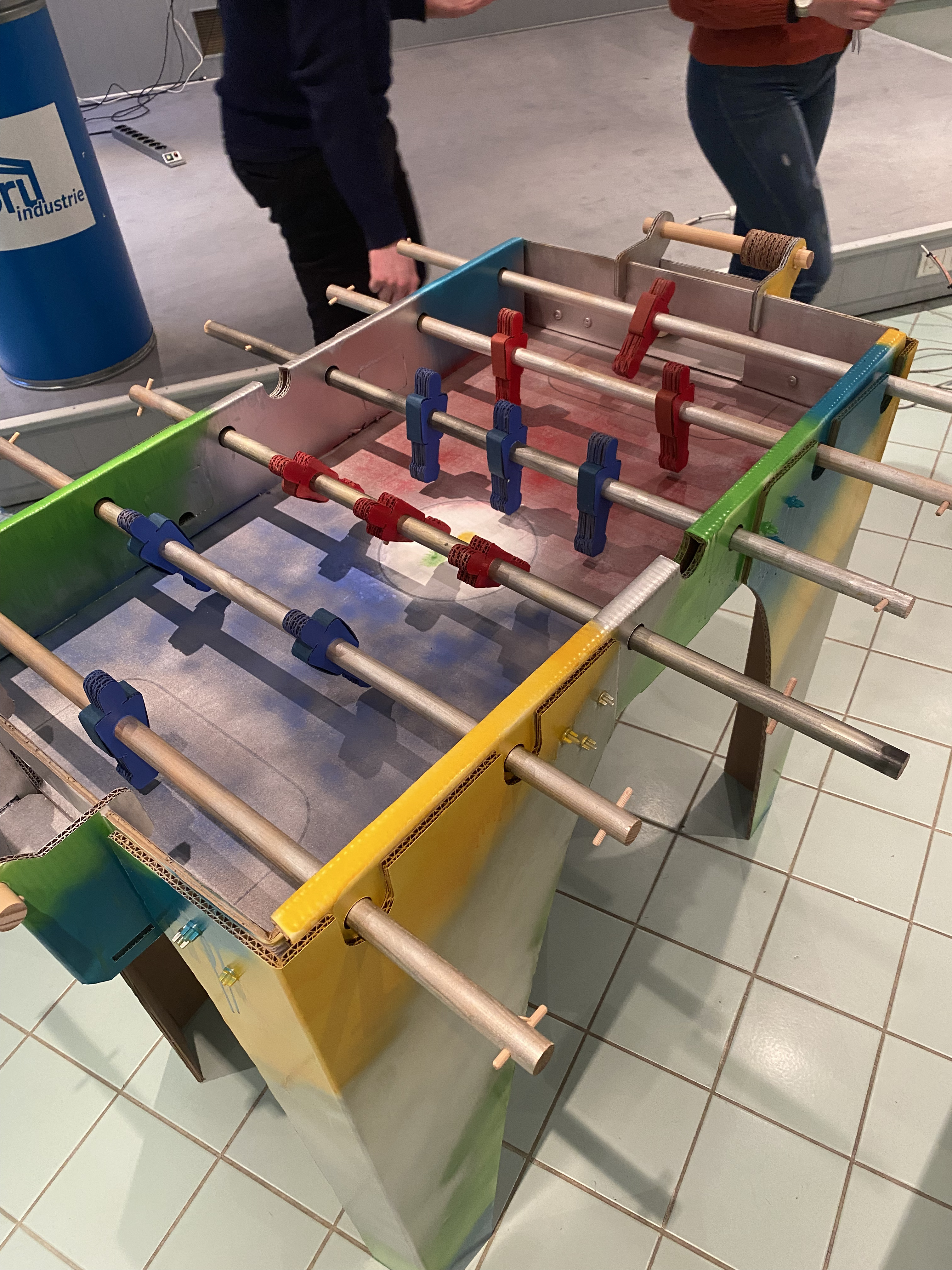
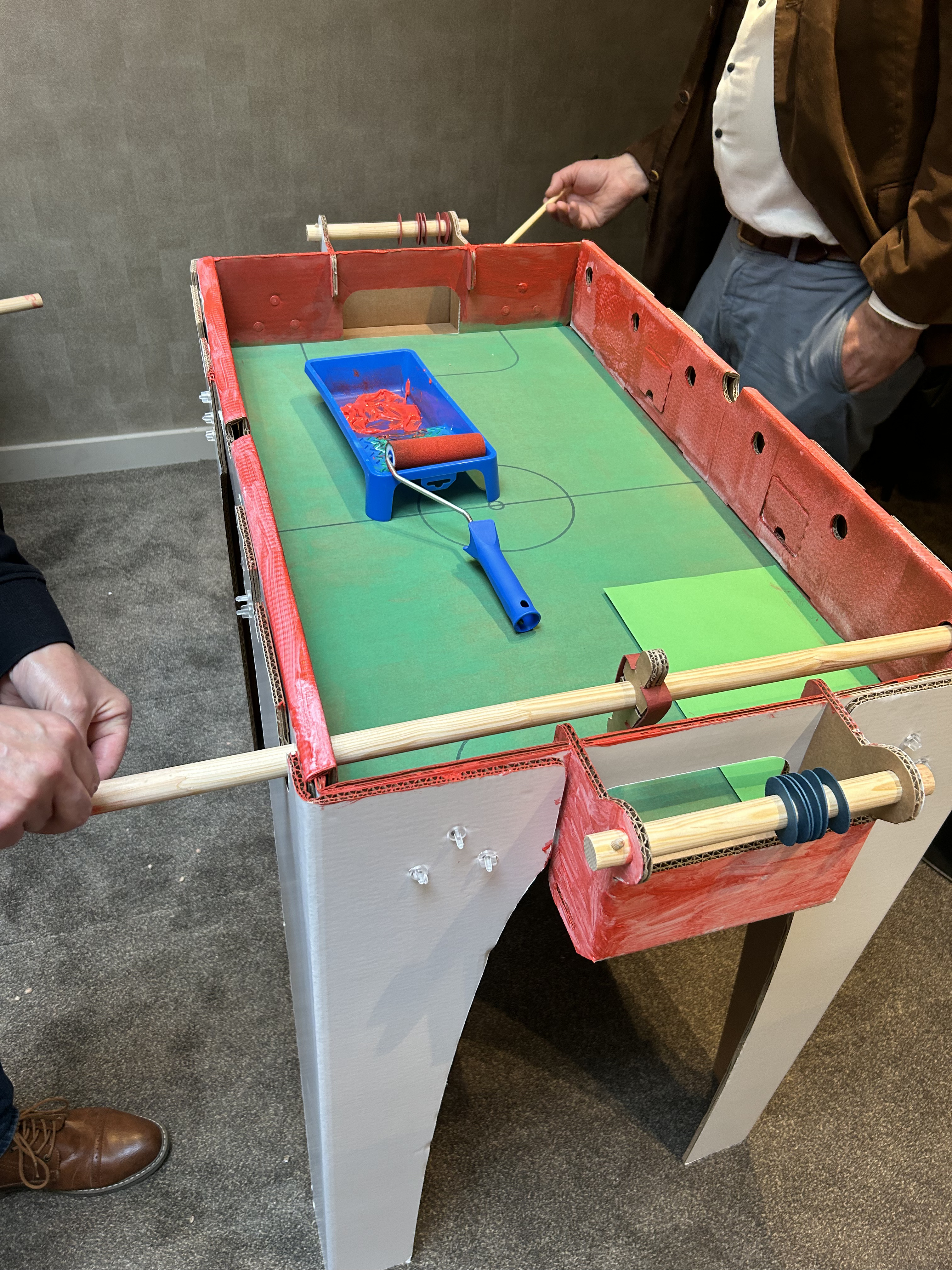
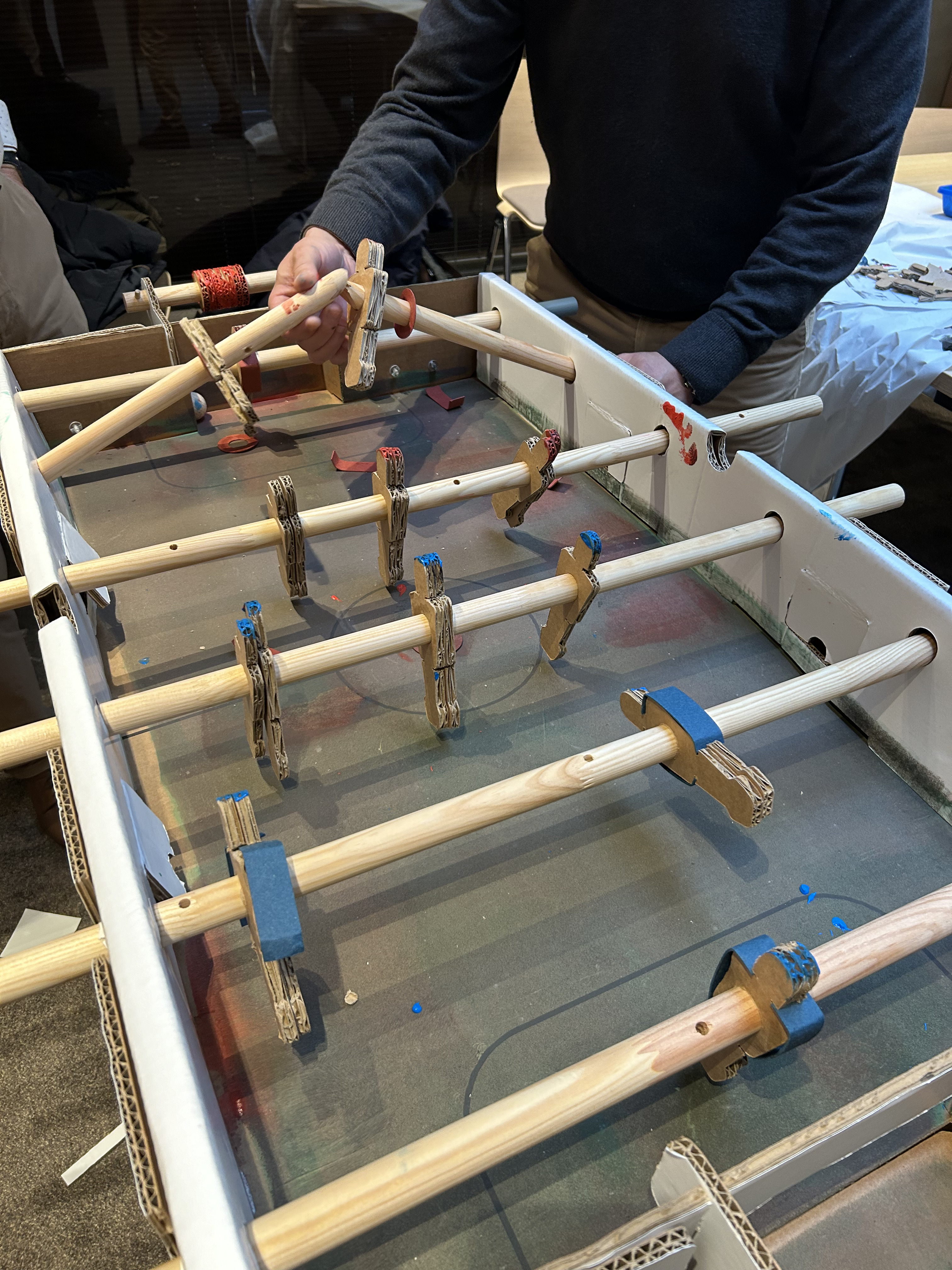
Shared accountability: each sub-team owns a deliverable (frame, legs, rods, players, scoring, branding), and the final assembly exposes gaps immediately—useful for managers who want a concrete mirror of collaboration habits.
Decision-making under constraints: we introduce fixed timeboxes and optional constraints (limited tools, capped budget tokens, change requests) to recreate realistic trade-offs without turning it into a gimmick.
Cross-functional communication: teams must standardize measurements and handoffs. This is where the learning happens: unclear specs create rework—exactly like project work.
Visible progress for internal comms: the build stages create multiple photo moments (planning, assembly, first play-test). We provide a simple shot list so the story is coherent and brand-safe.
Inclusive engagement: not everyone is comfortable with sports or stage moments. Building allows different profiles to contribute (precision, coordination, planning, QA, creative branding).
Post-event asset: the babyfoot can stay in the office (where feasible), becoming a durable symbol of a merger, onboarding cohort, or cross-site program—more defensible than a one-off activity.
Antwerpen has a strong culture of pragmatism and delivery—teams respect activities that “produce something real”. A well-run build workshop fits that expectation and supports leadership messaging about execution, cooperation, and pride in craftsmanship.
What companies in Antwerpen expect from the workshop format
In Antwerp, teams often arrive with a professional skepticism: they have seen “team building” that felt disconnected from work reality. To overcome that, the workshop must be framed as a structured challenge with clear outputs, roles, and time management. We align with HR on the behavioral objectives (collaboration, ownership, communication) and with communication teams on what can be shared internally (and what should not).
Operationally, Antwerp events frequently face venue constraints: limited freight elevator access, strict loading bays, and city traffic planning. We plan transport accordingly (vehicle size, unloading time, protective flooring), and we build a run-of-show that absorbs delays without impacting plenary times. If your event is near the city center, we also anticipate parking and access permits where relevant and propose earlier load-in.
Finally, language matters. Many Antwerp organizations are multilingual, and even within one group you may have Dutch-speaking teams plus international hires. We can facilitate in NL/FR/EN and ensure instructions are consistent across languages—critical in build activities where a translation error becomes a technical error.
What to add around a babyfoot build in Antwerpen
Engagement increases when the workshop is part of a coherent event flow: arrival, briefing, build, reveal, and a short “use moment” (play-test or mini-tournament). In Antwerpen, the strongest programs avoid stacking too many unrelated activities; instead, they add complementary moments that reinforce collaboration and the narrative.
Animations Interactives à Antwerpen
Team identity sprint: 10 minutes to define a name, a short “team charter”, and a design direction for the babyfoot. This prevents random decoration and makes the end result look intentional.
Timeboxed procurement game: teams receive limited “budget tokens” to request optional upgrades (extra grips, special players, branding elements). This creates smart negotiation and prioritization rather than chaos.
Play-test with QA criteria: we provide a checklist (rod alignment, screw torque, stability, ball return) and teams must sign off before first match—mirrors quality culture.
Animations Artistiques à Antwerpen
Brand-safe customization: subtle company colors, values icons, or Antwerp references that fit your brand guidelines. We avoid messy “craft” aesthetics by providing templates and controlled materials.
Photography corner: a clean background and lighting for a quick team photo with the finished table. Useful for internal comms without disrupting workshop flow.
Animations Innovantes à Antwerpen
Workshop-friendly catering: we recommend finger food that does not compromise tools and materials (low grease, no sauces on the build tables). We coordinate timing so the meal break does not split critical assembly phases.
Local Antwerp touches: if desired, we can integrate local suppliers for drinks/snacks, but always with venue compliance and allergy labeling.
Animations Gourmandes à Antwerpen
Mini “project management dashboard”: each team tracks progress on a simple board (milestones, risks, actions). Executives appreciate the visibility and it keeps the group focused.
Internal comms pack: a short, structured recap template (what we built, what it required, what it says about how we work). This turns the activity into a usable communication asset.
Whatever you add, alignment with brand image is non-negotiable: the workshop should look organized, safe, and intentional. That is why we control materials, signage, and visual consistency—especially when the audience includes leadership, clients, or social content approval flows.
Which Antwerpen venue setup works for a babyfoot build
Venue choice changes the perceived professionalism of the workshop. A build activity needs space, controlled acoustics, and reliable access for loading. In Antwerpen, we pay particular attention to city-center constraints and the realism of load-in times.
| Venue type | For which objective? | Main strengths | Possible constraints |
|---|---|---|---|
Corporate office / HQ in Antwerpen | Internal alignment, leadership messages, culture activation | No travel time, easy brand control, possibility to keep the babyfoot on-site | Freight access, lift size, floor protection, noise management, limited storage |
Hotel meeting space in Antwerpen | Offsite with smooth catering and AV integration | Reliable logistics, clear time slots, professional ambiance for executives | Strict rules on tools/materials, loading windows, possible extra fees for handling |
Industrial/creative event venue (Antwerp area) | Large groups, product launches, employer branding moments | Space for multiple build stations, strong visual impact, flexible layouts | Higher production needs (heating, acoustics), longer load-in, safety requirements |
We strongly recommend a site visit (or at minimum a technical call with photos and measurements). Most workshop issues come from underestimated access and room flow. A 30-minute check can prevent a one-hour delay on event day.
Budgeting a Babyfoot bouwen workshop in Antwerpen realistically
Pricing depends on participant volume, the build specifications, branding expectations, and logistical complexity in Antwerpen. We prefer transparent budgeting: what is fixed, what scales per participant, and what depends on venue constraints.
Group size and parallel stations: 10–30 pax can work with one main build flow; 40–200 pax typically requires multiple stations, more facilitators, and more duplicate tool sets to avoid idle time.
Workshop duration: 60–90 minutes focuses on collaboration and a basic build; 120–180 minutes allows higher finish quality, deeper debrief, and structured branding.
Build quality and materials: sturdier parts, improved stability, and professional finishing increase cost but also improve the “office longevity” of the table—important if you plan to keep it.
Branding and comms assets: branded elements (colors, decals, value statements) and a comms pack require design prep and approval cycles, which we plan with your team.
Venue logistics in Antwerpen: city-center load-in restrictions, limited elevators, long carry distances, and strict time slots can require additional crew time or earlier setup.
Risk and compliance: PPE, protective flooring, waste management, and venue coordination are part of professional delivery and should not be treated as optional.
From an ROI perspective, the best value comes when the workshop supports an HR or transformation objective and produces reusable internal communication content. If the babyfoot remains on-site, it also becomes a durable symbol of a cohort or program—extending impact beyond the event day.
When an event agency in Antwerpen is the safer choice
For Antwerp events, local execution capacity is not a luxury—it is risk management. Access planning, venue rules, and timing discipline are easier when the team knows the territory and can react fast.
We often collaborate with local partners and can plug into your existing venue ecosystem. If you need a partner who is embedded locally, we can coordinate with an event agency in Antwerpen while keeping INNOV'events as the single point of accountability for the workshop design and delivery.
This setup is particularly useful when you run multi-day programs, split locations, or have last-minute changes (speaker delays, room swaps, weather impacts for travel). Local presence reduces downtime and avoids “supplier excuses” on the day.
- Faster troubleshooting for last-minute room layout changes, access issues, or missing technical information.
- More realistic planning for transport and loading windows in Antwerp districts with restrictions.
- Better venue cooperation because procedures and expectations are understood and respected.
- Cost control by reducing unnecessary standby time and avoiding rushed last-minute rentals.
From an ROI perspective, the best value comes when the workshop supports an HR or transformation objective and produces reusable internal communication content. If the babyfoot remains on-site, it also becomes a durable symbol of a cohort or program—extending impact beyond the event day.




What we’ve delivered in Antwerpen-style environments
Our corporate build workshops are used in contexts where leadership needs both energy and control: post-merger integration sessions, annual kick-offs, safety culture moments, onboarding cohorts, and cross-site alignment meetings. The common thread is operational pressure: people have limited time, expectations are high, and the event must look professional from the first minute.
In Antwerp-like setups, we frequently deliver inside venues with strict schedules and limited loading access. The workshop is therefore engineered to be modular: stations can be expanded, reduced, or split by floor, and the facilitation remains consistent. When an agenda shifts (a plenary runs long, an executive arrives late), we can compress certain phases without losing the core objective: the team still builds, tests, and reflects.
We also adapt to your internal culture. Some organizations want a competitive element; others explicitly avoid winners/losers. We can run a cooperative “single table” build, or multiple builds with a structured, fair play-test—always aligned with the tone set by HR and leadership.
Common pitfalls we prevent in Antwerpen corporate workshops
Underestimating space and flow: too many people around one station leads to delays and safety issues. We size stations to the room and the group.
No clear roles: without a project lead/timekeeper/QA role, the loudest voices dominate and the build quality drops. We assign roles and rotate if needed.
Tools and parts chaos: missing parts or unmanaged tools kills trust quickly. We prepare duplicate kits, labeling, and a controlled parts table.
Brand risk: messy decoration or off-brand visuals can embarrass internal comms. We provide templates and limit materials to what photographs well.
Agenda collision: placing the workshop right before a keynote without buffer often causes stress. We advise where it fits best and include contingency.
Weak debrief: if there is no structured reflection, leadership sees it as “just an activity”. We close with a concise, usable debrief.
Our job is to remove these risks before your stakeholders notice them—so HR, comms, and leadership can stay focused on content and people, not operational firefighting.
Why Antwerpen clients repeat programs with INNOV'events
Repeat business is earned when delivery is predictable and stakeholder management is strong. Clients return when they know the workshop will start on time, look professional, and support the message leadership wants to land.
High repeat rate on corporate formats that can be refreshed yearly (new constraints, new branding, new learning focus) without reinventing the full production.
Low stakeholder load: we provide a single project lead and clear deliverables (timings, room plan, materials list, facilitation script), reducing internal coordination time.
Consistent participant feedback: not based on hype, but on clarity, fairness, and the feeling that the time was well used.

Loyalty is the most reliable proof point in corporate events: it reflects operational trust, not one-off excitement. That is the standard we aim for in Antwerpen deliveries.
Our delivery process for Antwerpen corporate teams
👉 Step 1 (Antwerpen): objective and constraints call
We schedule a 30–45 minute call with HR/Comms and, ideally, the executive sponsor. We lock the purpose, participant profile, languages, venue constraints, and timing. Output: a clear workshop recommendation (duration, format, number of stations) and the first budget range.
👉 Step 2 (Antwerpen): technical validation and room plan
We validate access (loading, elevators, distances), room dimensions, flooring, and waste rules. Output: a station layout, power needs (if any), protective materials plan, and a draft run-of-show with buffers.
👉 Step 3 (Antwerpen): build design, branding and approvals
We define build components, tool kits, and optional branding elements aligned with your guidelines. Output: a simple approval pack (visual references, text elements, colors), plus a photo shot list if internal comms needs it.
👉 Step 4 (Antwerpen): production and pre-brief
We prepare and label kits, allocate facilitators, and run an internal checklist to prevent missing parts. We brief your on-site contact on timings, roles, and contingency. Output: final run-of-show, contact list, and site instructions.
👉 Step 5 (Antwerpen): delivery, debrief and handover
On the day, we manage setup, facilitation, and teardown. We close with a structured debrief and confirm the babyfoot handover (storage, transport, or placement in the office). Output: optional post-event recap for HR/Comms and recommendations for next edition.
FAQ sur l'organisation Babyfoot bouwen workshop à Antwerpen
How long should a babyfoot build take in Antwerpen?
Plan 90 to 150 minutes for a solid corporate format (briefing, build, play-test, short debrief). For tighter agendas, 60 minutes is possible but requires simplified specs and strong facilitation.
How many participants per babyfoot table in Antwerpen?
Operationally, 8 to 12 participants per build keeps everyone useful (assembly, QA, logistics, branding). For larger groups, we run parallel stations or multiple builds with a controlled final assembly phase.
Can we run it in our Antwerpen office meeting rooms?
Yes, if access and space are validated. As a rule of thumb, you need a clear working area with walkways, protective flooring, and enough room for stations. We confirm lift dimensions, loading access, and noise constraints before we commit.
What budget range for a workshop in Antwerpen?
Budgets vary with group size, duration, branding and logistics. For corporate delivery, expect a structured quote built from fixed production plus variable facilitation. After a short scoping call, we typically provide a range within 24–48 hours.
Do you facilitate in Dutch for Antwerpen teams?
Yes. We can facilitate in NL, and also in FR/EN for mixed groups. For build workshops, we ensure instructions are consistent across languages to avoid technical mistakes and rework.
Request a quote for Antwerpen and lock your date early
If you are comparing agencies, we suggest starting with a short scoping call: attendee count, venue type, timing constraints, and the leadership message you want to support. Based on that, we will propose the most reliable format for a Babyfoot bouwen workshop in Antwerpen, with clear deliverables and transparent pricing.
Dates in Antwerpen venues can become tight during peak periods (kick-off season, end-of-year, major trade moments). Contact us early so we can secure the right production plan and avoid last-minute compromises on quality or timing.
Agence INNOV'events Antwerpen
Justin JACOB est le responsable de l'agence événementielle Antwerpen. Contactez-le directement par mail via l'adresse belgique@innov-events.be ou par formulaire.
Contacter l'agence AntwerpenToutes nos prestations & animations Antwerpen, Belgique
Découvrez nos prestations événementielles
Découvrez nos animations événementielles disponibles au Belgique
- Hôtesse événementielle à Antwerpen
- Escape Game à Antwerpen
- Cours de cuisine type MasterChef à Antwerpen
- Magicien à Antwerpen
- Location de chapiteau à Antwerpen
- Atelier colorimétrie à Antwerpen
- Jeux gonflables à Antwerpen
- Service de voiturier à Antwerpen
- Simulateur de football à Antwerpen
- Location de mobilier lumineux à Antwerpen
- Flocage lumineux à Antwerpen
- Repas insolite à Antwerpen
- Light Painting à Antwerpen
- Murder Party à Antwerpen
- Jeu concours à Antwerpen
- PLV événementielle à Antwerpen
- Réalité virtuelle à Antwerpen
- Cuisine moléculaire à Antwerpen
- Animation Halloween à Antwerpen
- Feu d’artifice à Antwerpen
- Jeux géants à Antwerpen
- Animateur événementiel à Antwerpen
- Animation photo à Antwerpen
- Père Noël à Antwerpen
- Animation enfants à Antwerpen
- Visite guidée à Antwerpen
- Rallye urbain à Antwerpen
- Piscine à balles à Antwerpen
- Simulateur de vol à Antwerpen
- Location de food truck à Antwerpen
- Record du monde à Antwerpen
- Simulateur de surf à Antwerpen
- Casino du vin à Antwerpen
- Atelier relooking à Antwerpen
- Atelier création de parfum à Antwerpen
- Atelier acting à Antwerpen
- Animations RSE à Antwerpen
- Tir à l’arc à Antwerpen
- Agent de sécurité à Antwerpen
- Œnologie à Antwerpen
- Mime à Antwerpen
- Jeu télévisé à Antwerpen
- Fête foraine à Antwerpen
- Atelier gestion de crise à Antwerpen
- Atelier négociation de crise à Antwerpen
- Jeux d’arcade à Antwerpen
- Simulateur de chute libre à Antwerpen
- Simulateur de ski à Antwerpen
- Simulation circuit automobile à Antwerpen
- Baptême de l’air à Antwerpen
- Dégustation à Antwerpen
- Création de baby-foot à Antwerpen
- Rallye 2CV à Antwerpen
- Challenge LEGO à Antwerpen
- Animation casino à Antwerpen
- Interprète / traducteur à Antwerpen
- Goodies à Antwerpen
- Bus / transfert à Antwerpen