
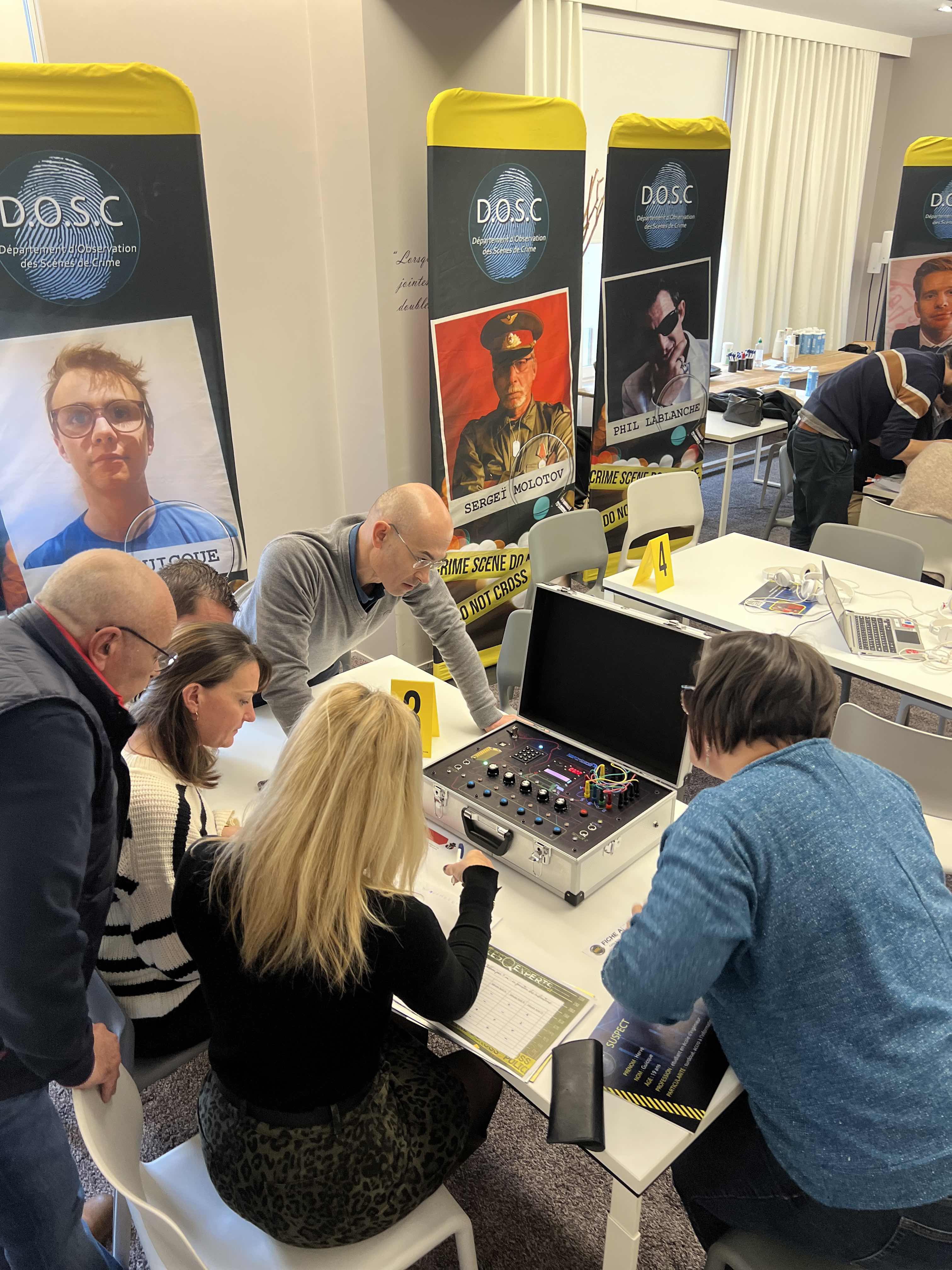
Escape Game in Brussel that actually delivers team alignment
INNOV'events designs and runs Escape Game formats in Brussel for executive committees, HR, and communication teams—typically from 12 to 250 participants. We handle scenario choice, logistics, facilitation, and on-site coordination so your event remains on time, on brand, and measurable.
Whether you need a tight 60-minute energizer between plenaries or a full half-day team-building with debrief, we secure the operational details that make the day work in real corporate conditions.
Sommaire
In a corporate agenda, entertainment is not a “nice-to-have”: it is one of the few levers that creates shared attention and collaboration in a short time window. A well-run Escape Game helps you surface behaviors that matter—decision-making under pressure, role clarity, listening—without turning the moment into a training session.
Organizations in Brussel usually expect precision: strict timing between meetings, bilingual or international audiences, and venues with access constraints. They also need discreet facilitation that respects hierarchy while still engaging everyone, including executives who don’t want “forced fun”.
INNOV'events is based in Brussel. We work with local venues, technicians, and facilitators we can rely on in peak periods, and we build formats that fit your reality: security rules, brand guidelines, and the pressure of “event day” when nothing can drift.
Numbers decision-makers in Brussel usually ask for
10+ years of corporate event operations: formats tested under real constraints (tight plenary schedules, multi-site groups, executive attendance).
Brussel-based production: shorter reaction time for venue visits, last-minute client changes, and supplier coordination.
Teams from 12 to 250 people managed on the same day via multi-room rotations and staggered starts to avoid bottlenecks.
30–120 minutes playable formats depending on your agenda, with optional 15–30 minutes debrief to connect to your management objectives.
Escape Game support across Brussel’s corporate ecosystem
We regularly support organizations operating in Brussel—from EU-facing structures and federations to headquarters teams and multi-country departments. In practice, several clients come back year after year because the format is easy to refresh (new scenario, new mechanics, new venue) while keeping a stable production method that their stakeholders trust.
If you share company names you want us to mention as references, we can integrate them precisely in this section (including the context: team size, objective, venue type, and key constraints). We prefer doing it responsibly—only with names you have approved for public use.
 Besoin d’un devis rapide ?
Nous vous envoyons une première proposition sous 24h.
Why run an Escape Game in Brussel for leadership and HR
A Escape Game in Brussel is most valuable when it is designed as a management tool: not to “entertain”, but to accelerate interactions that are hard to obtain in day-to-day work. In executive or cross-functional contexts, it creates a neutral playing field where you can observe collaboration patterns without threatening anyone’s status.
For HR and communication teams, it is also a practical way to connect people across sites and cultures—especially common in Brussel where teams often mix Belgian entities, international colleagues, and external stakeholders in the same room.
Faster team alignment: the game forces prioritization and makes implicit assumptions visible (who decides, how information circulates, how trade-offs are made).
Concrete observation material for managers: you can capture examples to feed a debrief (communication loops, leadership distribution, problem-solving approach) without naming-and-shaming.
Safer cross-hierarchy interaction: in many companies, senior profiles speak less in “team building” moments. A well-framed Escape Game gives them a role without putting them in an uncomfortable spotlight.
Onboarding and culture: for new departments, mergers, or reorganizations, the format builds shared references quickly—useful when people have not yet built trust.
Employer image without the clichés: when the experience is coherent with your brand (tone, design, facilitation style), it reinforces your internal narrative: “we work seriously, but we collaborate intelligently”.
Brussel is a dense decision-making hub where calendars are tight and audiences are diverse. That economic culture rewards formats that are punctual, clear, and respectful of people’s time. An Escape Game fits that reality—provided it is produced with discipline.
What Brussel-based departments expect from an Escape Game provider
In Brussel, you rarely run events in a vacuum. Many teams operate under public-sector-like constraints even in private organizations: approval loops, security access lists, and reputational sensitivity. That changes how we produce a Escape Game.
Typical local expectations we see from executives and HR:
- Multilingual facilitation (often EN + FR, sometimes NL): instructions must be simple, repeated consistently, and supported with clear signage to avoid delays.
- Venue practicality: proximity to EU quarter, central stations, or corporate clusters matters; participants may arrive from different sites and you cannot afford “lost time” before the game even starts.
- Timeboxing: many groups need a format that fits between two meetings, with a hard stop. We plan briefings, rotations, and resets like a production schedule, not like a casual activity.
- Discretion and brand safety: scenarios must avoid sensitive topics (politics, stereotypes, certain security themes) when audiences include public affairs, regulated industries, or international partners.
- Measurement: HR often needs more than smiles—simple feedback capture, participation rate, and a short debrief note that can be shared internally.
Finally, Brussel traffic and access restrictions are real operational factors. We build buffers, define arrival instructions with map pins, and align loading/unloading windows with venues so your schedule remains credible.
Which Escape Game formats work best in Brussel corporate events
Engagement comes from a simple truth: people collaborate when the task is concrete, time-bound, and slightly challenging. A corporate Escape Game in Brussel works when the mechanics are aligned with your audience and constraints (space, timing, brand, language).
Animations Interactives à Brussel
Multi-room escape rotations: ideal for 24–120 participants when you can secure several rooms. Teams rotate through different puzzles; scoring can be balanced to avoid “winner takes all”.
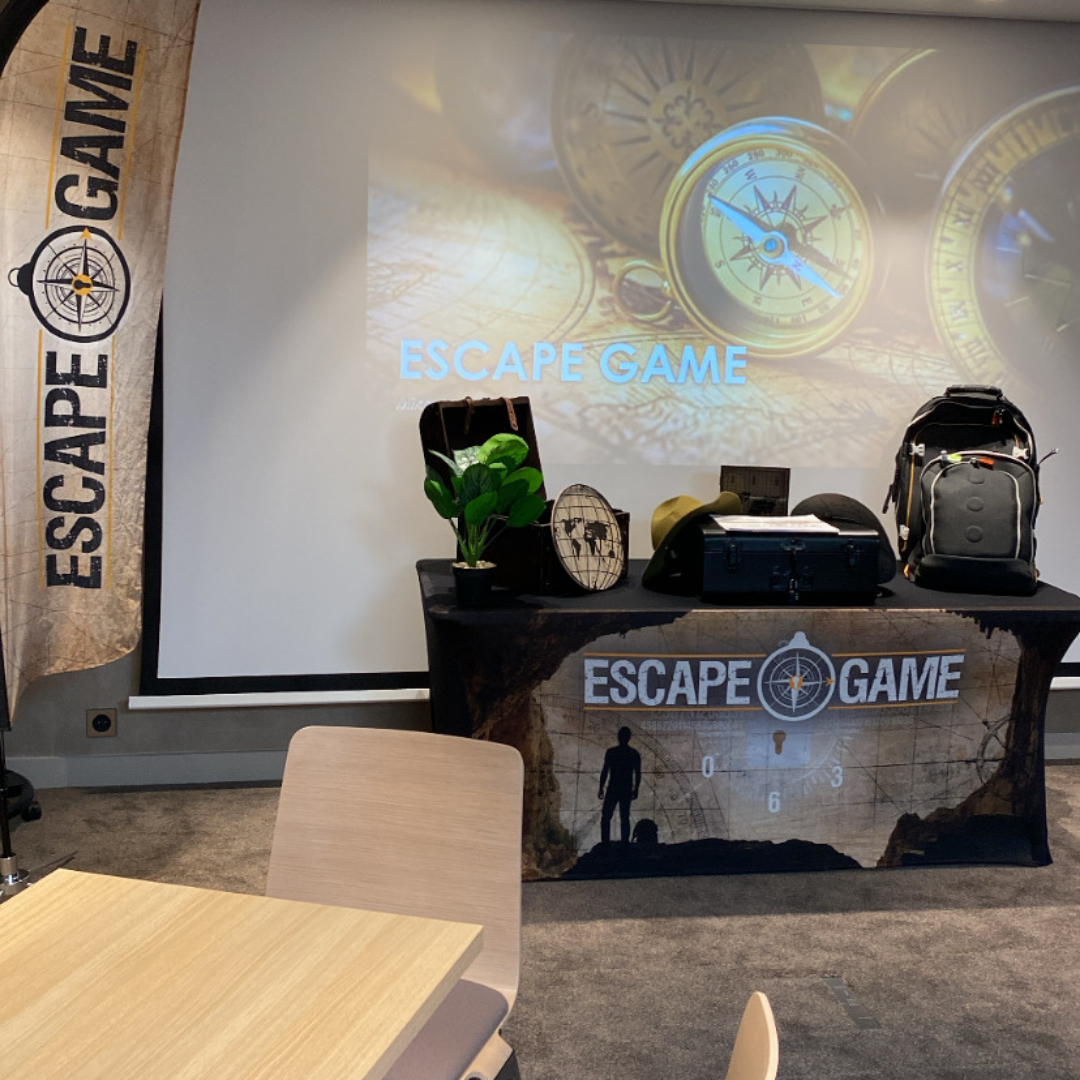
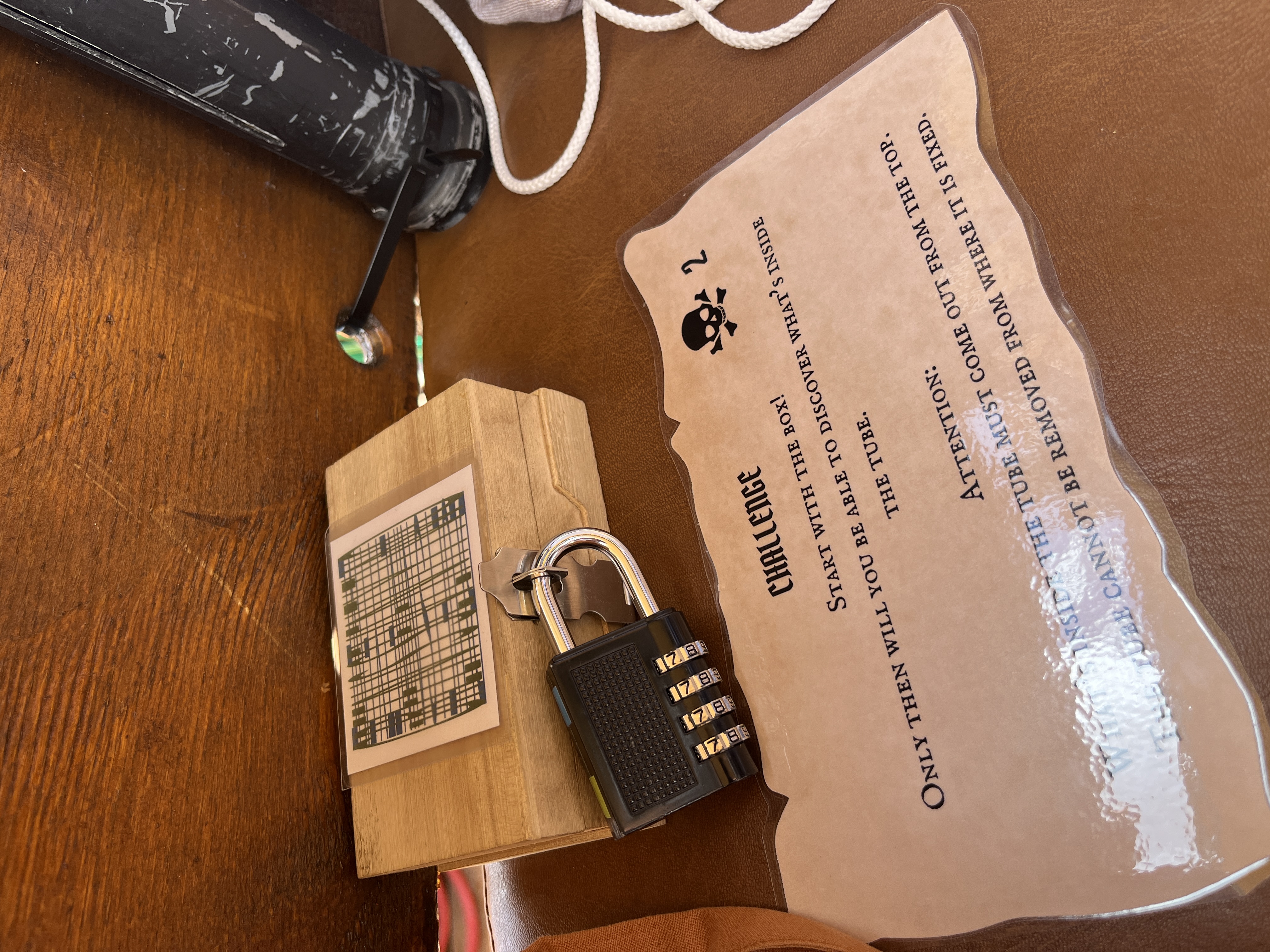
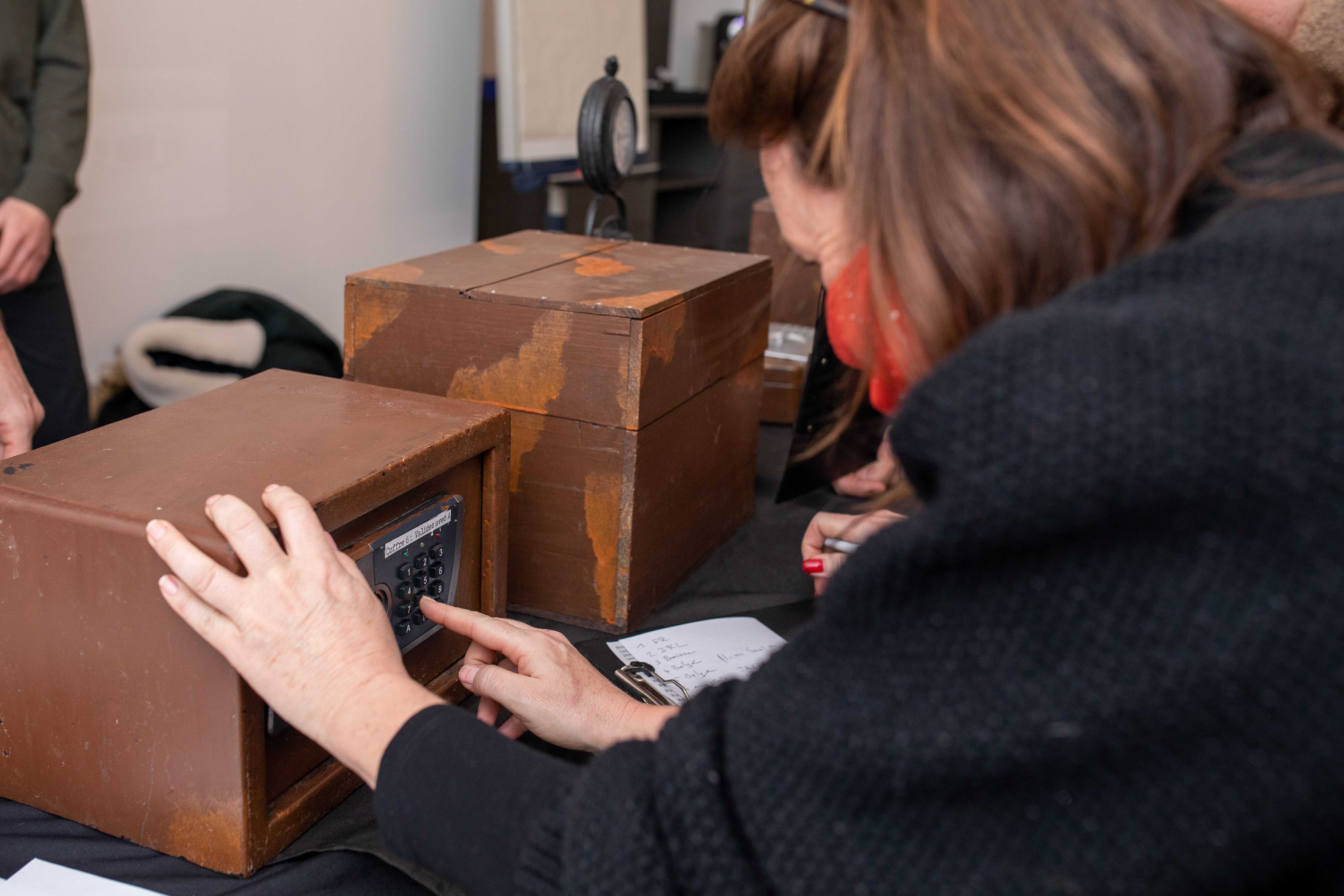
Table-top escape boxes: suitable for hotel meeting rooms or offices in Brussel where wall setups are limited. Fast deployment, consistent timing, and easy to combine with a plenary.
Digital-assisted escape (QR + tablets): useful for international groups because instructions can be multilingual and updated quickly; also helpful when you need proof of timing and participation.
Onboarding-themed missions: we embed your internal vocabulary (values, product lines, key milestones) without turning the game into a quiz. This works well after reorganizations.
Animations Artistiques à Brussel
Actor-driven immersion: a discreet performer can play a “briefing character” to set the tone in 3–5 minutes. In corporate settings, we keep it subtle so the experience remains credible for senior profiles.
Sound and light design: often underestimated. Even simple cues (countdown, ambient sound) increase focus and reduce side conversations—important in venues where acoustics are challenging.
Animations Innovantes à Brussel
Escape + networking tasting: after the game, we use a short structured tasting (local beers, chocolate pairing, mocktails) to extend cross-team interactions. In Brussel, it is a practical way to keep people on-site rather than dispersing.
Timed coffee reset: for half-day programs, a disciplined 10–15 minute break between rotations reduces fatigue and keeps performance consistent across teams.
Animations Gourmandes à Brussel
Hybrid “escape + decision lab”: the game is followed by a short facilitated debrief where teams map what helped/hurt them (information sharing, leadership clarity). HR can reuse the output as concrete action points.
City micro-mission in Brussel: a short outdoor segment around a defined area (e.g., near your venue) can work well, but only with clear safety boundaries and a weather-resilient backup plan.
Executive track: for leadership groups, we add puzzles that require trade-offs and delegation (not just “find the key”). It creates credible value for senior participants.
Whatever the format, alignment with your brand image is not decoration—it is governance. We validate tone, visual codes, and facilitator posture so the Escape Game supports your internal narrative and does not contradict your communication standards.
Where to host an Escape Game in Brussel without logistical surprises
The venue sets the tone before the first puzzle starts. In Brussel, the right setting also prevents operational friction: access for suppliers, breakout capacity, acoustics, and clear participant flow. We help you choose based on objective, not on aesthetics alone.
| Venue type | For which objective? | Main strengths | Possible constraints |
|---|---|---|---|
Hotel conference venue (meeting rooms) | Timeboxed Escape Game between plenaries; mixed audience from different sites | Reliable AV, reception desk, catering options, easy participant management | Room layout limits immersion; reset time must be planned to avoid noise spill |
Corporate offices in Brussel (on-site) | Internal engagement, onboarding, minimal travel time | Zero transfers, high attendance rate, easy to connect to internal messages | Security access lists, limited storage/loading, strict time windows for setup |
Dedicated escape venue (partner location) | Maximum immersion and “out of office” break | High production value, ready-built rooms, proven flow for multiple teams | Less control on branding; fixed schedules; transport coordination required |
We recommend a site visit (or at minimum a technical recce) before confirming. In Brussel, small details—lift access, corridor width, nearby works, reception capacity—can decide whether your first group starts on time or not.
What an Escape Game in Brussel costs and what drives it
Pricing for a corporate Escape Game in Brussel depends on parameters that directly affect staffing, reset time, and risk level. We quote transparently so you can arbitrate between impact and complexity.
In practice, budgets often land in the following ranges (excluding VAT, indicative): €45–€120 per person for standard formats, and €6,000–€18,000+ for larger bespoke productions where we build multi-room flows, custom props, or strong brand integration.
Group size and rotation design: 20 people in one wave is not the same as 120 people over 3 waves; staffing scales with the number of simultaneous teams and rooms.
Venue constraints in Brussel: access hours, loading restrictions, and room availability can increase setup time and therefore cost.
Level of customization: adding your brand elements, internal storyline, or multilingual materials (EN/FR/NL) requires design and testing time.
Duration: a 45-minute energizer needs tight facilitation; a half-day program needs breaks, resets, and often additional staff for flow management.
Production values: sound, lighting, scenic elements, and professional props increase immersion but also transport, installation, and contingency needs.
Measurement and debrief: post-event feedback capture, facilitator notes, or a structured debrief adds value for HR but must be staffed and prepared.
We frame ROI in operational terms: fewer silos, faster cross-team interactions, and a shared reference that managers can reuse after the event. When your agenda includes strategic messages, the cost of a “flat” moment is often higher than the price difference between a basic activity and a properly produced Escape Game.
Why a Brussel agency reduces risk on Escape Game day
Choosing a partner established in Brussel is less about proximity and more about control. Local production means fewer assumptions: we know access realities, peak traffic patterns, venue standards, and the supplier ecosystem. That translates into fewer last-minute surprises and faster decisions when something changes.
When you work with an event agency in Brussel, you also gain a partner who can do pre-event site checks quickly, align with building management, and be on standby if you need an extra facilitator or a timing adjustment.
- Faster on-site troubleshooting: missing prop, room switch, late arrivals—handled without escalating stress to your internal team.
- Reliable local staffing: facilitators who are used to corporate audiences and multilingual briefings.
- Venue-fit scenarios: we propose formats that respect your space constraints instead of forcing a concept that only works “in theory”.
- Better cost control: fewer travel costs, fewer overnights, less idle time in schedules.
We frame ROI in operational terms: fewer silos, faster cross-team interactions, and a shared reference that managers can reuse after the event. When your agenda includes strategic messages, the cost of a “flat” moment is often higher than the price difference between a basic activity and a properly produced Escape Game.




Examples of Escape Game missions delivered in Brussel
Our projects in Brussel range from compact team energizers to complex multi-department programs. What stays constant is our production method: clarify objective, design the participant flow, lock timing, and run facilitation with consistent standards.
Typical real-life situations we manage:
- Post-merger departments: two teams share the same building but not the same habits. We run a Escape Game that forces information exchange between roles, followed by a short debrief focused on “what helped us collaborate”.
- Executive offsite with limited tolerance for gimmicks: we choose a narrative and puzzle style that feels like a strategic mission, not a costume party, and keep facilitation discreet and time-efficient.
- International teams: instructions and hints are structured to avoid language bias; we build a scoring model that rewards collaboration, not just speed, to reduce frustration.
- Communication-driven internal events: we integrate key messages as optional clues (not mandatory quiz questions) so the experience remains a game while still supporting your campaign.
Across these contexts, the challenge is the same: protect your internal stakeholders from operational noise so they can focus on people and outcomes.
Common pitfalls with Escape Games in Brussel and how we prevent them
Underestimating timing: briefings, late arrivals, and resets eat into playtime. We build a minute-by-minute running order and assign ownership for each transition.
Wrong difficulty level: if 50% of teams fail, executives call it poorly designed. We calibrate to your audience and test the flow before event day.
Bottlenecks and waiting lines: too many people in one corridor kills energy. We plan rotations and holding areas, and we brief group captains to keep movement smooth.
Too much “theatre” for a corporate crowd: some audiences shut down if the tone feels childish. We align narrative and facilitation posture to your culture.
Ignoring venue constraints in Brussel: access badges, lifts, noise rules, and limited storage can break setup. We confirm logistics with the venue and keep contingency options.
No closure: without a wrap-up, the activity remains a bubble. We provide a short conclusion (and optional debrief) to link the experience to your objective.
Our role is to absorb these risks before they reach your participants. You should not have to “manage the activity” on the day—you should be able to host.
Why Brussel clients repeat the Escape Game format with us
Repeat business happens when the experience is not only fun, but operationally dependable. Many clients in Brussel reuse the format because it can be refreshed while keeping a stable delivery method, which is crucial when multiple stakeholders approve the program.
High replayability: new scenarios and puzzle sets allow annual or semi-annual repeats without “we did this already” feedback.
Predictable timing: we maintain consistent run-of-show standards so planners can integrate the activity into packed agendas.
Stakeholder comfort: HR and internal comms appreciate having one partner who can handle briefing notes, multilingual instructions, and post-event feedback capture.

Loyalty is a strong signal in event production: it means the client trusts you under pressure. In Brussel, where reputational standards are high, that trust is earned through discipline.
How we run an Escape Game project in Brussel from brief to debrief
👉 Brussel scoping call and objective definition
We start with a short, structured call with HR/Comms and an operational contact. We clarify: audience profile, hierarchy mix, languages, timing constraints, and the “non-negotiables” (brand, sensitivities, security rules). We also validate what success looks like: networking density, onboarding, cross-silo collaboration, or pure energizer.
👉 Format selection and participant flow design
We propose 2–3 Escape Game formats with a clear comparison: required space, number of facilitators, total duration, and risk points. For larger groups, we design rotations (start waves, reset windows, holding zones) and share a draft running order so you can validate it internally.
👉 Venue alignment and technical preparation in Brussel
We confirm room specs, access conditions, and supplier logistics. If the game is hosted in your offices, we align with building management on badges, delivery time windows, and safety rules. We plan signage, storage, and a backup solution for common issues (power access, noise constraints, last-minute room change).
👉 Content adaptation and multilingual readiness
Where relevant, we adapt briefing materials (EN/FR/NL) and ensure facilitators follow a consistent script. If you want brand integration, we validate what can be integrated without turning the game into a corporate quiz. We also define the hint policy and scoring model to keep the experience fair.
👉 On-site delivery and show-calling
On event day in Brussel, we arrive early for setup and run a short technical check. One lead coordinates timing and transitions (show-calling), while facilitators manage teams. We protect your agenda: controlled starts, clear briefings, and fast resets between waves.
👉 Debrief and measurable wrap-up
We close with a concise wrap-up: winners (if relevant), key observations, and a short feedback capture (QR or paper). If you request it, we provide a short debrief note summarizing what was observed and what it implies for collaboration—useful for HR reporting or internal communication.
FAQ sur l'organisation Escape Game à Brussel
How long should an Escape Game session be in Brussel?
Plan 60–90 minutes door-to-door for a standard session: 10 minutes briefing, 45–60 minutes play, 5–10 minutes wrap-up. Add 15–30 minutes if you want a meaningful debrief linked to HR or leadership objectives.
How many people per team for an Escape Game in Brussel?
The most reliable range is 4–8 participants per team. Below 4, teams lack diversity of ideas; above 8, people disengage and you get “spectators”. For larger groups, we run multiple teams in parallel or in rotations.
Can you run a corporate Escape Game in our Brussel offices?
Yes, if we can secure enough rooms or a modular space for the chosen format. We typically need a briefing area, one or several play zones, and a small storage/reset corner. We also align on building access lists, delivery windows, and noise constraints to avoid disrupting your operations.
What budget range is typical for Escape Games in Brussel?
For corporate groups, budgets commonly range from €45–€120 per person for standard formats. More complex productions (multi-room setups, strong customization, larger staffing) often fall between €6,000 and €18,000+ depending on scope and timing.
Do you provide bilingual facilitation for Brussel groups?
Yes. We can deliver in English and French as standard, and include Dutch where needed depending on your audience. The key is not only language coverage, but consistency: the same rules, hint policy, and timing across all teams to keep the experience fair.
Request a Brussel quote with a realistic running order
If you want a Escape Game in Brussel that fits a real corporate agenda, send us your date, location zone (or venue shortlist), participant count, and time slot constraints. We will respond with a clear format recommendation, staffing approach, and a running order you can share internally.
For peak periods in Brussel, we recommend securing the venue and facilitation team 4–8 weeks in advance; for larger groups or branded scenarios, plan 8–12 weeks. Contact INNOV'events to lock the operational details early and keep your stakeholders confident.
Agence INNOV'events Brussel
Justin JACOB est le responsable de l'agence événementielle Brussel. Contactez-le directement par mail via l'adresse belgique@innov-events.be ou par formulaire.
Contacter l'agence BrusselToutes nos prestations & animations Brussel, Belgique
Découvrez nos prestations événementielles
Découvrez nos animations événementielles disponibles au Belgique
- Hôtesse événementielle à Brussel
- Escape Game à Brussel
- Cours de cuisine type MasterChef à Brussel
- Magicien à Brussel
- Location de chapiteau à Brussel
- Atelier colorimétrie à Brussel
- Jeux gonflables à Brussel
- Service de voiturier à Brussel
- Simulateur de football à Brussel
- Location de mobilier lumineux à Brussel
- Flocage lumineux à Brussel
- Repas insolite à Brussel
- Light Painting à Brussel
- Murder Party à Brussel
- Jeu concours à Brussel
- PLV événementielle à Brussel
- Réalité virtuelle à Brussel
- Cuisine moléculaire à Brussel
- Animation Halloween à Brussel
- Feu d’artifice à Brussel
- Jeux géants à Brussel
- Animateur événementiel à Brussel
- Animation photo à Brussel
- Père Noël à Brussel
- Animation enfants à Brussel
- Visite guidée à Brussel
- Rallye urbain à Brussel
- Piscine à balles à Brussel
- Simulateur de vol à Brussel
- Location de food truck à Brussel
- Record du monde à Brussel
- Simulateur de surf à Brussel
- Casino du vin à Brussel
- Atelier relooking à Brussel
- Atelier création de parfum à Brussel
- Atelier acting à Brussel
- Animations RSE à Brussel
- Tir à l’arc à Brussel
- Agent de sécurité à Brussel
- Œnologie à Brussel
- Mime à Brussel
- Jeu télévisé à Brussel
- Fête foraine à Brussel
- Atelier gestion de crise à Brussel
- Atelier négociation de crise à Brussel
- Jeux d’arcade à Brussel
- Simulateur de chute libre à Brussel
- Simulateur de ski à Brussel
- Simulation circuit automobile à Brussel
- Baptême de l’air à Brussel
- Dégustation à Brussel
- Création de baby-foot à Brussel
- Rallye 2CV à Brussel
- Challenge LEGO à Brussel
- Animation casino à Brussel
- Interprète / traducteur à Brussel
- Goodies à Brussel
- Bus / transfert à Brussel