
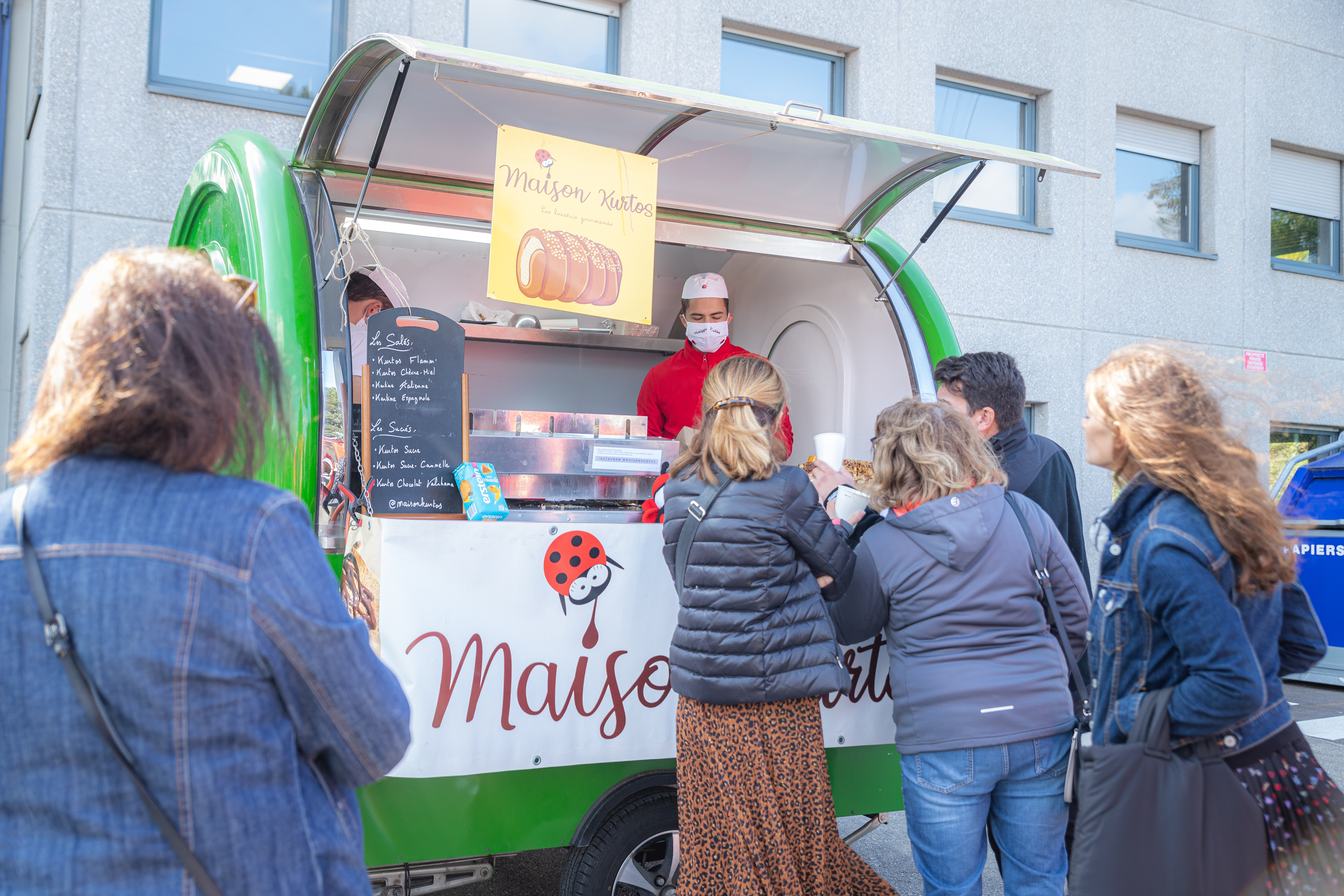
Foodtruck verhuur in Luik that stays operational from first service to last
INNOV'events (Brussels) organizes Foodtruck verhuur for corporate events in Luik, typically from 50 to 2,000 attendees. We secure the right trucks, the production setup (power, water, access), the service flow, and on-site coordination so your teams can focus on guests and business objectives.
Whether it’s an HQ courtyard lunch, a family day near the Meuse, or a large staff celebration on an industrial site, we design a food service plan that is realistic under event-day constraints: queues, timing, dietary requirements, and site rules.
Sommaire
On a corporate event, food is not “just catering”: it directly impacts attendance, schedule discipline, and how people talk about the company the day after. A well-managed Foodtruck verhuur in Luik can accelerate networking and reduce friction in multi-department gatherings.
Organizations in Luik typically expect fast service, reliable timing (especially during shift changes or tight agendas), and a setup that respects site constraints: limited loading windows, security procedures, and a clean end-of-service handover.
We operate with local production habits and a risk-first mindset: pre-checks, vendor contingencies, and clear responsibilities on site. INNOV'events brings a Brussels-level production standard while working seamlessly with venues and suppliers around Luik.
Operational proof points for Luik projects
10+ years of corporate event production across Belgium, with repeat deployments in Wallonia.
A network of 60+ vetted foodtruck partners (burgers, world cuisine, vegetarian/vegan, dessert & coffee concepts) with known service capacity metrics.
Ability to scale from 1 to 12 trucks on one site, with unified signage, token/cashless systems, and coordinated service windows.
Standard production checklist covering power (kVA), access widths, turning radii, waste streams, and fire safety to avoid last-minute improvisation.
Corporate teams we support year after year in Luik
We regularly support corporate and institutional teams in and around Luik, often on recurring formats: summer staff gatherings, onboarding days, project kick-offs, safety milestones, and family days. In practice, “recurring” means we keep your lessons learned: the entrance that works best for trucks, the preferred service rhythm around speeches, and the vendor mix that matches your workforce profile.
To be transparent: you mentioned “the company names I provided as references,” but none were included in your last message. If you share the list (even 3–5 names), we will integrate them here in a compliant and professional way (e.g., “operations site in Grâce-Hollogne,” “HQ in central Luik,” “industrial campus near Herstal”) without disclosing sensitive details.
What we can already confirm is our working method with local stakeholders: we coordinate directly with facility management, HSE/safety officers, and building security, because that is where foodtruck projects succeed or fail on the day.
 Besoin d’un devis rapide ?
Nous vous envoyons une première proposition sous 24h.
Why schedule a foodtruck moment in Luik for your teams
A foodtruck setup works when you need a strong participation rate without blocking the day. For executives and HR, the benefit is not “fun”: it is the ability to bring people together with minimal friction and a controlled operational footprint.
Higher participation with less formal pressure: employees tend to join a food-based moment more naturally than a seated lunch, which supports inclusion across functions and seniority.
Time control for management: with service slots and a defined service rate (e.g., 120–180 servings/hour/truck depending on menu), you can protect the agenda and avoid the “late return from lunch” effect.
HR value without heavy logistics: onboarding days, employer branding and recognition moments work well around a casual food area that encourages conversations.
Brand and internal comms consistency: you can align truck visuals, menu naming, and signage with your messaging (safety campaign, ESG week, charity initiative), without turning it into a marketing show.
Operational resilience: compared to a single buffet line, multiple trucks reduce the single point of failure; if one concept slows, the others keep the flow moving.
Luik has a pragmatic business culture: people value straightforward organization, solid execution, and respect for time. A properly engineered foodtruck service fits that culture while still giving teams a real break together.
What changes when your foodtruck event is in Luik
In Luik, foodtruck operations are often impacted by very concrete, local realities: mixed-access sites, older buildings with limited exterior power, and venues near dense urban zones where noise, parking, and waste handling are scrutinized.
We typically see three recurring constraints in the territory:
- Access & maneuvering: some sites have narrow gates, loading zones shared with daily operations, or slope/curb issues. We confirm truck dimensions, turning radius, and safe queuing space before contracting.
- Power availability: many trucks can be self-sufficient, but for a clean production we often prefer a planned power distribution (e.g., 16A/32A connections, cable routing, back-up). This avoids generators running where you don’t want them.
- Service rhythm around shift patterns: for industrial and logistics employers around Luik, the service plan must match shift changes. We build staggered slots and pre-brief line management to keep queues predictable.
Decision-makers also expect supplier discipline: punctual arrival windows, safe installations, and a site left clean enough that facilities teams do not “pay the price” the next day. That is precisely where agency-level production makes the difference.
Which foodtruck concepts work best for corporate events in Luik
Food is already an activation: it creates movement, conversation, and a natural “shared moment” without forcing people into structured networking. The right concept depends on your workforce profile, venue constraints, and the message your leadership wants to send (care, recognition, diversity, local anchoring).
Animations Interactives à Luik
Token-based food market: guests receive a fixed number of tokens to spend across trucks. It spreads demand and avoids one truck getting overloaded. Good for 200–1,500 attendees.
Time-slot service by team: ideal for sites with shift constraints around Luik. We allocate slots (e.g., 12:00–12:30 Team A, 12:30–13:00 Team B) and enforce it via internal comms and signage.
Chef’s “limited drop” menu: a short menu with a timed special (e.g., 12:45 drop) creates engagement while preserving throughput. Works well when leadership wants a focal moment without speeches.
Animations Artistiques à Luik
Branded service zone design: not decoration for decoration’s sake: clear wayfinding, menu boards, and a coherent layout that looks professional in internal photos (often used later in employer branding posts).
Acoustic-friendly background sets: small jazz trio or acoustic DJ setup placed away from service lines, to avoid competing noise where orders are taken. Particularly relevant in urban Luik courtyards.
Animations Innovantes à Luik
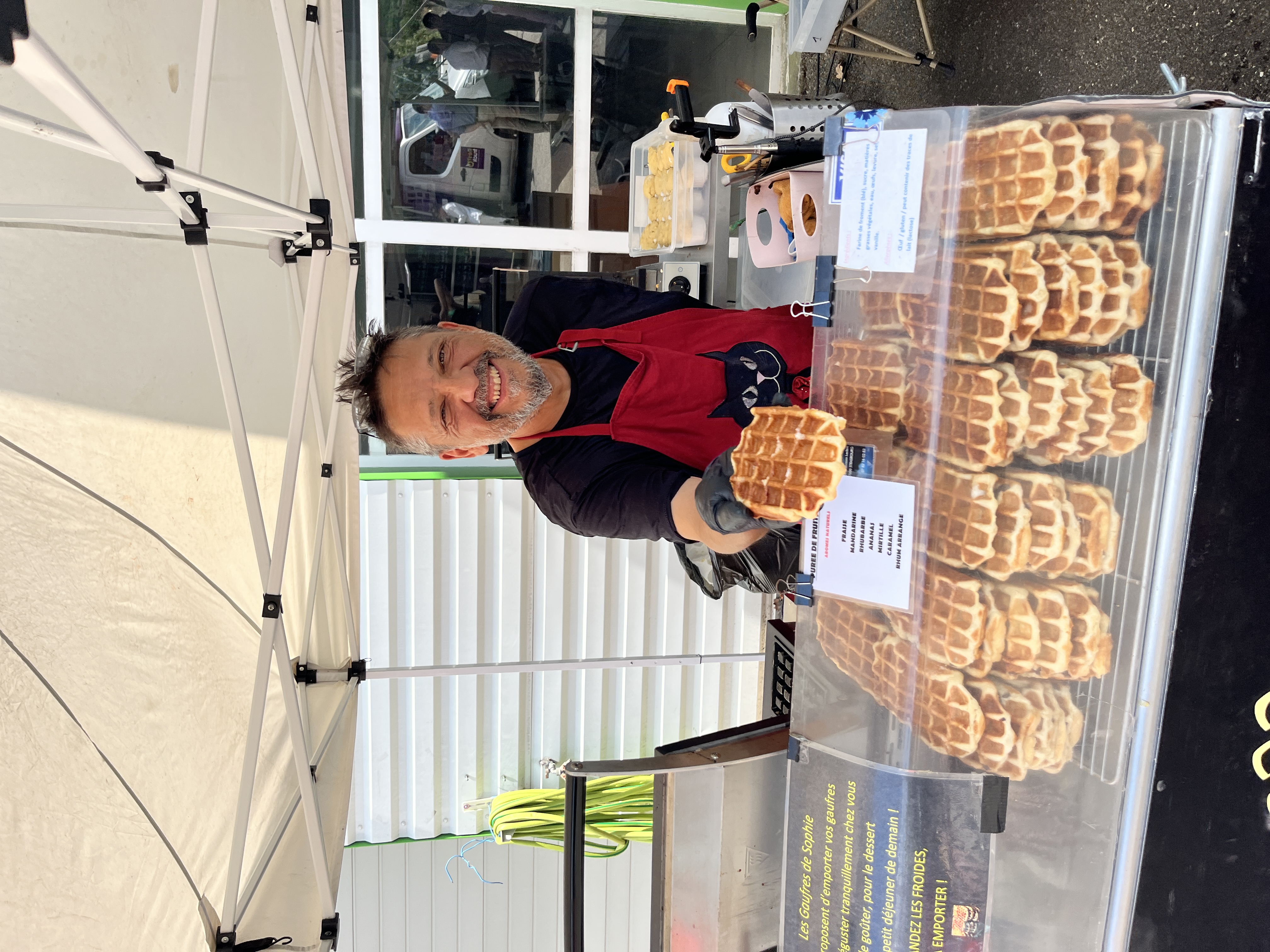
Local-inspired options with operational logic: concepts that reference the region (e.g., gaufre-focused dessert truck) while keeping service fast. We prioritize menus that can deliver 150+ servings/hour at peak.
Balanced dietary coverage: we plan for vegetarian/vegan and allergen-aware options as standard, not as an afterthought. For many corporate populations, we target 20–35% non-meat demand depending on demographics.
Premium coffee & dessert pairing: a coffee truck plus dessert reduces the pressure on main-course trucks and extends the moment for networking.
Animations Gourmandes à Luik
Pre-order via QR with pick-up windows: reduces queue time and supports tight schedules. Especially effective for executive events where timing is non-negotiable.
Consumption tracking for HR/finance: when using tokens or cashless, you can get a simple post-event report: servings per concept, peak times, and waste estimation. Useful for next-year budget decisions.
Low-impact production options: re-usable cup systems, structured sorting, and menu choices with lower waste. In Luik, it also helps when venues are strict about waste streams and site cleanliness.
Whatever the concept, we align it with your brand image through concrete choices: service posture, signage tone, queue management, and the level of “show.” For corporate audiences, professionalism is felt in timing, clarity, and cleanliness more than in big statements.
Where to place foodtrucks in Luik to protect guest flow
The venue is not a backdrop; it is an operational system. For Foodtruck verhuur in Luik, the right setting determines whether your guests circulate smoothly or stand in congested lines that block entrances and frustrate facility teams.
| Venue type | For which objective? | Main strengths | Possible constraints |
|---|---|---|---|
Company HQ courtyard / parking zone (Luik city) | Staff appreciation lunch, internal comms day, short-format gathering | Low travel friction, easy participation, strong employer proximity | Power availability, neighbor noise sensitivity, limited maneuvering |
Industrial or logistics site (Liège area) | Shift-friendly meal service, safety milestone, family day | Large space, controlled perimeter, simple truck access if planned | HSE requirements, separation from operations, strict access badges |
Event venue with outdoor terrace near the Meuse | Client event, partner day, mixed internal/external reception | Strong perceived quality, easier comfort setup, photo-friendly zone | Venue rules, fixed suppliers sometimes, limited service hours |
We strongly recommend a site visit (or at least a technical video walkthrough) before finalizing trucks. In Luik, small differences in access height, gate width, and power distribution often determine whether set-up is smooth or becomes a last-minute negotiation with security and facilities.
What budget to plan for Foodtruck verhuur in Luik
Pricing depends less on “the truck” and more on production realities: guest volume, service duration, menu complexity, and the technical conditions of the site. A realistic budget avoids compromises that later show up as queues, late service, or rushed cleanup.
Guest count and peak load: serving 300 people in 90 minutes is harder (and costs more) than serving the same number over 3 hours, because it dictates staffing and number of trucks.
Number of trucks and menu throughput: a grill-to-order concept may require more staff than a concept with prepped finishing. We select menus based on service rate, not only taste.
Base package (minimum spend) vs. pay-per-consumption: for corporate predictability we often recommend a pre-paid package with a margin for over-consumption, rather than open-ended spending.
Technical costs: power distribution, cable ramps, generators (if needed), lighting for evening service, and sometimes water access planning.
Site constraints in Luik: restricted access windows, security requirements, and additional cleanup or waste handling can add coordination time and costs.
Staffing and on-site coordination: agency coordination, service hosts, queue management, and a dedicated on-site point of contact reduce risk and protect your internal teams.
From an ROI perspective, the question is not “How cheap can it be?” but “What level of operational control do we need?” When a food moment is tied to leadership presence, client perception, or a tight agenda, the cost of failure (delays, dissatisfaction, reputational irritation) is usually higher than the delta between a basic and a properly produced setup.
When you run Foodtruck verhuur in Luik, why use a local event partner
Foodtruck events fail on practical details: access misunderstandings, missing power, unclear responsibilities, and suppliers arriving late or setting up in the wrong zone. A partner who is used to producing events in Luik reduces these risks because they know how local sites behave on real weekdays, not only in ideal scenarios.
At INNOV'events, we combine a national-level production standard with local execution: we speak the language of facility management, security, and HSE, and we brief suppliers with a real technical plan rather than a generic call sheet. If your project includes broader event architecture beyond food (program flow, stages, guest management), we can integrate it within our event agency in Luik delivery model while keeping the foodtrucks as a controlled module.
- Reliable supplier matching: we choose trucks based on capacity, punctuality history, and compliance—not only on Instagram photos.
- Local operational reflexes: we plan around traffic patterns, loading constraints, and venue rules that are specific to the Luik area.
- One accountable owner on site: executives and HR need a single point of contact who can make decisions fast and document them.
- Clear governance: we define who validates menus, who controls consumption, who signs off safety, and who approves site handover.
From an ROI perspective, the question is not “How cheap can it be?” but “What level of operational control do we need?” When a food moment is tied to leadership presence, client perception, or a tight agenda, the cost of failure (delays, dissatisfaction, reputational irritation) is usually higher than the delta between a basic and a properly produced setup.







What we have delivered around Luik: formats and complexity levels
Our foodtruck projects range from compact executive lunches to large-scale staff events with complex site conditions. The common factor is that we engineer service like an operational process, not like a “nice idea.”
Examples of typical assignments we deliver in the Luik area (without naming clients when confidentiality applies):
- HQ appreciation lunch (150–300 guests): 2–3 trucks, token system, clear time slots between meetings, and a fast site reset so the parking returns to normal use.
- Industrial site celebration (500–1,200 guests): multiple service waves aligned with shifts, dedicated queue hosting, reinforced waste plan, and strict vendor briefing to comply with HSE rules.
- Client/partner reception (80–200 guests): premium menu selection, discreet service zone, branded signage, and controlled noise so conversations remain comfortable.
In each case, the deliverable is not only the food: it is the reliability of arrival, setup, service flow, and site handover—because that is what your internal stakeholders will judge.
Common Foodtruck verhuur mistakes we prevent in Luik
Underestimating peak demand: one truck for 300 people over 90 minutes creates predictable dissatisfaction. We size trucks using throughput, not optimism.
Signing a vendor before checking access: if the truck cannot enter, the event becomes a crisis. We validate access routes, gate widths, and turning angles early.
No power plan: “They have a generator” is not a plan. We verify load, connectors, cable routing, and backup options.
Queue blocking safety exits or entrances: we map lines and place barriers/signage to keep circulation compliant and comfortable.
Ignoring dietary coverage: if 20–30% of guests cannot eat properly, HR hears about it first. We plan menu balance and allergen communication.
Unclear consumption control: without tokens/cashless rules, budgets drift and it becomes difficult to report internally. We set governance from the start.
End-of-event cleanup left vague: the fastest way to lose internal support is leaving facilities with a mess. We define cleaning, waste pickup, and sign-off.
Our role is to remove these operational risks from your day. You should not have to manage truck logistics between leadership speeches or while greeting clients.
Why Luik clients renew with INNOV'events
Repeat business is rarely about “creativity.” It is about predictability, stakeholder comfort, and a partner who improves the format year after year with measurable adjustments.
Recurring formats: many clients repeat the same foodtruck moment annually (summer gathering, end-of-year thank you, onboarding). Our value is in making iteration easier and safer each cycle.
Operational documentation: we keep technical sheets, vendor notes, site maps, and post-event learnings so you do not restart from zero with each new internal project owner.
Vendor stability with controlled rotation: we can keep the most reliable trucks and rotate one concept to maintain interest without changing the whole operational system.

Loyalty is a strong signal in corporate events: it means the event day was under control, stakeholders felt supported, and the internal effort remained reasonable.
Our production process for Luik foodtruck events
👉 Scope and constraints call (Luik project framing)
We start with objectives (HR, leadership, client-facing), guest count range, desired service window, and non-negotiables (dietary policy, budget cap, brand rules). We also identify the internal owners: HR, Comms, Facilities, Security/HSE.
👉 Site validation and technical plan
We confirm access route, unloading zone, truck placement, power availability, and safety requirements. Deliverable: a concise technical plan (layout, power distribution assumptions, arrival schedule) that facilities and security can approve.
👉 Foodtruck selection based on capacity and reliability
We propose a short list of trucks with clear service metrics (expected servings/hour, staffing), menu coverage (including vegetarian/vegan), and operational fit (self-sufficient or requiring power/water). We avoid over-complex menus that slow service.
👉 Consumption model and guest communication
We set the consumption rules: tokens, cashless, or hosted open bar-style. We prepare practical comms: service hours, how to pay, allergen information, and how queues will be managed. This reduces confusion and shortens peak congestion.
👉 Event-day coordination and supplier management
We run arrivals, check installations, validate safety, and coordinate service rhythm. If issues occur (delays, menu shortage, weather), we manage adjustments centrally and keep your internal teams out of operational firefighting.
👉 Handover, cleanup, and post-event debrief
We ensure waste removal and site cleanup according to agreed standards, then close with a short debrief: what worked, what to adjust, and practical recommendations for the next Foodtruck verhuur in Luik edition.
FAQ sur l'organisation Foodtruck verhuur à Luik
How many foodtrucks do we need in Luik for 500 guests?
For 500 guests, plan typically 3 to 5 trucks depending on the service window. As a rule of thumb: if you need to serve within 90 minutes, you size closer to 5; if you have 2.5–3 hours, 3–4 can work. Menu complexity and payment method (tokens/cashless) also change throughput.
What is a realistic budget range for Luik foodtruck rentals?
Corporate Foodtruck verhuur in Luik usually lands between €25 and €55 per person for a complete food solution, depending on menu level, number of trucks, and technical needs. Add coordination/production if you want one accountable owner on site and a controlled technical setup.
Do foodtrucks in Luik require power, or are they autonomous?
Many trucks are autonomous, but relying only on autonomy can increase noise and complexity. For a controlled setup, we often prefer planned site power (e.g., 16A/32A connections). We confirm the exact kW/kVA needs per truck and plan backups when the site supply is uncertain.
How do you manage queues during a corporate lunch in Luik?
We manage queues with a combination of sizing (enough trucks), layout (clear entry/exit lines), and governance (tokens/cashless, time slots by team if needed). In practice, queue issues are usually solved before the event by matching service capacity to the real peak, not by “asking people to be patient.”
Can we cover vegetarian, vegan, and allergens in Luik foodtrucks?
Yes. We typically build a mix where at least 20–35% of options are non-meat (depending on your audience) and we require clear allergen communication at point of order. If your policy requires it, we can include one dedicated vegetarian/vegan truck and ensure cross-contamination precautions are briefed.
Request a Luik quote with a technical-first approach
If you are comparing agencies, we suggest starting with operational facts: guest count, service window, site constraints, and the level of control you want on consumption and timing. Send us those elements and we will come back with a realistic plan for Foodtruck verhuur in Luik: number of trucks, service model, technical needs, and a transparent budget structure.
For best supplier availability in Luik (especially for peak months), plan the first scoping call 6–10 weeks ahead for mid-size events, and 10–16 weeks for large staff gatherings. Contact INNOV'events to secure the right vendors and a production setup that will not put your internal teams under pressure on event day.
Agence INNOV'events Luik
Justin JACOB est le responsable de l'agence événementielle Luik. Contactez-le directement par mail via l'adresse belgique@innov-events.be ou par formulaire.
Contacter l'agence LuikToutes nos prestations & animations Luik, Belgique
Découvrez nos prestations événementielles
Découvrez nos animations événementielles disponibles au Belgique
- Hôtesse événementielle à Luik
- Escape Game à Luik
- Cours de cuisine type MasterChef à Luik
- Magicien à Luik
- Location de chapiteau à Luik
- Atelier colorimétrie à Luik
- Jeux gonflables à Luik
- Service de voiturier à Luik
- Simulateur de football à Luik
- Location de mobilier lumineux à Luik
- Flocage lumineux à Luik
- Repas insolite à Luik
- Light Painting à Luik
- Murder Party à Luik
- Jeu concours à Luik
- PLV événementielle à Luik
- Réalité virtuelle à Luik
- Cuisine moléculaire à Luik
- Animation Halloween à Luik
- Feu d’artifice à Luik
- Jeux géants à Luik
- Animateur événementiel à Luik
- Animation photo à Luik
- Père Noël à Luik
- Animation enfants à Luik
- Visite guidée à Luik
- Rallye urbain à Luik
- Piscine à balles à Luik
- Simulateur de vol à Luik
- Location de food truck à Luik
- Record du monde à Luik
- Simulateur de surf à Luik
- Casino du vin à Luik
- Atelier relooking à Luik
- Atelier création de parfum à Luik
- Atelier acting à Luik
- Animations RSE à Luik
- Tir à l’arc à Luik
- Agent de sécurité à Luik
- Œnologie à Luik
- Mime à Luik
- Jeu télévisé à Luik
- Fête foraine à Luik
- Atelier gestion de crise à Luik
- Atelier négociation de crise à Luik
- Jeux d’arcade à Luik
- Simulateur de chute libre à Luik
- Simulateur de ski à Luik
- Simulation circuit automobile à Luik
- Baptême de l’air à Luik
- Dégustation à Luik
- Création de baby-foot à Luik
- Rallye 2CV à Luik
- Challenge LEGO à Luik
- Animation casino à Luik
- Interprète / traducteur à Luik
- Goodies à Luik
- Bus / transfert à Luik