
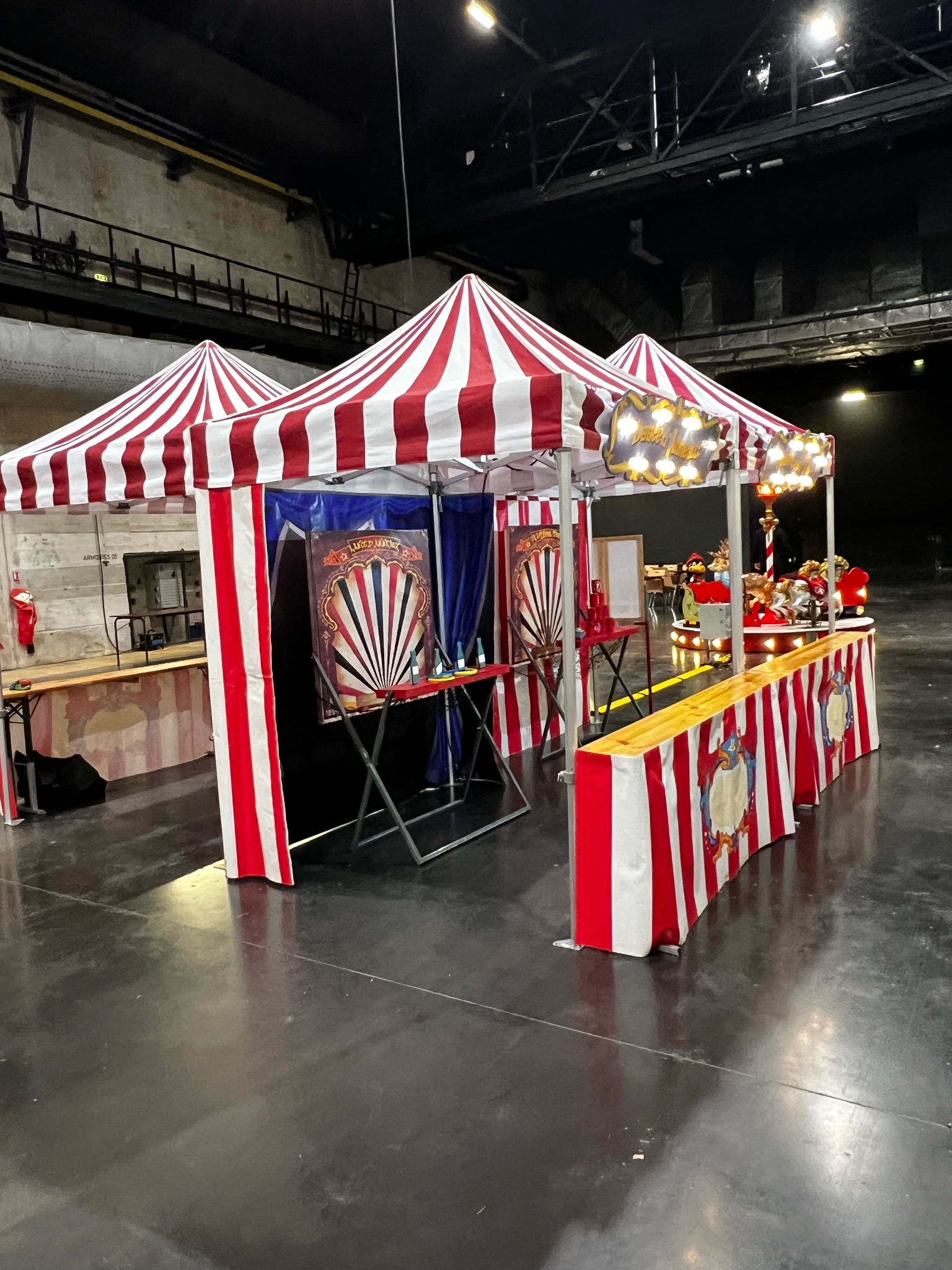
Kermisanimatie in Luik that keeps your event controlled and engaging
INNOV'events supports executives, HR and communication teams with Kermisanimatie in Luik for 80 to 2,000 attendees. We manage concept, staffing, technical coordination, safety, and on-site production so you keep control of brand image and timing. Expect clear budgeting, realistic planning, and a production team used to corporate constraints.
Sommaire
In a company setting, entertainment is not “extra”: it is a management tool. A well-produced fairground format helps you structure arrivals, create spontaneous interaction between departments, and keep energy stable across the entire time slot—without forcing people into awkward icebreakers.
In Luik, organisations often expect a high level of hospitality with pragmatic execution: fast service, multilingual staff (FR/NL/EN depending on audience), and strict respect of venue rules. The entertainment must look simple to guests while being tightly planned backstage.
Based in Brussels with regular productions in Wallonia, INNOV'events operates with a local supplier network and an on-site method designed for corporate risk management. We deliver corporate event entertainment in Luik that is visually coherent, operationally safe, and aligned with your internal and external communication goals.
Key figures that matter for corporate events in Luik
10+ years of corporate event production in Belgium, with repeated deployments in Wallonia and the Luik area.
150+ events/year delivered through our Brussels core team and field partners (from HR family days to client evenings and employer branding activations).
80 to 2,000 participants managed with scalable staffing models (hosts, game operators, technicians, coordinators).
1 production lead + 1 safety/operations lead on medium/large deployments to prevent last-minute “DIY decisions” on event day.
Local references and recurring collaborations in Luik
We support organisations active in and around Luik—industry, public services, utilities, logistics, and international groups with sites on both sides of the language border. Many clients rebook the same core format year after year, not because they want “the same event”, but because they want a predictable process and a partner who understands internal approvals, union constraints, and brand validation cycles.
When you share your internal context (works council expectations, safety officer requirements, brand guidelines, and the real objective of the day), we translate it into a workable fairground deployment: a clear layout, controlled guest flow, and animations that keep participation high without turning the event into a noisy funfair that competes with speeches or networking.
If you want, we can provide a reference call list adapted to your sector and event type (family day, staff celebration, client event, or recruitment/awareness day) for the Luik area.
 Besoin d’un devis rapide ?
Nous vous envoyons une première proposition sous 24h.
Why run kermisanimatie for a company event in Luik?
Kermisanimatie works particularly well in corporate settings because it combines two things leaders care about: predictable logistics (modular stands, repeatable game mechanics, manageable timing) and real social mixing (people talk naturally while playing, queueing, or redeeming tokens). In Luik, where many organisations bring together office teams, field teams, and production teams, that mix is often the real KPI.
For executives: a format that looks welcoming and inclusive, while remaining controllable in terms of budget, safety and brand exposure (signage, staff dress code, sound levels, cleanliness).
For HR: measurable participation without forcing people into “team building”. We can set up participation systems (tokens, scorecards, prize counter) to track engagement per department or per site.
For communication teams: strong visual output for internal comms and social content (colourful stands, branded tickets, photo points) without risking off-brand staging.
For operations/safety: clear zoning, queue management, stable electricity planning, and a staffing plan that prevents game stands from becoming bottlenecks.
For mixed audiences: easy entry for all ages and profiles (families, interns, senior staff, external partners), with multi-level difficulty games to avoid frustration.
Luik has a pragmatic economic culture: people value authenticity and good hospitality, but they also notice when execution is sloppy. A well-produced fairground format respects that culture—warm on the surface, disciplined behind the scenes.
What organisations in Luik expect on event day
In the Luik region, we often see three recurring constraints that drive decision-making for HR and communication directors.
1) Access and mobility realities. Guest arrival patterns can be uneven (shift changes, family arrivals, parking constraints). We plan a “soft landing” zone: low-friction games near the entrance, immediate beverage point, and a layout that avoids early congestion. This matters when you have a mix of colleagues coming from industrial sites, offices, and partner companies.
2) Noise and neighbour considerations. Some venues in and around Luik impose strict limits on amplified sound and outdoor activity times. Fairground entertainment can work perfectly without a full sound system, but it must be designed accordingly (visual attractors, micro-animations, roaming staff, timed moments rather than continuous loud music).
3) Corporate safety culture. Many local employers have robust internal HSE standards. We integrate them from the start: cable routing and protection, fire lane access, stable structures, operator briefing, and documented checks. Executives do not want to “discover” safety questions at 16:30 on event day—so we handle them during preproduction.
Finally, bilingual or international audiences are common (FR/NL/EN). We propose signage and staffing accordingly, and we keep game rules extremely clear to avoid operator improvisation that can create complaints.
Which kermisanimatie formats work best for Luik corporate events?
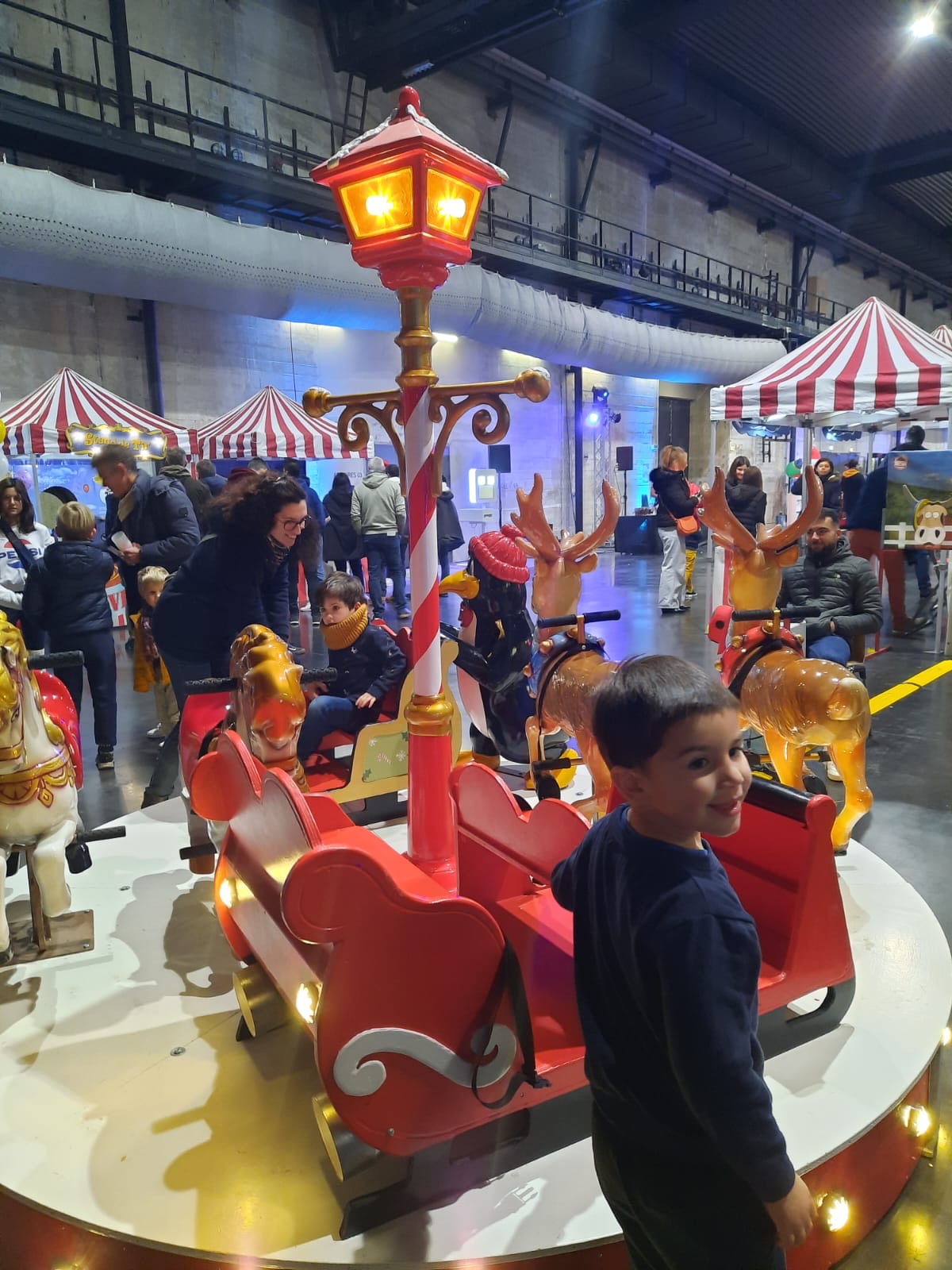
Engagement comes when guests can participate within 30 seconds of arrival, understand the rules instantly, and feel comfortable joining even if they are not “game people”. For Kermisanimatie, we curate a balanced mix: quick wins, collaborative games, and a few signature pieces that create visual impact without operational complexity.
Animations Interactives à Luik
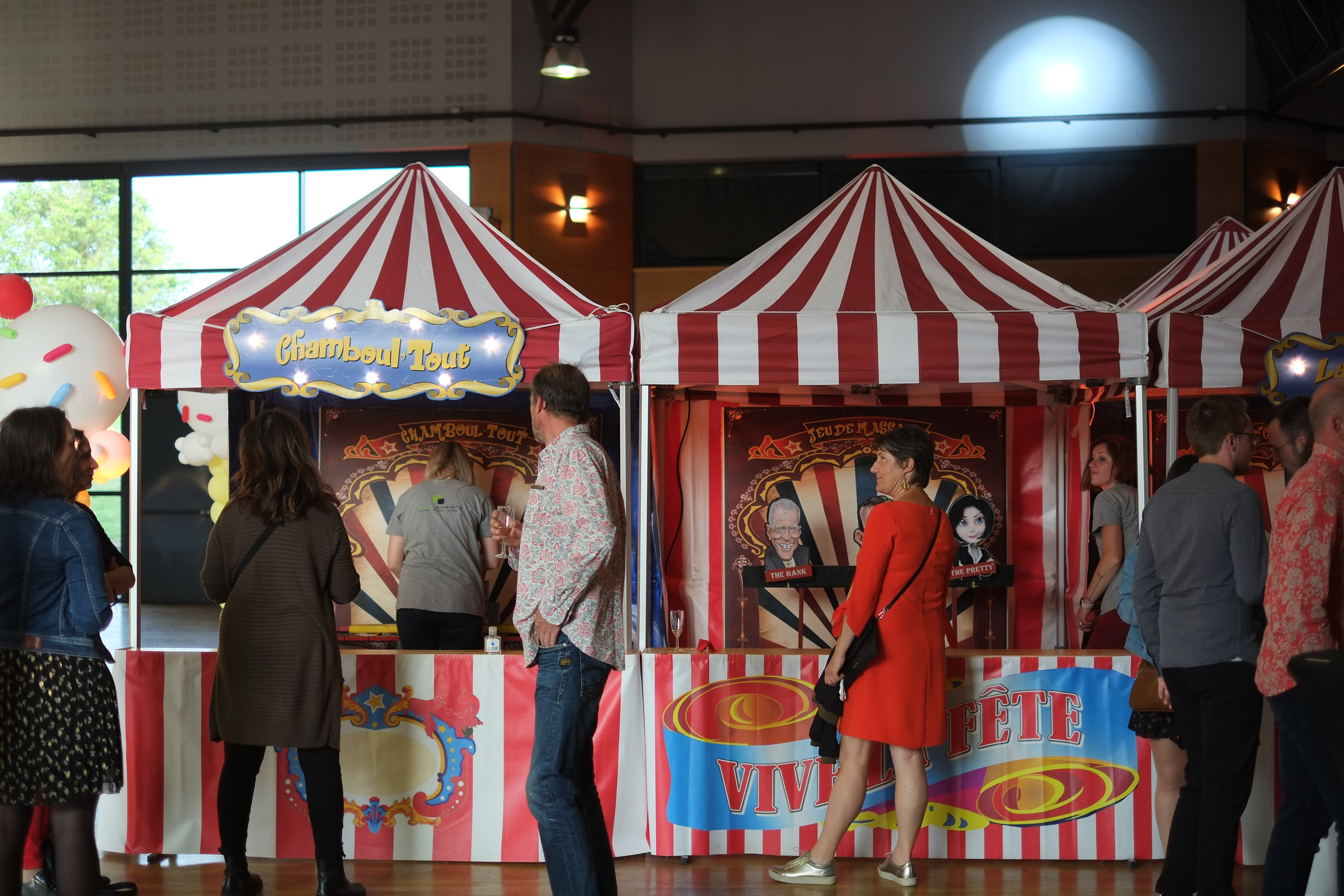
Token-based game parcours (6–12 stands): guests receive tokens on arrival; each stand earns points or stamps. Practical benefit: you control participation and can manage prize stock with a clear redemption logic.
Team leaderboard challenge: departments or sites compete via a QR check-in at each stand. Useful when HR wants structured interaction but does not want a formal team-building workshop.
Roaming fair hosts: instead of waiting for guests to approach stands, hosts activate quieter areas, invite shy participants, and regulate queues.
Photo point with branded frame: designed for internal comms; we can add a “Liège / Luik edition” visual cue without making it touristy.
Animations Artistiques à Luik
Close-up magic adapted to corporate audiences: performed during welcome drinks to reduce awkwardness and start conversations between mixed groups (leadership + operational staff, clients + internal teams).
Stilt walkers or elegant roaming characters: works best in high-ceiling venues and outdoor courtyards; we keep it visually strong but controlled (no invasive interactions during speeches).
Short circus-style interludes (3–6 minutes): scheduled moments between program blocks to reset attention without delaying catering or plenary timing.
Animations Innovantes à Luik
Waffle or crêpe stand with throughput planning: we calculate service rate and propose either one high-capacity point or two smaller stations to avoid queues at peak time.
Popcorn + cotton candy corner: very effective for family days; we plan hygiene, waste management, and allergen signage as part of the set-up.
“Prize counter” with local touch: instead of random gadgets, we propose branded useful items (quality tote, insulated bottle) and a few locally sourced options aligned with company policy.
Animations Gourmandes à Luik
Cashless token system (QR or badge scan): reduces operational friction and provides participation reporting—relevant when management asks for evidence beyond “people seemed happy”.
Hybrid indoor/outdoor zoning: in the Luik area, weather can be unpredictable. We design an indoor backbone (core stands + catering) and outdoor satellites that can be closed without breaking the experience.
Micro-learning stand disguised as a game: ideal for safety days or transformation programs (cybersecurity, compliance). The rule is simple: no long lectures—just a 2-minute challenge with immediate feedback.
Whatever the mix, we align entertainment with your brand image: sound level, visual codes, staff behaviour, and the balance between playful and professional. That alignment is what prevents fairground entertainment from looking “cheap” in a corporate context.
Which venue types in Luik fit a kermisanimatie layout?
The venue determines guest flow, safety constraints, acoustic comfort, and the perceived “level” of your event. For Kermisanimatie in Luik, we look for flat surfaces, good power access, and a clear separation between games, catering, and speeches—so entertainment supports the program instead of competing with it.
| Venue type | For which objective? | Main strengths | Possible constraints |
|---|---|---|---|
Industrial hall / large event warehouse (Luik area) | High-capacity staff celebration, family day, multi-stand fairground circuit | High ceilings, strong load capacity, easy zoning, weather-proof | Acoustics to manage, sometimes limited ambience without decoration, strict access slots |
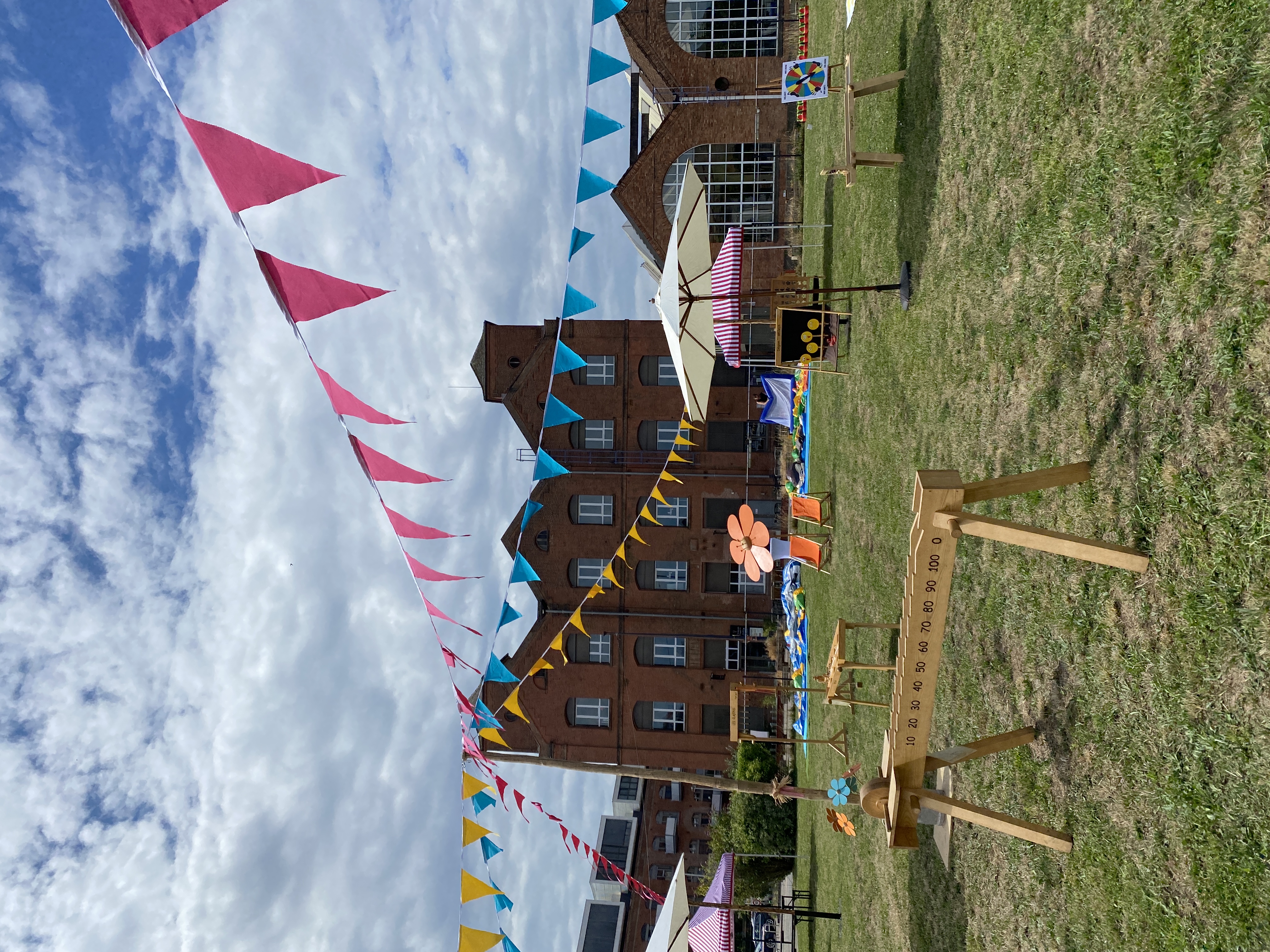
Corporate site courtyard or parking area in Luik | Employer branding day, internal open day, low travel friction for staff | Convenient for employees, strong “we invest in our people” signal, easy to integrate site visits | Weather contingency needed, neighbour noise limits, power distribution to secure |
Hotel/conference venue with terrace (Luik region) | Client evening + light fairground corner, after-seminar networking | Professional service standards, integrated catering, comfort for VIP guests | Space limits for large stands, restrictions on certain machines, loading logistics |
We strongly recommend a site visit (or at minimum a technical walk-through) before locking the stand count. In Luik, small differences—service corridors, power points, ceiling height—can decide whether your set-up stays elegant or becomes visibly “patched together”.
What budget to plan for kermisanimatie in Luik?
Pricing for Kermisanimatie in Luik depends on operational reality more than on “the number of games”. The same concept can vary significantly based on staffing, duration, access constraints, and technical requirements. Our approach is to build a transparent quote where each cost driver is visible, so you can arbitrate intelligently.
Scale and duration: a 2-hour activation for 150 guests is not the same as a 6-hour family day for 1,200 guests; staffing ratios and replenishment (prizes, consumables) change accordingly.
Number of stands and throughput needs: more stands can reduce queues, but sometimes two high-throughput stands are smarter than five slow ones. We model capacity to avoid “we paid for stands but people waited in line”.
Staffing level: corporate-grade operators, bilingual hosts, technical lead, and production coordination. Understaffing is the fastest way to damage guest experience.
Technical and safety: power distribution, lighting, cable protection, fire lane management, signage, and any venue-required documentation.
Branding and reporting: branded tokens, visual elements, and optional participation reporting (useful for HR and internal communication debriefs).
Access constraints in Luik: limited loading windows, distance from trucks to event area, and the need for additional handling time or crew.
From an ROI perspective, the question is not “how cheap can we do it?” but “what level of execution protects our image and keeps participation high?”. A controlled, well-staffed fairground deployment often reduces hidden costs: last-minute fixes, overtime, complaints handling, and reputational risk after internal events.
Why work with an event agency in Luik for kermisanimatie?
For fairground-style entertainment, local execution matters: deliveries, access slots, venue rules, and the ability to replace a missing component quickly. Working with a partner who is operationally active in the region reduces the typical friction points that executives end up hearing about only when something goes wrong.
Through INNOV'events, you get a structured production approach and the advantage of local coordination. When your brief involves multiple stakeholders (HR, Comms, Facilities, HSE), we keep the chain of responsibility clear, and we maintain decision speed on event day—especially critical when weather or attendance patterns shift.
If you are comparing providers, see how we position ourselves as an event agency in Luik with a corporate-grade production method rather than a “rental catalogue”. The difference shows in preparation: site checks, risk prevention, staffing discipline, and the way we protect your agenda timing.
- Faster on-site response: local sourcing and realistic load-in planning reduce the chance of late set-up.
- Venue familiarity: we anticipate constraints (noise rules, access routes, power limits) instead of learning them during build.
- Supplier accountability: one production lead coordinates all moving parts; you avoid chasing multiple vendors.
- Consistency: repeatable processes across years and sites, which is what many HR and comms teams actually need.
From an ROI perspective, the question is not “how cheap can we do it?” but “what level of execution protects our image and keeps participation high?”. A controlled, well-staffed fairground deployment often reduces hidden costs: last-minute fixes, overtime, complaints handling, and reputational risk after internal events.




What we deliver in Luik: realistic project scenarios
Our projects in and around Luik range from compact “fair corner” activations to full-scale company family days. The common denominator is operational control.
Scenario 1: staff celebration after a results meeting. Constraint: the CEO speech ends at 18:15 and catering must start at 18:30. We deploy fast-start stands (ring toss, quick skill games) already live during the final minutes of guest arrival, with sound kept low. Operators are briefed to keep flow moving and prevent crowding near the bar. Result: networking starts immediately, without waiting for a “program moment”.
Scenario 2: family day for an industrial site. Constraint: mixed audience, child safety, and HSE requirements. We design clear zones (kids, teens, adults), add barrier planning where needed, and implement wristbands or family check-in if requested. We schedule short highlight moments (mini show, prize draw) to structure the day without turning it into a stage-centric festival.
Scenario 3: client event with employer branding touch. Constraint: brand image must stay premium. We use a restrained visual palette, quality materials, and staff etiquette aligned with hospitality standards. Entertainment stays conversational (close-up magic, elegant games, photo point) while still creating activity that supports relationship-building.
These examples illustrate how we adapt the same fairground logic to different corporate priorities: timing, safety, image, and stakeholder management.
Common pitfalls we prevent on kermisanimatie projects in Luik
Underestimating queue management: one popular stand can block access to catering or emergency routes. We plan stand placement and staffing to keep aisles clear.
Overloading the space: too many stands reduce comfort and make the event feel chaotic. We prioritise a coherent layout over a long list of rentals.
Late safety discussions: cable ramps, fire lanes, and stability checks should be solved in preproduction, not during set-up.
Mismatch between entertainment and corporate tone: what works for a public fair may not fit a regulated company environment. We brief operators and adjust visuals accordingly.
Ignoring weather contingency: outdoor deployments in the Luik region need a Plan B that is operational, not theoretical.
Prize counter mismanagement: wrong stock levels, poor quality gifts, or unclear rules create dissatisfaction. We forecast quantities and define simple redemption mechanics.
Our role is to prevent these risks through method, not through promises: capacity planning, technical coordination, documented checks, and a clear on-site chain of command. That is what keeps your internal stakeholders confident on event day.
Why Luik clients rebook INNOV'events
Repeat business is rarely about novelty; it is about reliability under real corporate constraints. In Luik, clients come back when they see that preparation reduces internal workload and that the event day runs without escalations.
Recurring annual formats: many organisations keep a stable event backbone (welcome zone + game circuit + catering flow) and evolve it each year with 20–30% new elements to stay fresh without increasing risk.
Lower internal workload: with a clear RACI (who validates what), HR and Comms typically reduce meeting loops and last-minute vendor chasing.
Fewer day-of surprises: structured set-up schedules and checklists significantly reduce the typical “missing item / wrong cable / unclear timing” incidents.

Loyalty is proof of quality because corporate teams do not rebook partners who create stress. Our objective is simple: you should look good internally because the project is managed professionally from brief to debrief.
How we build a controlled kermisanimatie project in Luik
👉 Align objectives and constraints for Luik stakeholders
We start with a structured intake with HR/Comms/Operations: purpose (celebration, employer branding, client relations), audience mix, timing constraints, safety requirements, and venue restrictions. We also identify what can damage success (noise limits, union constraints, VIP protocol, peak arrival patterns) and define decision owners.
👉 Design the fairground system, not just a list of stands
We propose a layout and a stand mix based on capacity planning: estimated throughput, zoning, and guest journey. We define the token/prize mechanics, signage needs, and how the entertainment integrates with speeches and catering so the schedule remains credible.
👉 Lock technical plan and staffing plan in advance
We coordinate power distribution, lighting needs, cable protection, load-in slots, and venue approvals. We staff the project with the right roles (operators, hosts, technical lead, production coordinator) and brief them on corporate etiquette, languages, and escalation rules.
👉 Run set-up, opening, and live operations with one chain of command
On site in Luik, we follow a timed build plan, test each stand, and run a team briefing before guests arrive. During the event, we manage flow, replenish prizes/consumables, and adjust in real time (e.g., opening an extra stand, repositioning staff) without disrupting your program.
👉 Debrief with actionable learnings
After the event, we provide a concise debrief: what worked, where queues formed, what guests preferred, and recommendations for the next edition. If a reporting system was used, we summarise participation and engagement indicators in a way that is usable for management reporting.
FAQ sur l'organisation Kermisanimatie à Luik
How far in advance should we book kermisanimatie in Luik?
Plan 6–10 weeks for a standard corporate deployment (150–600 guests). For peak periods (June, September–December) or complex sites, aim for 10–14 weeks to secure staffing, venue approvals, and technical planning.
What is a realistic budget range for Luik corporate kermisanimatie?
For corporate events in Luik, a compact set-up (3–5 stands + staff) often starts around €2,500–€6,000. Mid-scale (6–10 stands, prize counter, more staff) is typically €6,000–€15,000. Larger family days can exceed €15,000–€35,000+ depending on duration, catering add-ons, and technical constraints.
How many game stands do we need for 400 guests in Luik?
As a practical baseline, plan 6–8 stands for 400 guests over 3–4 hours, assuming staggered participation and good throughput. If your audience arrives all at once (after a plenary), we may add capacity or deploy roaming activators to reduce queues during the first 45 minutes.
Can kermisanimatie in Luik work indoors in winter?
Yes. Indoor Kermisanimatie works very well in winter when the layout is planned for acoustics and comfort. We prioritise stands with low noise and high participation, ensure safe cable routing, and coordinate ventilation/odour considerations for any warm food stations.
Do you handle permits and safety requirements in Luik venues?
We manage venue coordination, safety checks, and documentation required by the site (power plan, cable protection, stability checks, fire lane respect, staff briefing). If a specific permit is needed due to public space use or special installations, we flag it early and support the process with the venue and local authorities.
Request a clear proposal for kermisanimatie in Luik
If you are planning a company event in Luik, involve us early—before the venue layout and timing are locked. A short scoping call is usually enough to confirm feasibility, propose the right stand mix, and prevent avoidable cost drivers (queues, understaffing, last-minute technical fixes).
Send us your date, estimated attendance, venue type, and objective (HR, client, employer branding). INNOV'events will come back with a structured concept, operational plan, and a transparent budget—so you can compare agencies on facts and execution quality.
Agence INNOV'events Luik
Justin JACOB est le responsable de l'agence événementielle Luik. Contactez-le directement par mail via l'adresse belgique@innov-events.be ou par formulaire.
Contacter l'agence LuikToutes nos prestations & animations Luik, Belgique
Découvrez nos prestations événementielles
Découvrez nos animations événementielles disponibles au Belgique
- Hôtesse événementielle à Luik
- Escape Game à Luik
- Cours de cuisine type MasterChef à Luik
- Magicien à Luik
- Location de chapiteau à Luik
- Atelier colorimétrie à Luik
- Jeux gonflables à Luik
- Service de voiturier à Luik
- Simulateur de football à Luik
- Location de mobilier lumineux à Luik
- Flocage lumineux à Luik
- Repas insolite à Luik
- Light Painting à Luik
- Murder Party à Luik
- Jeu concours à Luik
- PLV événementielle à Luik
- Réalité virtuelle à Luik
- Cuisine moléculaire à Luik
- Animation Halloween à Luik
- Feu d’artifice à Luik
- Jeux géants à Luik
- Animateur événementiel à Luik
- Animation photo à Luik
- Père Noël à Luik
- Animation enfants à Luik
- Visite guidée à Luik
- Rallye urbain à Luik
- Piscine à balles à Luik
- Simulateur de vol à Luik
- Location de food truck à Luik
- Record du monde à Luik
- Simulateur de surf à Luik
- Casino du vin à Luik
- Atelier relooking à Luik
- Atelier création de parfum à Luik
- Atelier acting à Luik
- Animations RSE à Luik
- Tir à l’arc à Luik
- Agent de sécurité à Luik
- Œnologie à Luik
- Mime à Luik
- Jeu télévisé à Luik
- Fête foraine à Luik
- Atelier gestion de crise à Luik
- Atelier négociation de crise à Luik
- Jeux d’arcade à Luik
- Simulateur de chute libre à Luik
- Simulateur de ski à Luik
- Simulation circuit automobile à Luik
- Baptême de l’air à Luik
- Dégustation à Luik
- Création de baby-foot à Luik
- Rallye 2CV à Luik
- Challenge LEGO à Luik
- Animation casino à Luik
- Interprète / traducteur à Luik
- Goodies à Luik
- Bus / transfert à Luik