Escape Game in Antwerp for teams that need results, not noise
INNOV'events is a Brussels-based corporate event agency delivering Escape Game formats in Antwerp for 10 to 500 participants. We manage the full operational chain: scenario choice, logistics, facilitators, timing, scoring, and on-site coordination. Your teams get a structured, high-energy moment; you keep control of the agenda, the message, and the risk.
Sommaire
In a corporate agenda, entertainment is not a “nice extra”: it is often the only moment where people from different functions actually collaborate under time pressure. A well-run Escape Game gives leadership a concrete observation window on decision-making, communication, and ownership—without turning the event into a training session.
In Antwerp, expectations are typically pragmatic: tight schedules around shifts and client commitments, multilingual groups, and a need for a format that works equally well for HQ staff and operational teams. Companies ask us for engagement that is measurable (scores, completion rates, team feedback) and compatible with brand standards and safety rules.
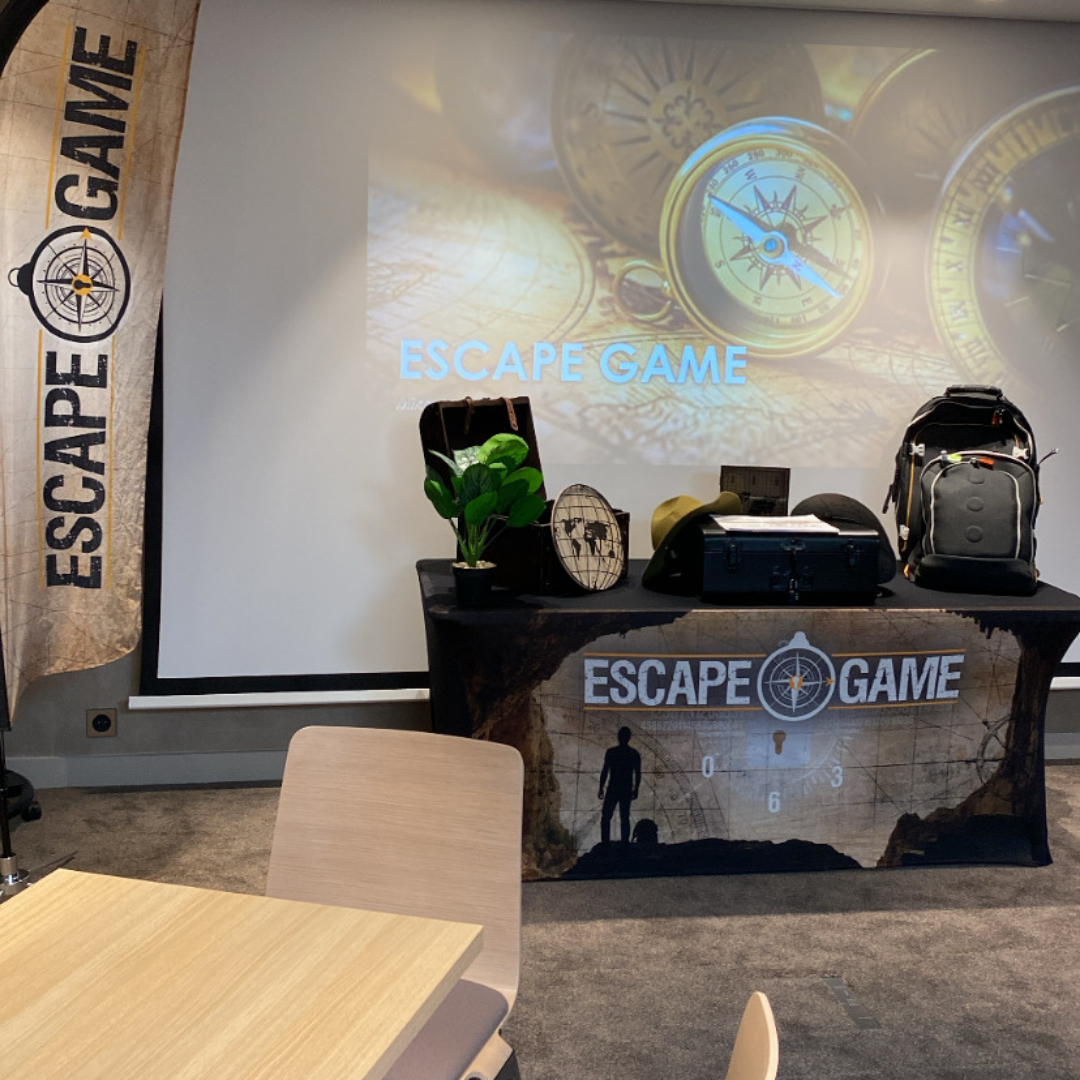
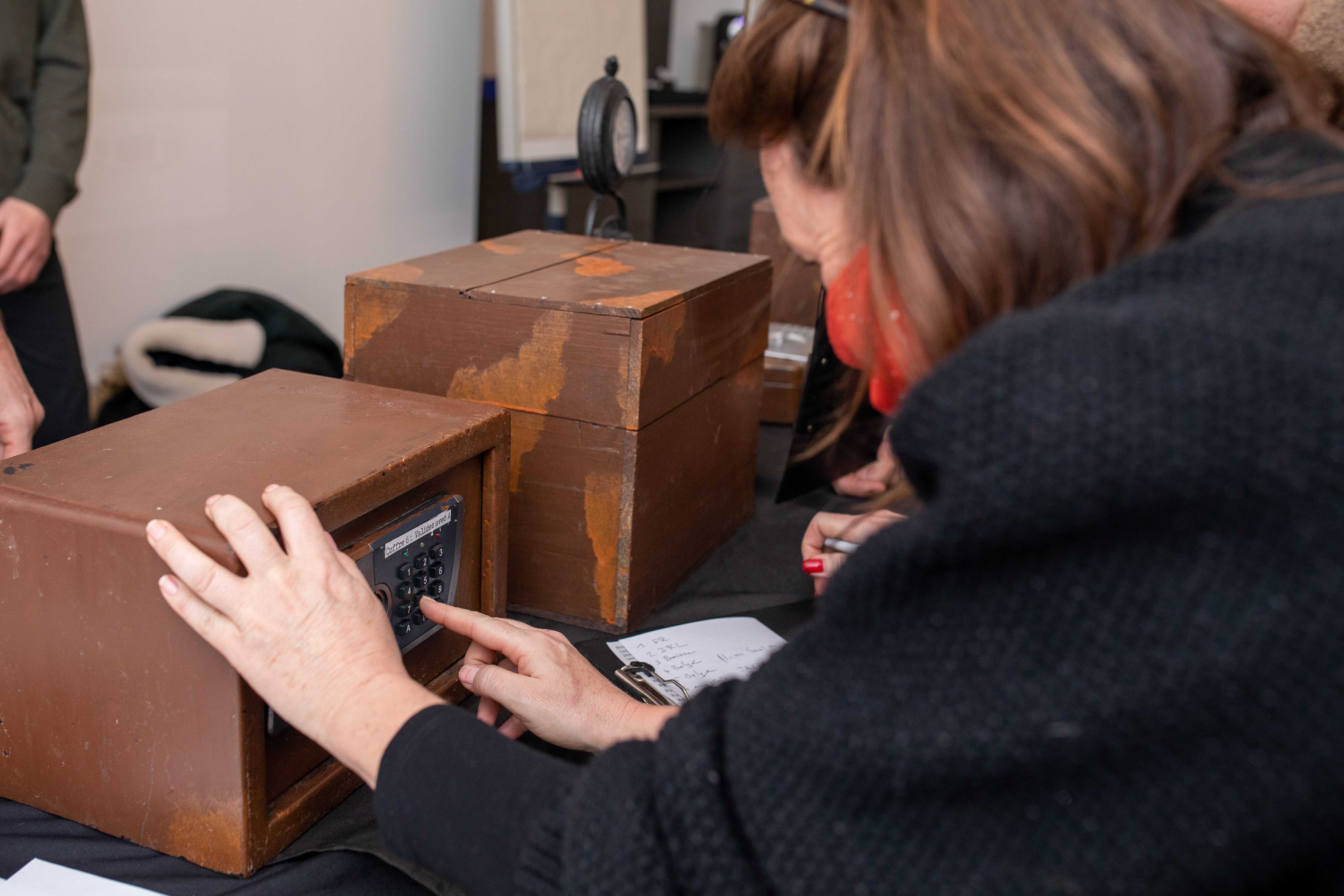
We deliver Escape Game in Antwerp as a controlled production: pre-event briefing with HR/Comms, venue and flow check, facilitator staffing plan, and a run-of-show aligned with your plenary and catering constraints. Our local network and recurring suppliers in the Antwerp area help us move quickly while keeping quality consistent.
INNOV'events numbers that matter in Antwerp operations
15+ years producing corporate events in Belgium, with repeat clients across finance, pharma, logistics and public institutions.
100+ corporate team formats delivered yearly (including Escape Game, city challenges and indoor problem-solving formats) with standardized safety and timing procedures.
10–500 participants per session capacity via parallel game stations, multi-facilitator staffing and synchronized scoring.
48h for a first operational proposal (format + indicative budget) once objectives, headcount and date window are confirmed.
NL/FR/EN facilitation available, crucial for mixed Antwerp teams and international leadership groups.
Antwerp references and recurring corporate teams
We regularly work with organizations active in Antwerp and the wider port ecosystem—headquarters teams, operational departments, and project teams that need a format compatible with real constraints (shift changes, site access rules, multilingual communication). Many collaborations continue year after year because the format remains easy to justify internally: it delivers engagement, provides observable behaviors, and fits into an executive agenda.
You mentioned “the company names I provided” as references; we can integrate them on this page exactly as you prefer (full legal entity, brand name, or “client sector only”) depending on your approval level and NDA requirements. In practice, we often publish references as “industry + scope + outcome” (e.g., logistics group, 180 pax, indoor multi-room Escape Game, 3 time slots) and keep the company name for direct proposal discussions.
If your procurement or comms policy requires it, we can also provide Antwerp-based supplier confirmations (venue, catering, AV) and evidence of insurance coverage before signature, so the decision chain remains smooth.
 Besoin d’un devis rapide ?
Nous vous envoyons une première proposition sous 24h.
Why run an Escape Game for a company in Antwerp
When leadership asks for “team cohesion”, what they often need is more specific: cross-department collaboration that survives workload peaks, faster internal escalation, and clearer ownership when priorities compete. A corporate Escape Game in Antwerp is effective when it is designed and facilitated as a management tool: short, intense cycles of problem-solving with clear roles, time constraints, and feedback.
We typically position the activity as a structured highlight inside a broader agenda (kick-off, quarterly meeting, safety day, employer branding moment, management offsite). It becomes the shared experience people reference afterwards—useful for internal communication, onboarding narratives, or culture initiatives—without requiring a “training” label.
Faster collaboration across silos: mixed teams (operations, sales, finance, IT) face the same information with limited time—exactly what happens during real project escalations. We see communication patterns emerge within minutes, which is valuable for managers and HR.
Observable leadership and decision-making: in a controlled scenario, leaders appear naturally (or not). You can spot who summarizes, who delegates, who keeps calm under pressure—insights that are hard to capture in a meeting room.
Safe way to test process discipline: many Antwerp-based organizations operate with strict compliance and HSE habits. A well-designed Escape Game rewards method (checking information, validating assumptions) rather than “loud confidence”, which mirrors operational excellence culture.
Internal communication leverage: the activity produces content (scores, photos, team names, completion times) that comms teams can use immediately—especially effective when combined with a corporate message (strategy, values, safety, customer promise).
Predictable timing for executives: unlike open-ended entertainment, an Escape Game is built on time blocks (e.g., 45–60 minutes game + briefing + debrief). This makes it compatible with tight agendas and venue constraints.
The economic culture around Antwerp is performance-driven and operationally grounded: deadlines, coordination, and reliability matter. That is precisely why this format works here—when it is executed with discipline and not treated as a gimmick.
What Antwerp companies expect from corporate entertainment
In Antwerp, decision-makers tend to be demanding on operational realism. We are frequently asked very practical questions early: How many facilitators per 50 people? What happens if a team finishes early? Can we run it during a lunch-to-lunch program? How do you manage multilingual instructions without losing energy?
Another frequent constraint is calendar pressure: busy peak periods, last-minute changes in attendance, and the need to integrate with existing suppliers already contracted by procurement. Our role is to secure the activity as a stable “module” inside the event day: fixed time blocks, clear responsibilities, and contingency plans (spare materials, buffer times, backup puzzles, and a plan B room in case of noise or access issues).
Finally, the Antwerp region has many international teams. We therefore design for mixed language tables, avoid culture-specific riddles that exclude newcomers, and ensure instructions and hints can be delivered in NL/FR/EN. This is not an aesthetic detail; it directly impacts participation equity and the perceived professionalism of the organizer.
Which Escape Game formats work best in Antwerp corporate events
Engagement comes from clarity: clear objective, clear time box, clear roles. We propose Escape Game formats in Antwerp that can be deployed in meeting rooms, venues, or workplaces, with a level of intensity adapted to your audience (from leadership committees to large operational teams). Below are formats we use regularly because they remain reliable under corporate constraints.
Interactive animations in Antwerp
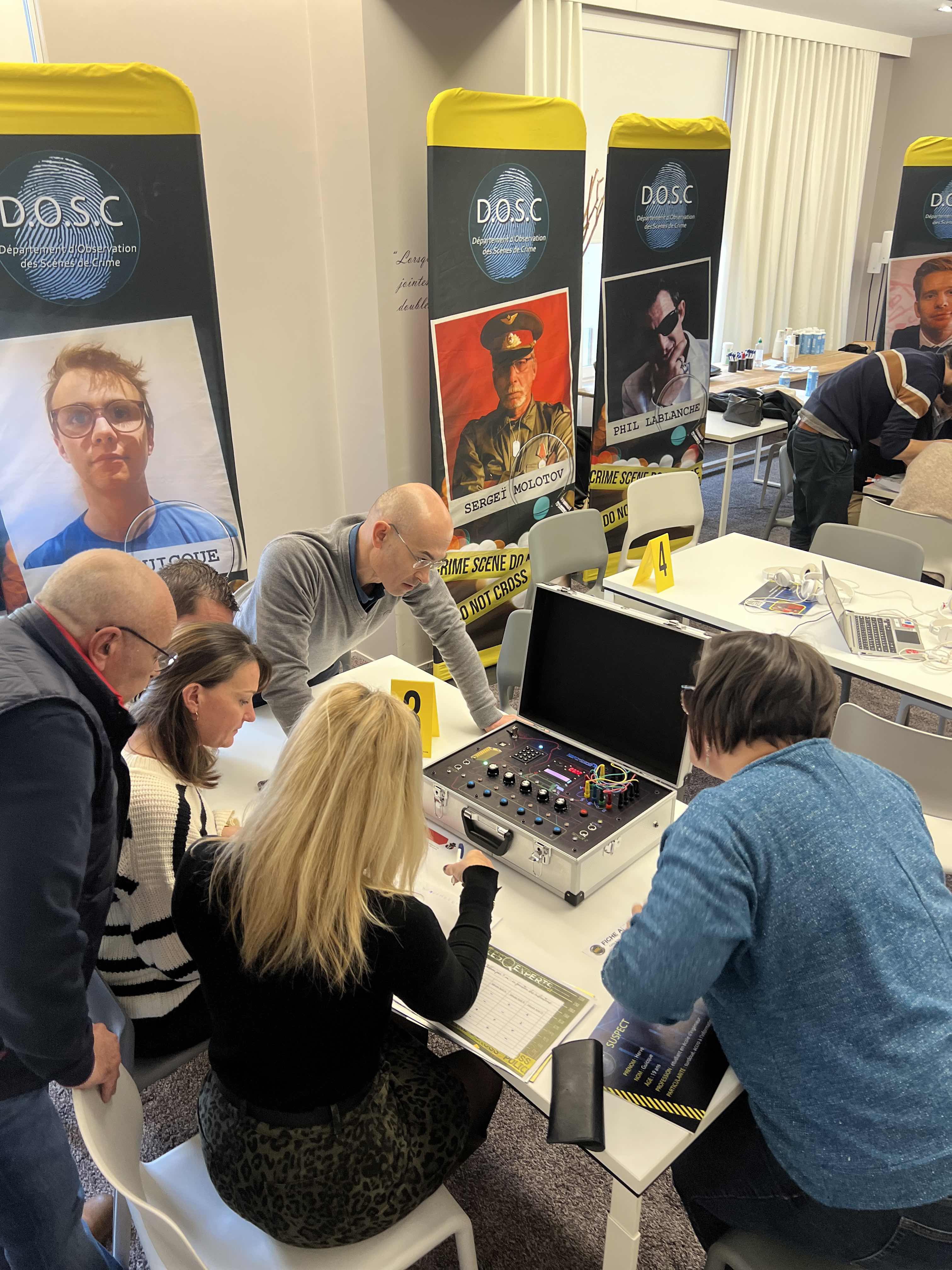
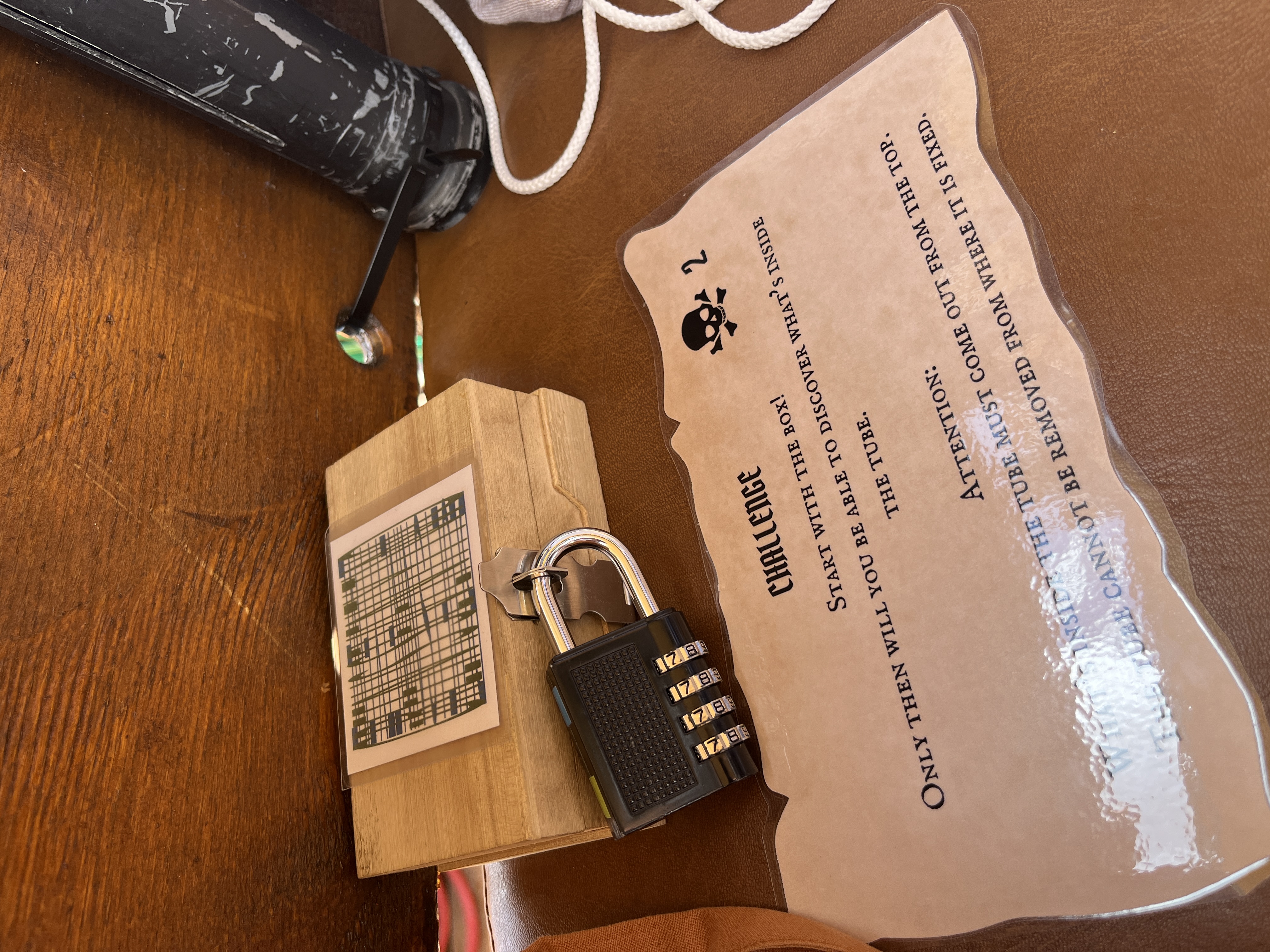
Table-top Escape Game (indoor, modular): ideal for dinner setups or conference breakouts. Teams solve parallel puzzle paths; we synchronize scoring and provide a live leaderboard. Works well for 40–300 pax in a ballroom or large meeting space.
Multi-room rotation (time slots): for groups with limited space, we run consecutive sessions (e.g., 4 x 60 minutes) with controlled transitions. Practical when you must keep people on-site and avoid city transfers.
Executive-friendly “strategy & coordination” scenario: less physical, more decision-focused; strong for leadership offsites where the goal is alignment and communication, not adrenaline.
Art animations in Antwerp
Actor-led immersion: one or two professional role-players can elevate the narrative without turning the event into theatre. Useful when comms teams want a brand message integrated into the story (e.g., customer promise, safety culture, transformation theme).
Sound and light design: subtle cues (timed audio, “mission control” announcements) increase intensity while keeping the production corporate-appropriate. We keep it venue-compliant to avoid disturbing other functions.
Innovative animations in Antwerp
Escape Game + tasting checkpoints: teams unlock a small tasting step (coffee, praline, local snack) after milestones. This works well for mixed seniority groups because it creates natural micro-pauses and social interaction.
Networking debrief around a structured drink: we time the debrief so the first drinks are served exactly when teams exit, preserving energy and conversation continuity. This is a small operational detail that improves perceived quality.
Gourmand animations in Antwerp
Hybrid digital scoring (QR + facilitator validation): keeps results consistent across multiple rooms while preventing “self-declared” outcomes. Particularly relevant for larger Antwerp groups where fairness matters.
On-site “business context” missions: when appropriate, we can embed company-neutral process challenges (handover, quality check, incident response) as puzzle mechanics—without exposing confidential information.
City-based escape trail in Antwerp: for teams who benefit from movement and informal conversation. We plan routes with realistic walking times, crowd density considerations, and weather contingencies.
The best format is the one aligned with your brand image and risk profile. A premium brand may prefer controlled, elegant puzzles and disciplined facilitation; a fast-growth scale-up might prefer a higher-energy competitive structure. We help you choose based on audience, message, and venue constraints—not on what looks good on a brochure.
Where to host an Escape Game in Antwerp without logistical surprises
The venue shapes the perceived seriousness of the event and the practical success of the Escape Game. In Antwerp, the key is matching your audience flow to the space: ceiling height and acoustics for briefings, breakout corners for puzzles, and enough buffer zones for transitions. We validate the venue with a site check (or a technical call supported by photos and plans) before confirming the final setup.
| Venue type | For which objective? | Main strengths | Possible constraints |
|---|---|---|---|
Hotel conference spaces in Antwerp | Combine meeting + Escape Game + catering in one place | Professional staffing, predictable timing, easy AV integration, good for executive agendas | Room acoustics can be challenging; strict setup windows; costs may increase with extra breakout rooms |
Industrial or event halls (port-area style venues) | Large-scale team building for 150–500 pax | Space for parallel game stations, strong “wow” factor without overproducing, flexible layouts | Heating/noise considerations; additional AV and power distribution often required |
Your office / workplace in the Antwerp area | Maximize participation, minimize travel, connect to internal culture | Low transfer risk, easy scheduling around shifts, strong internal ownership | Need careful mapping of corridors/rooms; confidentiality and access control; interruption risk if business continues |
Site visits matter because small details decide the experience: where teams queue, where bags go, how hints are delivered without disturbing other groups, and whether a room’s lighting allows quick reading. We treat the visit as a production check, not as a formality.
What does an Escape Game in Antwerp cost for a company
Pricing for a corporate Escape Game in Antwerp depends on operational parameters more than on “the idea”. The main cost drivers are staffing, parallelization (how many teams play at the same time), venue constraints, and the level of customization needed for your internal message.
To give decision-makers a usable reference, most corporate projects fall into these ranges: €45–€95 per person for a table-top or indoor modular format (depending on complexity and staffing), and €60–€130 per person for city-based or highly facilitated formats. For small leadership groups, pricing is often package-based rather than per-person.
Headcount and time slots: one wave of 120 people is not priced like 240 people over two rotations; facilitator hours and reset time change the calculation.
Facilitator staffing plan: credible delivery requires enough facilitation for pacing, fairness, and safety. Under-staffing is the fastest way to disappoint a senior audience.
Venue situation in Antwerp: distance, load-in rules, elevator access, parking, security badges and setup windows all affect production time and transport.
Language and audience mix: multilingual facilitation and adapted materials increase staffing needs but reduce friction on the day.
Customization level: integrating a message (values, strategy pillars) can be light-touch (briefing + debrief + naming) or deeper (puzzle mechanics). We recommend the level based on your comms objectives and internal sensitivity.
Risk management and backup: contingency materials, spare devices, additional room option, and dedicated on-site producer reduce operational risk—often a wise investment for executive events.
We frame budget with ROI in mind: fewer no-shows due to tighter timing, stronger cross-team ties that support retention, and a comms narrative that extends beyond the event day. For leadership, the question is not “cheap vs expensive” but “controlled vs risky”.
Why choose an event agency in Antwerp for an Escape Game
When your event is in Antwerp, local execution capacity is not a comfort—it is a risk-control lever. A local team knows the realities of access, loading constraints, traffic patterns, and venue response times. It also means faster on-site decisions when something changes (a room becomes unavailable, a supplier is delayed, headcount shifts).
At INNOV'events, we combine Brussels-based project management with a strong Antwerp operating network. For clients, this translates into one accountable point of contact and a delivery team that is used to Antwerp venues and corporate standards. If you need broader support beyond the activity itself, our event agency in Antwerp services cover venue sourcing, catering coordination and full event production.
- Venue-fit accuracy: we confirm what “works on paper” actually works in the room (acoustics, flow, storage, briefing visibility).
- Supplier responsiveness: local contacts shorten the loop for last-minute needs (extra microphones, additional signage, transport adjustments).
- Realistic scheduling: we build run-of-show based on Antwerp travel realities and venue changeover rules, reducing agenda drift.
- On-site authority: when decisions are needed fast, a local senior producer can arbitrate and protect your priorities.
We frame budget with ROI in mind: fewer no-shows due to tighter timing, stronger cross-team ties that support retention, and a comms narrative that extends beyond the event day. For leadership, the question is not “cheap vs expensive” but “controlled vs risky”.










Examples of Escape Game deployments in Antwerp contexts
Our Escape Game in Antwerp projects vary because corporate realities vary. We deliver formats for leadership offsites where every minute is counted, and for large staff events where safety and flow matter more than complexity. The common thread is operational discipline: clear time blocks, controlled scoring, and facilitation that keeps energy high without creating chaos.
Typical situations we handle in the Antwerp area include: a quarterly meeting where the CEO wants a single shared moment but refuses agenda drift; a post-merger integration where teams do not know each other and HR needs a neutral collaboration test; a safety day where the content must support HSE culture without becoming didactic; and a client-facing evening where brand image requires an elegant, well-paced experience with discreet facilitation.
In each case, we adjust scenario mechanics (logic vs observation vs coordination), team size (often 5–8 people per team for corporate groups), and facilitation intensity. We also align with comms needs: what can be photographed, what can be shared internally, and what must remain off-camera.
Common Escape Game mistakes we prevent in Antwerp events
Underestimating transitions: in corporate settings, the “between” moments (briefing, seating, rotations) can consume more time than the game. We script transitions and assign responsibilities.
Choosing a scenario that excludes part of the group: puzzles that rely on niche cultural references or heavy reading can disengage multilingual teams. We design for clarity and fairness.
Weak facilitation: a great kit with poor facilitators becomes flat. We prioritize facilitator training, hint protocols and tone-of-voice appropriate for executives.
Noise and acoustics ignored: multiple teams in one room can quickly become chaotic. We plan spacing, audio cues, and “quiet rules” without killing energy.
Unclear scoring: if results feel arbitrary, competitive energy turns into frustration. We use consistent validation steps and transparent tie-breakers.
No contingency plan: late arrivals, missing participants, or room changes happen. We prepare buffer materials, flexible team allocation, and a plan B layout.
Our role is to absorb these risks so you do not have to improvise in front of leadership or staff. A corporate event is judged on reliability; we design the entertainment accordingly.
Why Antwerp clients renew their Escape Game formats
Clients come back when the experience is easy to defend internally: clear preparation, predictable timing, professional facilitation, and a debrief that gives meaning to the activity. In Antwerp, we see loyalty when we reduce workload for HR and communication teams instead of adding coordination pressure.
Renewals also happen because the format evolves. We do not repeat the same scenario year after year; we rotate mechanics, adjust difficulty, and refresh the narrative while keeping operational reliability. For recurring annual events, we keep documentation (plans, staffing ratios, venue notes) so next year’s preparation is lighter and faster.
30–60 minutes is the sweet spot per session for corporate groups; it keeps intensity high and protects the rest of the agenda.
Typical team sizing we recommend: 5–8 people per team to avoid passivity and to keep communication manageable.
For 200+ participants, we plan parallel stations with a dedicated flow manager to keep rotations on time.

Loyalty is the most concrete proof of quality in events: it means the format survived real constraints, real stakeholders, and real event-day pressure—and still delivered value.
Our delivery process for Antwerp Escape Game projects
👉 Antwerp objective and constraints intake
We start with a 20–30 minute call with HR/Comms/Exec sponsor to clarify objective (cohesion, integration, leadership alignment, employer branding), audience profile, languages, and non-negotiables (timing, safety rules, brand tone). We also identify constraints that typically break event days: shift schedules, VIP timing, access badges, confidentiality, photo policy.
👉 Format selection and first budget within 48h
We propose 2–3 formats that are realistic for Antwerp logistics (on-site, venue-based, or city trail), each with a clear run-of-show, staffing concept and indicative budget range. This allows you to validate feasibility internally before we invest in detailed customization.
👉 Venue and flow validation in Antwerp
We confirm room dimensions, acoustics, arrival flow, storage, power needs, and rotation paths. When possible, we do a site visit; otherwise, we run a technical validation call supported by floor plans and photos. We identify where the briefing happens, where facilitators stand, and how we avoid bottlenecks.
👉 Production design: staffing, materials, timing, scoring
We lock the facilitator plan (ratio per number of teams), materials list, reset timing, scoring rules and tie-breakers. We also define the hint protocol (when teams can request help, how to avoid unfair advantage) and the safety rules (trip hazards, accessibility, emergency exits, crowd management).
👉 On-site delivery and executive-level coordination
On the day, a lead producer coordinates check-in, briefing, timekeeping and transitions with your event lead and the venue. Facilitators run the experience consistently across teams, and we manage exceptions discreetly (late arrivals, team reshuffles). We keep the agenda on track, because that is usually the main KPI for leadership.
👉 Debrief and post-event wrap
We close with a short debrief aligned with your objective (collaboration behaviors, communication patterns, alignment points) and provide results if desired (rankings, completion times, qualitative observations). For comms teams, we can also deliver a concise summary and content recommendations that respect your photo policy.
FAQ sur l'organisation Escape Game à Antwerp
How many people can join an Escape Game in Antwerp?
Most formats scale from 10 to 500 participants. For 150+, we run parallel stations or rotations (e.g., 2–4 time slots) with synchronized scoring and dedicated flow management.
What is the ideal duration for a corporate Escape Game in Antwerp?
Plan 45–60 minutes of game time, plus 10–15 minutes for briefing and 5–10 minutes for debrief. For large groups, add buffer time for rotations; we usually protect 90 minutes total per slot.
Can you run a multilingual Escape Game for Antwerp teams?
Yes. We deliver in NL/FR/EN, with bilingual materials and facilitators. For mixed groups, we avoid puzzle mechanics that rely on heavy reading or culture-specific references that could disadvantage international colleagues.
What budget should we plan for an Escape Game in Antwerp?
Most corporate projects fall between €45–€95 per person for indoor modular formats and €60–€130 per person for city-based or highly facilitated formats. Final pricing depends on headcount, number of time slots, staffing ratio, venue constraints and customization level.
How early should we book an Escape Game in Antwerp?
For 50–150 participants, aim for 4–6 weeks lead time to secure venue compatibility and facilitator availability. For 200+ or peak periods, 8–12 weeks is safer, especially if you need multiple rooms or rotations.
Request a quote for an Escape Game in Antwerp
If you are comparing agencies, we can make your decision easier with a concrete proposal: recommended format, staffing plan, draft timing, and a budget range aligned with your constraints in Antwerp. Share your date window, headcount, venue (if known), and objective, and we will return a first operational option set within 48h.
For high-stakes days (leadership presence, client-facing events, tight agendas), we recommend reserving early so we can validate the venue flow and lock the right facilitation team. Contact INNOV'events to discuss your Escape Game in Antwerp and secure a delivery that is controlled from briefing to debrief.
INNOV'events Antwerp Agency
Justin JACOB is the manager of the INNOV'events Antwerp office. Reach out directly by email at belgique@innov-events.be or via the contact form.
Contact the Antwerp agencyToutes nos prestations & animations Antwerp, Belgique
Découvrez nos prestations événementielles
Découvrez nos animations événementielles disponibles au Belgique
- Event Hostess in Antwerp
- Escape Game in Antwerp
- MasterChef Cooking Workshop in Antwerp
- Magician in Antwerp
- Marquee Rental in Antwerp
- Color Analysis Workshop in Antwerp
- Inflatable Games in Antwerp
- Valet Parking Service in Antwerp
- Football Simulator in Antwerp
- LED Furniture Rental in Antwerp
- Light Branding in Antwerp
- Unique Dining Experience in Antwerp
- Light Painting in Antwerp
- Murder Mystery Party in Antwerp
- Prize Contest in Antwerp
- Promotional Displays (POS) in Antwerp
- Virtual Reality in Antwerp
- Molecular Gastronomy Workshop in Antwerp
- Halloween Entertainment in Antwerp
- Fireworks Show in Antwerp
- Giant Games Challenge in Antwerp
- Event Host / MC in Antwerp
- Photo Booth Animation in Antwerp
- Santa Claus Entertainment in Antwerp
- Kids Entertainment in Antwerp
- Guided Tour in Antwerp
- Urban Rally in Antwerp
- Ball Pit in Antwerp
- Flight Simulator in Antwerp
- Food Truck Rental in Antwerp
- World Record Challenge in Antwerp
- Surf Simulator in Antwerp
- Wine Casino in Antwerp
- Makeover Workshop in Antwerp
- Perfume Creation Workshop in Antwerp
- Acting Workshop in Antwerp
- CSR Activities in Antwerp
- Archery in Antwerp
- Security Staff in Antwerp
- Wine Tasting in Antwerp
- Mime Performer in Antwerp
- TV Game Show in Antwerp
- Funfair in Antwerp
- Crisis Management Workshop in Antwerp
- Crisis Negotiation Workshop in Antwerp
- Arcade Games in Antwerp
- Indoor Skydiving Simulator in Antwerp
- Ski Simulator in Antwerp
- Racing Circuit Experience in Antwerp
- Introductory Flight Experience in Antwerp
- Tasting Experience in Antwerp
- Build Your Own Foosball Workshop in Antwerp
- 2CV Rally in Antwerp
- LEGO Challenge in Antwerp
- Casino Night in Antwerp
- Interpreter / Translator in Antwerp
- Promotional Giveaways in Antwerp
- Shuttle Transport in Antwerp