
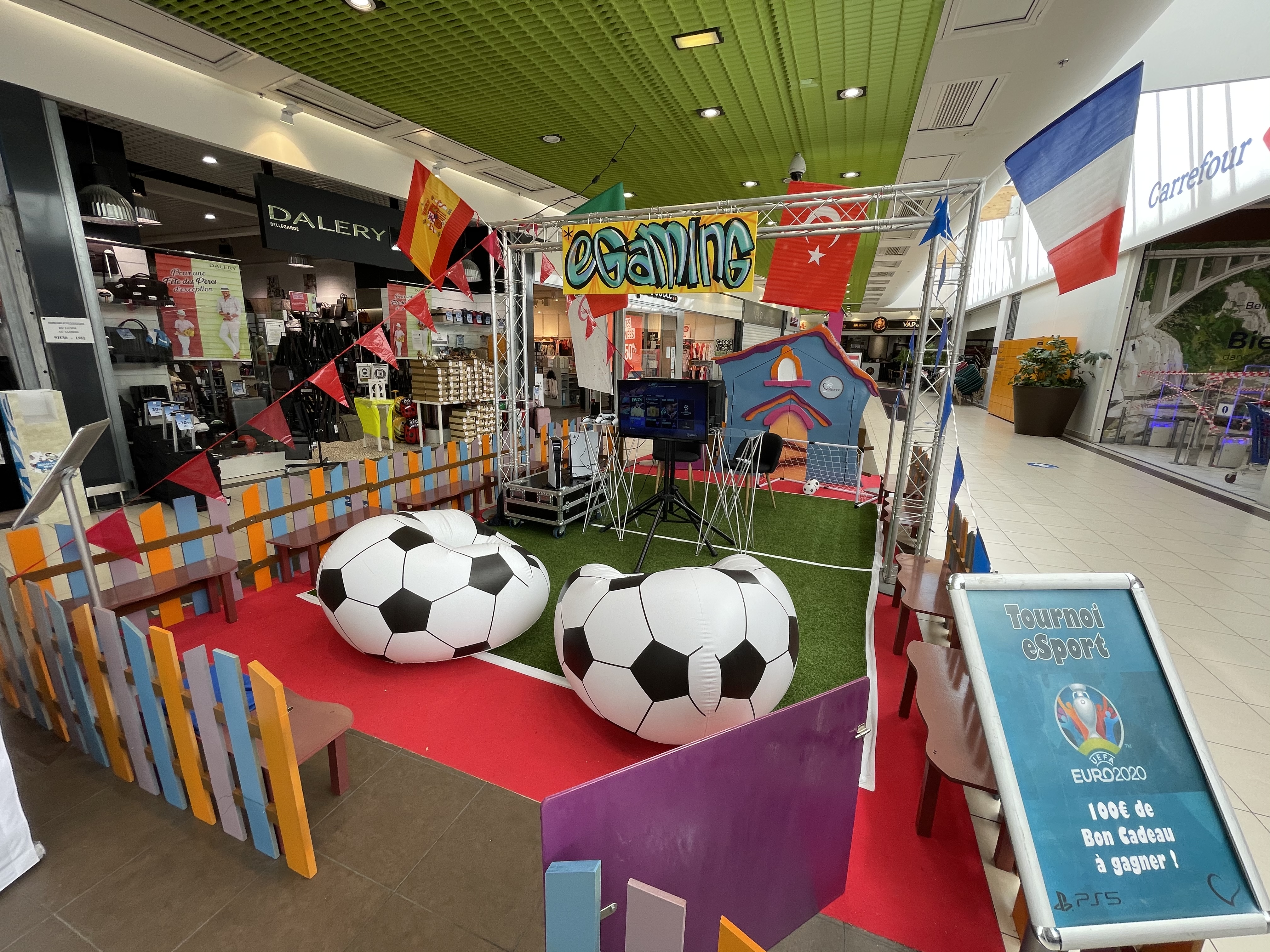
Soccer Simulator in Antwerp for corporate events that actually mobilize teams
INNOV'events (Brussels) deploys a Soccer Simulator for corporate events in Antwerp, from team moments (20–80 people) to large-scale activations (up to 500 guests with rotation). We manage delivery, installation, facilitation, scoring, and the on-site flow so your teams can focus on hosting, not troubleshooting.
Typical use cases: HR team building, internal communication launches, customer events, employer branding days, and end-of-year receptions where you need an activity that starts conversations quickly and stays controllable in timing.
Sommaire
In a corporate setting, entertainment is not a “nice extra”: it is a tool to structure interactions, reduce silo behaviour, and create a shared reference point executives can reuse in internal communication. A Soccer Simulator works because it delivers a simple challenge in under one minute, which makes participation easy even for non-sporty profiles.
Organisations in Antwerp tend to be demanding on flow, punctuality, and brand image: the activity must not block catering, must support multilingual hosting (NL/EN/FR), and must look clean and premium in photos. They also expect strong safety and compliance, especially in venues with strict technical rules and loading dock constraints.
INNOV'events operates weekly across Belgium and regularly in Antwerp for HR, communication, and executive teams. We bring a field-tested run-of-show, a trained facilitator, and the operational discipline needed to keep the activity smooth from the first kick to the last award.
Operational track record in Antwerp you can verify
10+ years of corporate event production in Belgium, with recurring deployments in Antwerp for internal events, client receptions, and public brand activations.
30–90 minutes typical setup window for a Soccer Simulator (depending on access, floor protection, and optional branding), plus a defined strike time aligned with venue curfews.
Formats validated from 20 to 500 attendees via tournament rotation, time slots, and queue management (including “fast lane” for VIPs or speakers).
1 dedicated facilitator included as standard; scalable to 2–4 staff for high throughput, multilingual hosting, or dual stations.
Standard production pack: risk assessment checklist, electrical load verification, floor protection options, and a pre-event technical sheet shared with your venue or facility manager.
Antwerp corporate references and recurring collaborations
We regularly support organisations active in Antwerp and the wider port and logistics ecosystem, as well as professional services and tech teams with multi-site staff. Many of our collaborations are multi-year because internal stakeholders change (HR, Comms, Procurement), but the operational expectations stay the same: predictable delivery, no surprises on invoice, and a calm crew on event day.
You mentioned providing company names to use as references. Share the list and we will integrate them here in a compliant way (e.g., “project delivered for X, Y, Z in Antwerp”), including what we actually delivered (format, attendee range, venue context) rather than name-dropping without substance.
On request, we can also provide anonymised case summaries (sector, headcount, objectives, constraints, what worked, what we would improve) which is usually more useful for directors comparing agencies than generic testimonials.
 Besoin d’un devis rapide ?
Nous vous envoyons une première proposition sous 24h.
Why run a Soccer Simulator in Antwerp for management goals?
Executives rarely need “more fun”; they need an event mechanism that supports engagement, attendance, and message retention without creating operational risk. A Soccer Simulator in Antwerp is effective because it is short-cycle, measurable (scores), and naturally creates micro-groups mixing departments.
HR: faster integration between teams — in a 2-hour window, you can rotate mixed teams through a quick competition, which reduces “department clustering” commonly seen at walking dinners and afterwork receptions.
Communication: a clean narrative — the simulator gives you a clear story to anchor your internal recap: participation rate, top scores, “teams of the day”, and on-brand visuals if you add a branded backdrop or scoreboard overlay.
Leadership visibility without forced speeches — directors can participate briefly (one round), generate approachable interactions, and still keep agenda discipline. This matters when you have tight run-of-show constraints (quarterly updates, safety briefings, award moments).
Predictable timing — unlike open-ended activities, a shot/round is easy to timebox. We design a throughput model (attempts per minute) so you know in advance how many participants can play per hour and how to avoid queues.
Inclusive participation — we adjust rules for mixed groups (distance, number of attempts, seated option if needed) so that the activity supports DEI objectives rather than excluding non-sporty or less mobile colleagues.
Antwerp has a strong results-driven business culture: people appreciate activities that are both light and structured. A Soccer Simulator fits well because it is competitive without being aggressive, and it provides measurable outcomes you can use in follow-up communication.
What Antwerp companies expect on event day (and why it matters)
In Antwerp, we frequently see events hosted in venues with strict access rules (time slots for deliveries, limited elevators, narrow corridors, or mandatory floor protection). This is particularly true in heritage buildings, conference centres, and locations around the city where loading docks are shared. For a Soccer Simulator, access impacts everything: setup time, equipment path, and how early we need to arrive to stay invisible during guest arrival.
Local stakeholders also tend to be detail-oriented about brand image and guest experience: signage must be bilingual (often NL/EN), staff must be comfortable addressing international visitors, and the activity must not compete with the key message (townhall content, product positioning, or employer branding). We therefore plan where the simulator sits in the room, how sound is managed, and how the facilitator handles “crowd energy” without turning the event into a sports bar atmosphere if that is not your brand.
Finally, Antwerp has a dense calendar (trade fairs, port-related events, peak hospitality periods). This affects supplier availability and venue restrictions. If the event is scheduled on a busy week, we recommend locking the slot early and validating the technical sheet with your venue as soon as possible—this is where many last-minute issues originate.
Which corporate event entertainment in Antwerp pairs well with a Soccer Simulator?
Entertainment works when it supports your event objective: networking, message retention, employer branding, or customer engagement. In Antwerp, where audiences often include international profiles, we favour concepts that are easy to understand, quick to join, and respectful of venue constraints. A Soccer Simulator is a strong anchor activity; the best results come from combining it with complementary formats that cover different guest personalities (competitive, creative, social).
Interactive animations in Antwerp
Scoreboard tournament + live ranking — ideal for townhalls or end-of-year events: you create a light competitive layer without extending the agenda. We manage rules, tie-breakers, and a short prize moment that fits in 5–10 minutes.
Team passport challenge — participants collect stamps across 3–4 micro-activities (including the simulator). This boosts circulation in the room and avoids crowding in one corner.
Commentator-style hosting (corporate tone) — a facilitator can add energy in a controlled way, using your vocabulary (values, campaign theme) rather than football clichés.
Art animations in Antwerp
Caricaturist or digital sketch artist — works well alongside the simulator because it gives a “low energy” alternative for guests who prefer conversation. It also generates take-away content for internal communication.
Photo corner with branded backdrop — positioned near the simulator to capture post-play reactions; we keep the setup clean and aligned with brand guidelines.
Innovative animations in Antwerp
Structured tasting bar (beer, chocolate, or 0% pairings) — in Antwerp, this is a reliable networking catalyst, especially for mixed internal/client audiences. We recommend controlling service pace so it doesn’t collide with the simulator’s safe operation.
Late snack station — a practical choice if your event runs after 21:00; it stabilises energy and reduces the “rush” effect at the bar, which indirectly improves safety around interactive zones.
Gourmand animations in Antwerp
Branded performance analytics — we can present results as a “skills dashboard” (accuracy, consistency) for teams, which is often appreciated by executive audiences when positioned as playful, not as HR assessment.
Hybrid participation option — for multi-site companies, we can organise a simple cross-location leaderboard where colleagues in Antwerp compete with another office on the same week, using standardised rules and a shared scoring template.
Alignment with brand image is non-negotiable: the same Soccer Simulator can feel premium or cheap depending on the surrounding set-up (lighting, signage, staff posture, and how the queue is handled). We plan the full zone—visuals, sound, and guest journey—so it supports your corporate identity in Antwerp, rather than looking like a rented gadget.
How to choose a venue type in Antwerp for a Soccer Simulator
The venue strongly influences perception and operational reliability. For a Soccer Simulator in Antwerp, we need a clear footprint, predictable power access, and a layout that keeps spectators safe while allowing catering and circulation. The best “fit” depends on your objective: internal cohesion, client hospitality, or employer branding.
| Venue type | For which objective? | Main strengths | Possible constraints |
|---|---|---|---|
Conference hotel / business venue in Antwerp | Townhall + networking with tight agenda | Reliable technical infrastructure, clear run-of-show discipline, easy addition of staging and AV | Access timing, strict noise rules, sometimes limited ceiling height in breakout areas |
Industrial/loft-style event space (city or port area) | Employer branding, internal celebration, client activation | Strong visual identity, space for branded zones, good photo/video output | Variable heating/acoustics, stricter safety perimeter planning, loading constraints depending on dock access |
Office HQ atrium or large meeting floor in Antwerp | Cost control and maximum participation | Zero guest transport, high attendance, easy alignment with internal communications | Floor protection, elevator logistics, neighbour noise considerations, require precise timing around working hours |
Site visits (or at least a structured technical call with photos, access plans, and ceiling measurements) prevent last-minute compromises. Our role is to validate feasibility early—access route, setup footprint, guest flow—and to coordinate with your venue manager so the simulator integrates cleanly into your Antwerp event.
What budget to plan for a Soccer Simulator in Antwerp
The price of a Soccer Simulator in Antwerp depends less on the “machine” and more on deployment conditions and service level. For directors, the key is to separate rental cost from production risk: staffing, timing, access complexity, branding, and throughput requirements.
Duration of operation: half-day vs evening vs full-day activation. Longer windows often require staff rotation and stricter queue management.
Attendance and throughput: 20–80 people can be managed with one station; beyond that, you may need a second station or a structured tournament format to avoid lines.
Venue access in Antwerp: city-centre access restrictions, loading dock availability, lift size, and distance from truck to setup location directly affect crew time.
Staffing level: 1 facilitator is standard; 2–4 staff improves speed, multilingual hosting, and VIP management.
Branding and communication assets: branded backdrops, score overlays, signage, and photo content creation (with usage rights) can be added if the event is customer-facing.
Safety and floor protection: protective mats, barriers, and additional perimeter marking for venues with strict requirements.
From an ROI perspective, the simulator performs when it increases participation and improves internal or external message recall. We therefore price and design it around measurable outcomes: participation rate, time-to-first-interaction, and content you can reuse. If your priority is cost control, we propose a lean configuration; if your priority is brand impact in Antwerp, we build a more visible activation with tighter production values.
Why choose an event agency in Antwerp for delivery control
Even when the concept is simple, the risk is operational: access, timing, and venue coordination. Working with an event agency in Antwerp (or an agency with strong local execution habits) improves reliability because local crews understand venue constraints, city logistics, and supplier responsiveness. For executive stakeholders, this reduces the “event day uncertainty” that often creates stress and last-minute escalations.
At INNOV'events, we combine Brussels-level production standards with regular deployments in Antwerp. Concretely, this means we anticipate access windows, build realistic schedules, and coordinate directly with your facility manager or venue technician—so your internal team is not stuck relaying technical questions during the event.
- Faster troubleshooting in case of venue constraints: we adapt layout, flow, or staffing without impacting your run-of-show.
- Better cost predictability: fewer “surprise hours” because access and strike conditions are validated early.
- Stronger alignment with local audiences: multilingual hosting and corporate tone that fits Antwerp business culture.
From an ROI perspective, the simulator performs when it increases participation and improves internal or external message recall. We therefore price and design it around measurable outcomes: participation rate, time-to-first-interaction, and content you can reuse. If your priority is cost control, we propose a lean configuration; if your priority is brand impact in Antwerp, we build a more visible activation with tighter production values.








Examples of Soccer Simulator projects delivered around Antwerp
Our Soccer Simulator deployments in and around Antwerp typically fall into three categories, each with its own operational design.
1) HR team building during a quarterly on-site. We often see a half-day agenda: business update, break, then a structured activity. The challenge is timing discipline. We run the simulator in waves (e.g., 8 teams rotating), keep briefing to under 20 seconds, and finish with a short awards moment. The HR benefit is mixed-team interaction without extending the day.
2) Client reception with brand image constraints. In these events, the simulator must look premium and stay secondary to hospitality. We position it to encourage “participation by invitation” rather than shouting for attention, and we adapt sound level and signage. We also manage VIP flow so key clients don’t queue; they get a scheduled slot and a quick photo moment if desired.
3) Large internal celebration with high participation goals. For 200–500 guests, the core topic becomes throughput and queue experience. We implement a visible but calm queue system, consider a second station, and add micro-activities nearby so waiting time feels intentional. The result is a high participation rate without bottlenecks at the bar or buffet.
Across these formats, our focus is the same: protect your brand image in Antwerp, keep the agenda on time, and ensure the activity is inclusive and safe.
Common mistakes we prevent on Antwerp Soccer Simulator events
Underestimating venue access in Antwerp: no reserved loading bay, wrong lift dimensions, or a setup area too far from unloading. This leads to delays before guests arrive.
No throughput plan: lines build up, VIPs disengage, and the activity becomes a frustration point rather than an engagement tool.
Poor placement: putting the simulator in a circulation corridor or too close to catering creates safety and service conflicts.
Mismatch with brand tone: overly “sports bar” facilitation style for a corporate audience, or visuals that clash with brand guidelines.
Ignoring inclusivity: rules that disadvantage non-sporty participants; we adapt distances and formats so everyone can join.
No contingency: no plan B for schedule compression, delayed speakers, or a room change requested by the venue.
Our role is to prevent these risks before they reach your executive sponsor. We do this with a clear technical sheet, a realistic production schedule, and on-site leadership that keeps decisions quick and calm in Antwerp.
Why Antwerp clients renew with INNOV'events
Recurring clients do not come back for “ideas”; they come back for predictability. In corporate environments, a single operational issue can damage trust internally—especially for HR and communication teams who already carry the pressure of attendance, stakeholder alignment, and reputation.
Year-over-year renewals are common when the event becomes part of a rhythm (quarterly moments, safety days, annual celebrations). We structure documentation so the next edition is easier, not a restart.
Stakeholder resilience: when HR changes or a new director takes over, we keep continuity through clear reporting, transparent costing, and a repeatable run-of-show.
Operational memory in Antwerp: we keep notes on access, venue rules, and what worked on flow, so each edition improves instead of repeating the same problems.

Loyalty is not about sentiment; it is proof that delivery standards hold under real conditions. That is what we aim to demonstrate on every Soccer Simulator project in Antwerp.
Our production process for Antwerp Soccer Simulator bookings
👉 Clarify objectives and constraints in Antwerp
We start with a short call focused on decision parameters: audience profile, agenda, venue, brand constraints, languages, and what success looks like (participation rate, networking, content for internal comms). We also identify the non-negotiables early: start/stop times, speeches, VIP moments, and any union or building rules.
👉 Define the operational design and throughput plan for Antwerp
We propose the format: free play vs tournament, number of attempts, and staffing. We map the expected throughput (participants/hour) and decide if a second station, time slots, or a passport system is needed. This is where we avoid queues and ensure the simulator supports—not disrupts—catering and networking.
👉 Validate technical feasibility with the Antwerp venue
We request access details, floor type, power availability, ceiling height, and delivery time windows. We share a technical sheet and confirm placement on the floor plan. If needed, we organise a site visit to confirm the access route and to avoid surprises with lifts, corners, or fragile surfaces.
👉 Deliver, install, and run the Soccer Simulator on event day
Our team arrives within the agreed access window, installs safely, tests the setup, and briefs your point of contact. During operation, our facilitator manages briefing, pace, and guest experience. We keep an eye on safety perimeter and coordinate with the venue if anything changes (timing, room flow, sound).
👉 Wrap-up and measurable outputs for Antwerp stakeholders
After strike, we can provide results (top scores, participation estimate) and a short debrief: what worked, what to improve next time, and any venue learnings. If you run internal comms, this gives you concrete material for a recap that feels credible to employees.
FAQ sur l'organisation Soccer Simulator à Antwerp
How much space is needed in Antwerp for a Soccer Simulator?
Plan a clear zone of around 4 x 6 m as a practical baseline, plus spectator space. Exact footprint depends on the simulator model and how strict the venue is on safety perimeter and circulation. If the venue is in central Antwerp with tight layouts, we validate the floor plan before confirming.
How many guests can play per hour in Antwerp events?
With 3 attempts per participant and a fast briefing, a single station typically handles about 40–70 participants/hour depending on the crowd and the venue flow. For 200+ guests in Antwerp, we often recommend a tournament schedule or a second station to keep queues short.
Can you run the Soccer Simulator indoors at Antwerp offices?
Yes, provided we can secure sufficient ceiling height, a stable power source, and a safe perimeter. We also check flooring (wood, polished concrete, carpet) and add protection when required. In Antwerp office buildings, the main constraint is usually access: lift size, corridor width, and delivery time restrictions.
What is the typical lead time to book in Antwerp?
For standard setups, 2–4 weeks is comfortable. For peak periods (end-of-year, major trade fair weeks, or busy Thursdays in Antwerp), we advise 4–8 weeks, especially if you need branding, multilingual staffing, or strict venue coordination.
Is the Antwerp Soccer Simulator suitable for mixed audiences?
Yes. We adjust rules to keep it inclusive (distance, number of attempts, team scoring). For mixed internal/client audiences in Antwerp, we also adapt facilitation tone and queue management so participation stays comfortable and professional, not overly competitive.
Request a quote for a Soccer Simulator in Antwerp
If you want a Soccer Simulator in Antwerp that runs on time, respects your venue constraints, and reflects well on your organisation, we should align early on objectives, agenda, and access. Share your date, venue (or shortlist), attendee range, and whether the event is internal or client-facing.
INNOV'events will come back with a clear proposal: recommended format, staffing level, timing plan, and a transparent budget structure. The earlier we validate the technical sheet and flow, the less risk you carry on event day.
INNOV'events Antwerp Agency
Justin JACOB is the manager of the INNOV'events Antwerp office. Reach out directly by email at belgique@innov-events.be or via the contact form.
Contact the Antwerp agencyToutes nos prestations & animations Antwerp, Belgique
Découvrez nos prestations événementielles
Découvrez nos animations événementielles disponibles au Belgique
- Event Hostess in Antwerp
- Escape Game in Antwerp
- MasterChef Cooking Workshop in Antwerp
- Magician in Antwerp
- Marquee Rental in Antwerp
- Color Analysis Workshop in Antwerp
- Inflatable Games in Antwerp
- Valet Parking Service in Antwerp
- Football Simulator in Antwerp
- LED Furniture Rental in Antwerp
- Light Branding in Antwerp
- Unique Dining Experience in Antwerp
- Light Painting in Antwerp
- Murder Mystery Party in Antwerp
- Prize Contest in Antwerp
- Promotional Displays (POS) in Antwerp
- Virtual Reality in Antwerp
- Molecular Gastronomy Workshop in Antwerp
- Halloween Entertainment in Antwerp
- Fireworks Show in Antwerp
- Giant Games Challenge in Antwerp
- Event Host / MC in Antwerp
- Photo Booth Animation in Antwerp
- Santa Claus Entertainment in Antwerp
- Kids Entertainment in Antwerp
- Guided Tour in Antwerp
- Urban Rally in Antwerp
- Ball Pit in Antwerp
- Flight Simulator in Antwerp
- Food Truck Rental in Antwerp
- World Record Challenge in Antwerp
- Surf Simulator in Antwerp
- Wine Casino in Antwerp
- Makeover Workshop in Antwerp
- Perfume Creation Workshop in Antwerp
- Acting Workshop in Antwerp
- CSR Activities in Antwerp
- Archery in Antwerp
- Security Staff in Antwerp
- Wine Tasting in Antwerp
- Mime Performer in Antwerp
- TV Game Show in Antwerp
- Funfair in Antwerp
- Crisis Management Workshop in Antwerp
- Crisis Negotiation Workshop in Antwerp
- Arcade Games in Antwerp
- Indoor Skydiving Simulator in Antwerp
- Ski Simulator in Antwerp
- Racing Circuit Experience in Antwerp
- Introductory Flight Experience in Antwerp
- Tasting Experience in Antwerp
- Build Your Own Foosball Workshop in Antwerp
- 2CV Rally in Antwerp
- LEGO Challenge in Antwerp
- Casino Night in Antwerp
- Interpreter / Translator in Antwerp
- Promotional Giveaways in Antwerp
- Shuttle Transport in Antwerp