Surf Simulator in Antwerp for high-energy team engagement
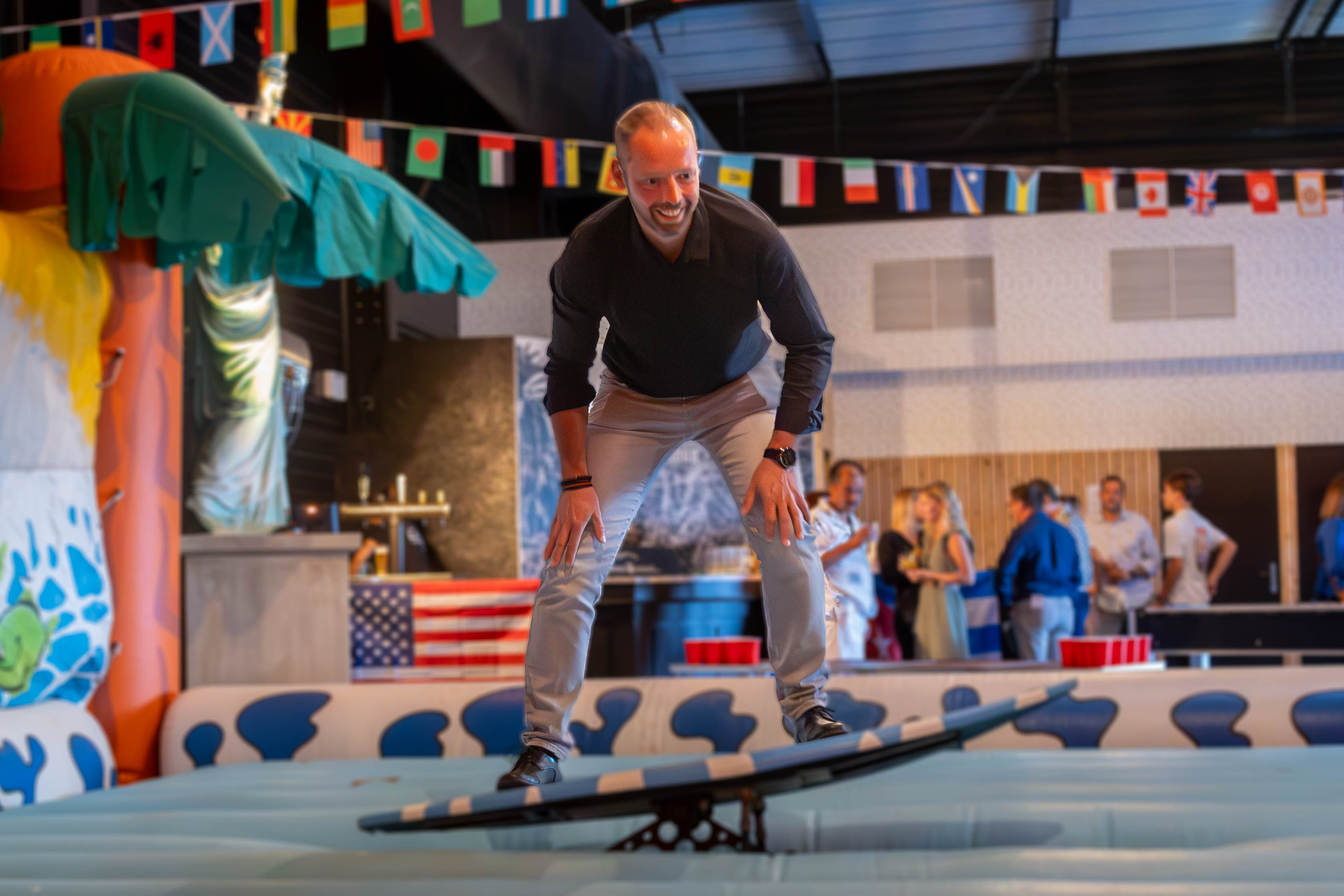
INNOV'events is a Brussels-based corporate event agency delivering a professionally operated Surf Simulator across Antwerp for internal events, client evenings and HR activations. Most projects run smoothly for 50 to 800 attendees, with controlled throughput, safety briefings and event-day staffing included. You keep control of your agenda and brand image; we handle delivery, installation, operations, and coordination with the venue.
Sommaire
In a corporate agenda, entertainment is not “nice to have”; it is a tool to structure the room, create natural conversations across silos, and keep people on site between key moments (speech, awards, product reveal). A Surf Simulator works particularly well because it is immediately understandable, visually strong, and supports short participation cycles that match event constraints.
In Antwerp, decision-makers typically expect predictable timing, polished onsite execution, and clear risk management—especially in venues where loading slots are tight and the guest mix is senior. For HR and communication teams, the priority is often to offer a fun challenge while keeping the experience inclusive for non-sporty participants and fully compliant with venue safety rules.
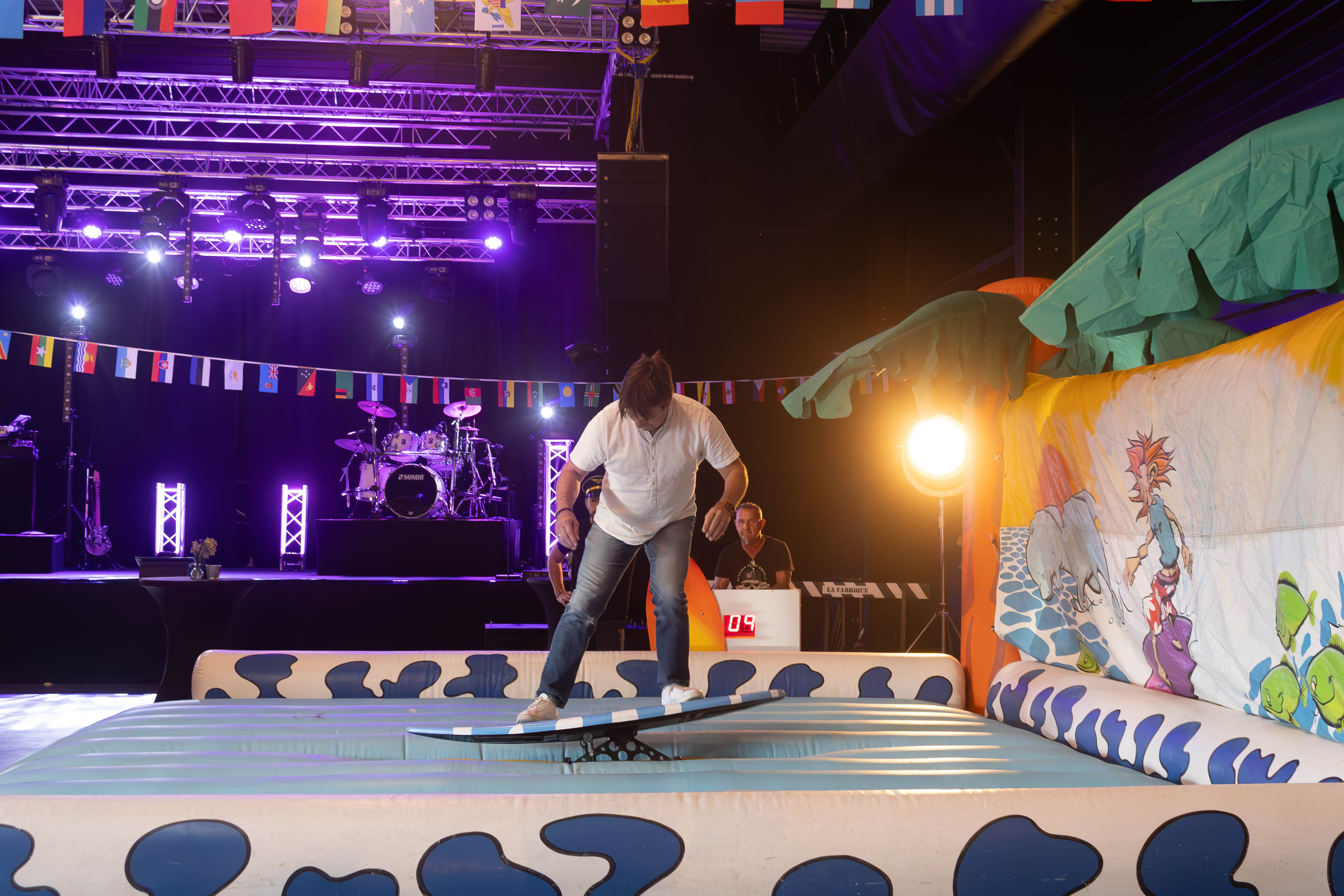
Our teams deliver corporate event entertainment in Antwerp with an operator-led approach: controlled speed settings, queue management, and a clean technical footprint. We coordinate in advance with your venue contact (power, access, ceiling height, floor protection) and integrate the activity into your run-of-show so your speakers, catering and networking do not get disrupted.
Operational numbers clients ask for in Antwerp
10+ years delivering corporate entertainment formats across Belgium, with repeat deployments in Antwerp for HR, internal comms and client events.
2 operators recommended per Surf Simulator setup (1 on controls + 1 on guest flow & safety), ensuring steady throughput without compromising risk management.
Typical throughput: 25–45 riders/hour depending on difficulty, briefing style and guest profile (team-building vs. cocktail).
Installation window: commonly 60–120 minutes on site, plus safety checks and branding placement. We plan around Antwerp venue loading restrictions.
Formats covered: 50–800 guests via single unit + structured slots, or multi-activity zones for higher volumes.
Trusted by teams operating in Antwerp
We support organizations that are active in Antwerp—from port-related industries and logistics to professional services, pharma and fast-growing tech teams. Several clients come back year after year because they want the same thing: a high-energy activity that looks great on the floor, without creating operational chaos behind the scenes.
You mentioned providing company names as references; integrate them here and we will position them correctly (e.g., “X uses the Surf Simulator in Antwerp during its annual staff evening”, “Y brings it for a client appreciation night near the city centre”). In our day-to-day, what matters most to these teams is not the concept; it is the reliability: clear call times, predictable footprint, coordinated access, and staff who can manage guests diplomatically—including executives who want a quick try without waiting in a long line.
In Antwerp specifically, recurring collaborators often ask us to align entertainment with internal policies (H&S, insurance requirements, venue constraints), and with brand rules (no noisy look, controlled signage, clean staff dress code). That is the type of delivery we are set up for.
 Besoin d’un devis rapide ?
Nous vous envoyons une première proposition sous 24h.
Why add a Surf Simulator to a corporate event in Antwerp?
A corporate event is expensive the moment you book the venue, catering and AV. The question executives ask is simple: does it create the behaviours we need—retention, cross-team connection, client proximity, or commitment to a change message? A Surf Simulator is effective when you want a visible “centre of gravity” that pulls people into one area, creates shared stories, and gives your communication team real content to capture (photos, short reels, internal newsletter).
In Antwerp, we often see two concrete drivers: (1) mixed audiences (blue collar + office, local + international) where you need a common, non-verbal activity; (2) event programmes with peaks and gaps where you must keep energy stable without forcing networking.
Stronger mingling without awkward icebreakers: people naturally talk while watching colleagues ride; it reduces “sticking with your own team” behaviour that HR often wants to break.
Controlled challenge that fits mixed seniority: the operator adjusts speed in real time; executives can do a 20–30 second ride for the photo moment, while competitive teams can push higher difficulty.
Time management for event flow: with structured mini-rounds (e.g., 2-minute slot including briefing), you keep the activity dynamic and avoid long waits that damage perception.
Content and employer branding: a surf zone provides visual proof of culture (collaboration, healthy competition) that communication teams can use internally and on social channels—without looking forced.
Reward and recognition mechanics: you can run leaderboards by department, “best wipeout” awards, or short finals before speeches—useful when you need a clear highlight moment.
This fits the pragmatic economic culture in Antwerp: people appreciate experiences that are well-run, concrete, and respectful of time—especially when the guest list includes senior leaders, key clients or partners from the port ecosystem.
What Antwerp companies typically require from event entertainment
When we deliver corporate event entertainment in Antwerp, the most common constraints are operational—not creative. Loading and access rules can be strict (time slots, specific lifts, protected floors), and several venues expect suppliers to arrive with clear documentation and to stick to planned call times. For internal events, HR often adds additional requirements: inclusive participation, safe operation, and a respectful tone (no “forced fun” or public embarrassment).
Antwerp also has a high proportion of international or bilingual environments. That affects how we run the activity: briefings must be short, clear, and comfortable in English; signage and “rules of play” should be readable at a distance; and the operator must handle different cultural comfort levels with physical challenges. In practice, we use a simple operating script (queue, posture, stop signal) and keep the queue moving with friendly but firm pacing.
Another local reality: many corporate events happen on weekdays, right after working hours. Guests arrive in waves (18:00–19:00) and leave earlier than expected if the room feels flat. A Surf Simulator in Antwerp placed near the bar or main circulation can stabilise energy during that critical first hour—provided the sound level, lighting and queue layout are planned so it does not block catering service or emergency exits.
Finally, brand image matters. Some Antwerp-based teams are comfortable with a “festival look”; others want a premium, clean setup. We adapt with neutral barrier systems, tidy cabling, and discreet staffing, and we align the activity with the event’s visual identity rather than turning the room into a playground.
What to pair with a Surf Simulator for events in Antwerp
A surf zone performs best when it is part of a coherent engagement plan: something that attracts people, something that keeps them in the room, and something that supports your message. In Antwerp, we often design a compact “activity island” that fits common venue constraints while still feeling substantial.
Interactive animations in Antwerp
Leaderboard + department challenge (Antwerp teams): we set simple scoring rules (time stayed on, style points, or a mix) and publish results on a screen near the activity. This works well for sales kick-offs and internal celebrations because it creates low-effort conversation starters.
Photo & short-video capture: one staff member captures consistent content (same angle, same framing, branded backdrop). Communication teams appreciate predictable assets rather than random phone videos.
MC micro-moments: a short, professional host can call “next riders” and announce mini-awards every 20 minutes. This increases participation without turning the evening into a noisy show.
Art animations in Antwerp
Acoustic or chill DJ set around the surf zone: in Antwerp cocktail formats, we often keep early sound levels moderate so networking remains possible, then increase energy later. The surf zone becomes a visual anchor while music sets the atmosphere.
Live illustrator / caricaturist: a second “low-intensity” activity balances the physical nature of the Surf Simulator and ensures inclusion for guests who prefer to watch rather than ride.
Innovative animations in Antwerp
Mocktail bar with timed service: pairing the activity with a fast service point avoids bar congestion. For example, a 2-hour activation window with a small menu keeps operations smooth.
Compact dessert station: in many Antwerp venues, late-night sweet bites placed near the activity increase dwell time and keep guests from leaving right after dinner.
Gourmand animations in Antwerp
Brand-aligned set dressing: rather than generic “tropical”, we can align colours and backdrop with your campaign visuals. In practice, that means a clean branded wall, controlled signage, and neutral safety barriers—so the activation looks corporate, not like a funfair.
Hybrid engagement for multi-site teams: for Antwerp organisations with colleagues in Brussels, Ghent or abroad, we can create a short video recap package the same night (highlights + award moment) for internal channels.
The key is alignment: the entertainment must support your brand image and event objective. We will recommend a configuration that matches your guest profile in Antwerp—from a premium client evening (clean look, lower noise, short VIP rides) to a staff party (higher energy, structured competition, stronger MC role).
Which Antwerp venues work best for a Surf Simulator setup?
The venue determines whether the activity feels premium and whether it runs smoothly. A Surf Simulator needs a clear footprint, safe spectator distance, and an access route that can handle delivery and installation without last-minute improvisation. In Antwerp, we pay particular attention to loading schedules and floor protection, because these are often the sources of hidden costs or delays.
| Venue type | For which objective? | Main strengths | Possible constraints |
|---|---|---|---|
Industrial or port-adjacent event halls (Antwerp region) | Large staff events, family days, high guest volume formats | Easy access for trucks, generous ceiling height, strong power capacity, natural “action” setting that fits a surf zone | Acoustics can be harsh; requires good zoning for catering and speeches; guest comfort needs attention (heating, signage) |
Hotels & conference venues in Antwerp | Client evenings, premium internal events, leadership gatherings | Professional onsite teams, clear safety procedures, good integration with catering and AV | Loading and timing restrictions; floor protection mandatory; footprint may require careful queue design |
Converted warehouses / creative spaces in Antwerp | Employer branding events, product launches, modern culture-driven formats | Strong aesthetic impact, flexible layouts, good for content creation and branded backdrops | Access routes can be narrow; power distribution sometimes limited; noise and neighbourhood constraints may apply |
We strongly recommend a short technical check (photos + measurements at minimum). In Antwerp, a 15-minute site review often prevents the classic issues: blocked loading dock, insufficient power, or a layout where the queue interferes with service staff. When needed, we join a site visit and translate venue constraints into a concrete floor plan that works on event day.
What does a Surf Simulator cost in Antwerp?
Pricing for a Surf Simulator in Antwerp is driven by operational reality: duration, staffing, transport and venue complexity. Two quotes can look similar but hide different levels of support (e.g., number of operators, safety perimeter, overtime policy, or what happens if the venue delays loading). We prefer to quote transparently so you can compare suppliers correctly.
Rental duration and schedule: a 2–3 hour cocktail activation is priced differently from a full evening with pauses for speeches and dinner. Longer windows often require additional staffing rotations.
Guest volume and expected participation: a 60-person leadership event needs a premium, low-wait experience; a 600-person staff party needs strict throughput management. The operating model changes accordingly.
Number of operators and queue control: for corporate settings, 2 staff is typically the baseline for safety and flow; some venues or high-volume formats benefit from an extra host or brand ambassador.
Venue access in Antwerp: tight loading windows, long push distances, lift dependency or strict supplier rules can add time and cost. We check this early to avoid surprise overtime.
Branding and event integration: branded backdrops, leaderboards, MC support, or content capture can be added in a controlled way, depending on your communication objectives.
Risk & compliance: documentation requests, insurance confirmations, or venue-specific safety checks can affect prep time—particularly for corporate venues with strict procurement processes.
From an ROI perspective, the question is whether the activation increases time-on-site, participation and internal content value. If your HR goal is engagement or your communication goal is shareable proof of culture, a well-run Surf Simulator often outperforms passive entertainment because it produces visible participation, not just consumption.
Why book a Surf Simulator through an Antwerp event agency?
When you are accountable for an event in Antwerp, the operational risk is usually not the idea—it is the last 10%: access, timing, venue rules, and how suppliers behave under pressure. Working with an agency that understands the local venue ecosystem and supplier realities reduces that risk significantly.
At INNOV'events, we coordinate entertainment as part of the full event machine: run-of-show, AV, catering rhythm, VIP timing, and safety. If you are comparing providers, ask who owns the “grey zones”: who talks to the venue about loading, who adjusts the schedule when your CEO speech runs late, and who ensures the activity does not disturb the room’s key moments.
If you need broader support beyond this activation, our Antwerp coverage is anchored through our network and on-the-ground coordination as an event agency in Antwerp for corporate formats.
- Fewer surprises on the day: we anticipate Antwerp access constraints and build realistic call times and buffers.
- One accountable owner: for HR and communication teams, it reduces internal coordination load—especially when multiple suppliers are involved.
- Brand-safe delivery: staff briefing, dress code, signage discipline, noise management and guest handling aligned with your corporate standards.
- Better guest experience: queue design and operator pacing adapted to your audience (executive-heavy vs. staff party).
From an ROI perspective, the question is whether the activation increases time-on-site, participation and internal content value. If your HR goal is engagement or your communication goal is shareable proof of culture, a well-run Surf Simulator often outperforms passive entertainment because it produces visible participation, not just consumption.




Examples of Surf Simulator formats we deliver in Antwerp
Leadership & client evenings (80–150 guests): We often deploy the Surf Simulator as a controlled “signature moment” rather than a continuous competition. Typical setup: discreet barriers, a clean branded backdrop, and a VIP-friendly operating mode where rides are short and photo-focused. The objective is to create a premium talking point without turning the room into a sports hall. We schedule micro-windows between courses, and we pause instantly for speeches to protect the programme.
Staff parties (250–800 guests): Here, throughput and flow are the priority. We implement clear rules (one attempt, then back to the queue unless the line is short), a visible timer, and a staff member dedicated to queue management. In Antwerp, we often see arrival waves; we open the activity early to absorb energy, then run a “finale” later to keep people engaged until the end.
Employer branding / recruitment activations: For teams hiring in the Antwerp market, we position the surf zone as a “culture proof point” and support comms with consistent content capture. The activation becomes a backdrop for interviews, internal testimonials, or a short highlight reel. The key is keeping the setup professional so it complements your employer brand rather than looking improvised.
Safety-first corporate environments: Some organisations—especially industrial or regulated sectors—need stricter rules: mandatory briefing, conservative speed caps, defined spectator distance, and strict stop protocols. We are comfortable with those constraints and adapt the operating model so compliance does not kill participation.
Common pitfalls with Surf Simulator rentals in Antwerp (and how we avoid them)
Underestimating space and queue footprint: the attraction itself is not the only footprint—spectators and waiting lines matter. We plan a practical perimeter so the bar, buffet and emergency routes remain clear.
Wrong placement in the room: placed too far from circulation, participation drops; placed at a bottleneck, it annoys guests and venue staff. We propose placement based on how people actually move in Antwerp venues.
Difficulty set too high: if early riders fall immediately, participation collapses. We start at an accessible level and increase progressively based on audience confidence.
No clear operating rules: without a queue policy and ride timing, the activity gets hijacked by a few participants. We use simple, enforceable rules that feel fair.
Not integrating with the run-of-show: entertainment that competes with speeches or awards damages your message. We plan opening/closing windows and coordinate with your AV lead.
Last-minute venue compliance issues: access times, floor protection, power confirmation—these are frequent causes of delays. We confirm technical points early and document them in a short production sheet.
Our role is to remove operational uncertainty: anticipate constraints, brief the right people, and run the activity in a way that protects safety, timing and brand image in Antwerp.
Why Antwerp clients rebook corporate entertainment with us
Rebooking happens when the internal project team feels protected: procurement gets clear documentation, HR sees inclusive participation, communication gets usable content, and management sees a well-paced event that respects time. That is what we aim to deliver with every Surf Simulator deployment.
In practice, clients come back because we remember what matters in their organisation: where the venue is strict, how their leadership likes to show up, what their risk tolerance is, and what “good” looks like for their employer brand.
Typical rebook drivers: predictable call times, consistent staffing quality, and fast resolution when the programme changes.
Most frequent feedback: “The operator kept it safe without killing the vibe,” and “The queue never became a problem.”
Planning comfort: once the Antwerp venue’s constraints are mapped, year-2 preparation is faster and more cost-efficient.

Loyalty is not about hype; it is proof that the activation performed under real event conditions—tight schedules, senior guests, and the pressure of the day.
Our delivery process for Antwerp corporate events
👉 Step 1 (Antwerp) — Brief and objective framing
We start with a 15–30 minute call to clarify your objective (HR engagement, client proximity, employer branding), guest profile, and success criteria. We also confirm practical constraints: date, schedule, venue type in Antwerp, and any internal compliance requirements (H&S, insurance, supplier onboarding).
Outcome: a clear recommendation on whether a Surf Simulator is the right format and what operating model fits your audience (open play vs. timed slots vs. competition).
👉 Step 2 (Antwerp) — Technical validation and layout
We validate access route, loading schedule, power, ceiling height, and floor protection needs. If the venue is complex, we request photos/videos or join a site visit. We propose a practical placement plan: where the unit sits, where the queue goes, and how to protect catering and circulation.
Outcome: fewer surprises and a supplier plan that the venue can approve.
👉 Step 3 (Antwerp) — Quote and production sheet you can compare
You receive a clear quote listing what is included: delivery, installation, operation staffing, timing, and options (branding, leaderboard, MC). We also specify assumptions (loading access, power availability) and how overtime is handled.
Outcome: procurement-friendly documentation and transparent comparison versus other suppliers.
👉 Step 4 (Antwerp) — Event-day installation and safety checks
Our team arrives within the agreed call time, installs the Surf Simulator, secures cables, sets the safety perimeter and performs functional tests. We brief your event lead and venue contact on stop procedures and operating rhythm.
Outcome: a controlled, professional setup that does not disrupt other suppliers.
👉 Step 5 (Antwerp) — Operation, guest flow and programme coordination
During the event we manage briefings, speed settings, queue fairness and pauses aligned with your run-of-show. If the schedule slips (late speeches, delayed dinner), we adapt without compromising safety or creating a negative guest experience.
Outcome: stable engagement and predictable event flow.
👉 Step 6 (Antwerp) — Dismantle and post-event debrief
We dismantle within the agreed time window and respect venue rules. When useful, we debrief with your team: participation level, what worked, and what to adjust for the next edition in Antwerp.
Outcome: continuous improvement and smoother delivery for repeat events.
FAQ sur l'organisation Surf Simulator à Antwerp
How much space is needed for a Surf Simulator in Antwerp?
Plan roughly 6 x 6 m for the attraction itself, plus a practical queue and spectator zone. For corporate events in Antwerp, we typically recommend reserving 40–60 m² total so circulation and catering remain comfortable.
How many people per hour can ride in Antwerp events?
In most corporate contexts, expect 25–45 riders/hour. The range depends on briefing length, how fast guests step on/off, and difficulty level. We can increase throughput with stricter slot timing and a dedicated queue manager.
Is a Surf Simulator safe for corporate audiences in Antwerp?
Yes, when it is operator-led with speed control, a defined safety perimeter and a short briefing. We adapt settings to your audience (executives vs. staff party) and stop immediately if posture or behaviour becomes unsafe.
What power requirements should Antwerp venues plan for?
Most setups require a standard 230V supply on a dedicated circuit when possible. The exact requirement depends on the unit and additional options (screens, lighting). We confirm this during technical validation and share it with your Antwerp venue contact.
How far in advance should we book in Antwerp?
For weekday events, 3–6 weeks can work if the venue is straightforward. For peak season (September–December) or venues with strict supplier onboarding, aim for 6–10 weeks to secure slots and complete compliance checks without rushing.
Request a Surf Simulator quote in Antwerp with a clear operating plan
If you are planning an internal event, client evening or employer branding activation in Antwerp, we will propose a Surf Simulator setup that is realistic for your venue and schedule—staffing, safety perimeter, throughput and integration with speeches/catering included.
Send us your date, venue (or shortlist), estimated headcount and timing constraints. We will revert with a clear recommendation and a transparent quote—typically within 24 hours on business days—so you can compare options confidently and move forward early enough to secure the best event-day conditions.
INNOV'events Antwerp Agency
Justin JACOB is the manager of the INNOV'events Antwerp office. Reach out directly by email at belgique@innov-events.be or via the contact form.
Contact the Antwerp agencyToutes nos prestations & animations Antwerp, Belgique
Découvrez nos prestations événementielles
Découvrez nos animations événementielles disponibles au Belgique
- Event Hostess in Antwerp
- Escape Game in Antwerp
- MasterChef Cooking Workshop in Antwerp
- Magician in Antwerp
- Marquee Rental in Antwerp
- Color Analysis Workshop in Antwerp
- Inflatable Games in Antwerp
- Valet Parking Service in Antwerp
- Football Simulator in Antwerp
- LED Furniture Rental in Antwerp
- Light Branding in Antwerp
- Unique Dining Experience in Antwerp
- Light Painting in Antwerp
- Murder Mystery Party in Antwerp
- Prize Contest in Antwerp
- Promotional Displays (POS) in Antwerp
- Virtual Reality in Antwerp
- Molecular Gastronomy Workshop in Antwerp
- Halloween Entertainment in Antwerp
- Fireworks Show in Antwerp
- Giant Games Challenge in Antwerp
- Event Host / MC in Antwerp
- Photo Booth Animation in Antwerp
- Santa Claus Entertainment in Antwerp
- Kids Entertainment in Antwerp
- Guided Tour in Antwerp
- Urban Rally in Antwerp
- Ball Pit in Antwerp
- Flight Simulator in Antwerp
- Food Truck Rental in Antwerp
- World Record Challenge in Antwerp
- Surf Simulator in Antwerp
- Wine Casino in Antwerp
- Makeover Workshop in Antwerp
- Perfume Creation Workshop in Antwerp
- Acting Workshop in Antwerp
- CSR Activities in Antwerp
- Archery in Antwerp
- Security Staff in Antwerp
- Wine Tasting in Antwerp
- Mime Performer in Antwerp
- TV Game Show in Antwerp
- Funfair in Antwerp
- Crisis Management Workshop in Antwerp
- Crisis Negotiation Workshop in Antwerp
- Arcade Games in Antwerp
- Indoor Skydiving Simulator in Antwerp
- Ski Simulator in Antwerp
- Racing Circuit Experience in Antwerp
- Introductory Flight Experience in Antwerp
- Tasting Experience in Antwerp
- Build Your Own Foosball Workshop in Antwerp
- 2CV Rally in Antwerp
- LEGO Challenge in Antwerp
- Casino Night in Antwerp
- Interpreter / Translator in Antwerp
- Promotional Giveaways in Antwerp
- Shuttle Transport in Antwerp