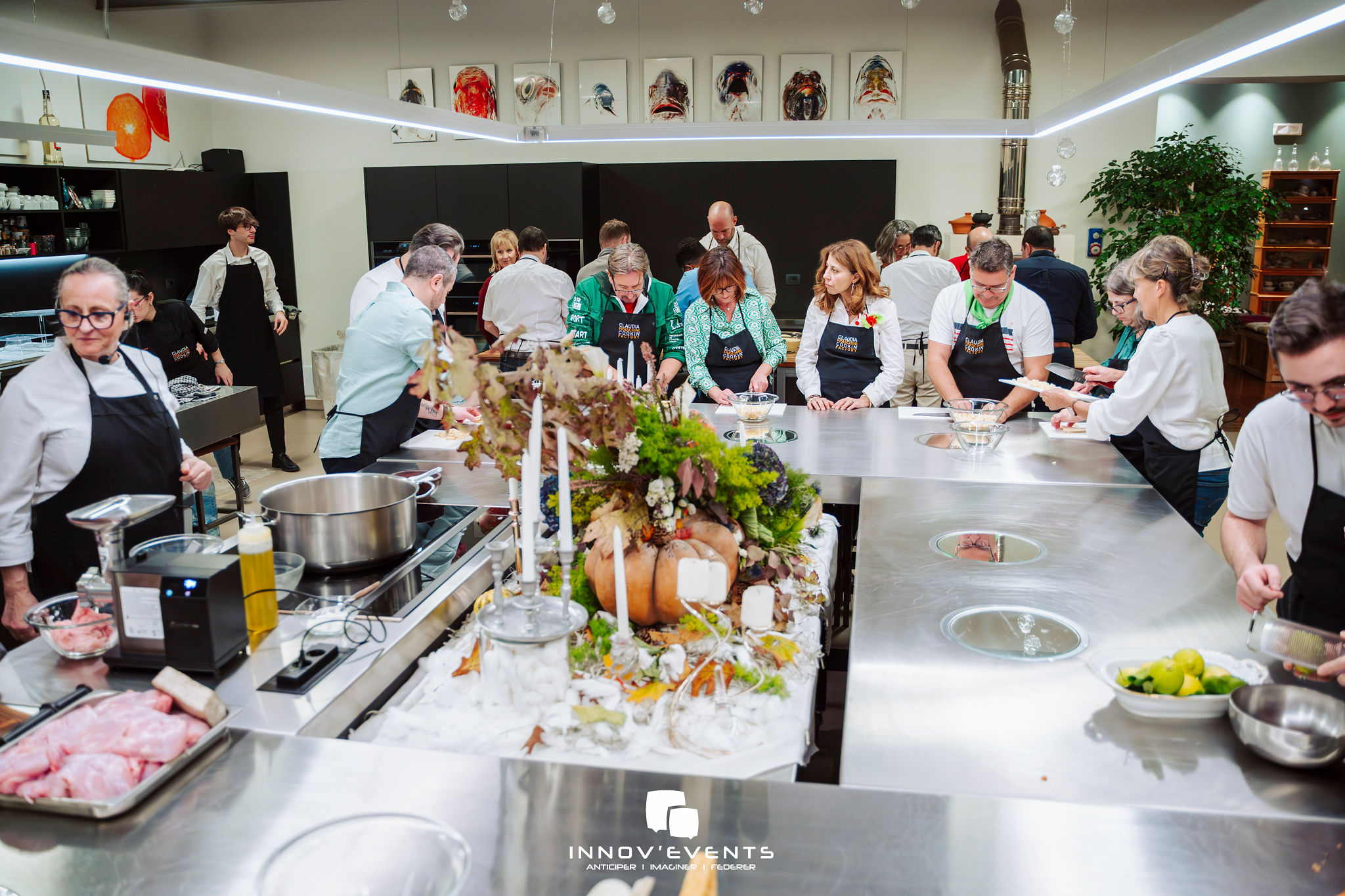
Molecular Gastronomy Workshop in Liege for teams who need measurable cohesion
INNOV'events is a Brussels-based event agency delivering Molecular Gastronomy Workshop formats in Liege for executive committees, HR and communication teams, typically from 10 to 200 participants. We manage the operational chain: venue selection, chef/science facilitators, food safety, timing, AV, and on-site coordination.
The result is a structured, hands-on workshop that creates collaboration and talking points without hijacking your agenda—ideal for offsites, leadership days, client moments, or internal culture programs.
Sommaire
In a corporate agenda, entertainment is not a “nice extra”: it is a tool to shift team dynamics. A Molecular Gastronomy Workshop creates immediate collaboration under constraints (time, technique, precision)—exactly the type of pressure executives want teams to navigate calmly.
In Liege, organizations typically expect pragmatism: clear timing, smooth logistics, bilingual facilitation when needed, and an activity that fits within a meeting day without creating operational chaos. The workshop must be engaging, but also respectful of safety and brand image.
We bring field-proven methods from national corporate events and adapt them to local realities: access and loading in the city center, venue constraints around the Meuse, and suppliers who can deliver reliably on weekdays or after working hours.
Key delivery figures for Liege decision-makers
10–200 participants per session, with scalable facilitation teams (1 lead chef + assistants per 25–30 guests).
60–150 minutes typical workshop duration, designed to fit between plenary sessions, dinners, or after-work moments.
2 to 6 tasting “stations” depending on objectives (team mixing, competitive format, or guided discovery).
48-hour operational readiness possible for simple setups in Liege (subject to venue availability and dietary constraints).
100% compliance focus: allergen mapping, temperature control, and a documented run-of-show shared with HR/Comms before event day.
Local delivery in Liege with repeat corporate partners
We regularly support companies and institutions around Liege and the wider province, with several teams renewing formats year after year because the operational standard stays consistent (briefing discipline, timing, safety, and on-site coordination).
To keep this page accurate, we only cite client names when they have been explicitly approved for publication. If you share your sector (industry, public sector, pharma/health, services, education) we can provide relevant, comparable case examples during the call—without oversharing and without generic “big logo” name-dropping.
In practice, our references in the area are often HR-driven: onboarding cohorts, leadership programs, and internal communication milestones where the activity must support a message (culture, cross-site collaboration, change management) and not compete with it.
 Besoin d’un devis rapide ?
Nous vous envoyons une première proposition sous 24h.
Why book a Molecular Gastronomy Workshop in Liege for your teams
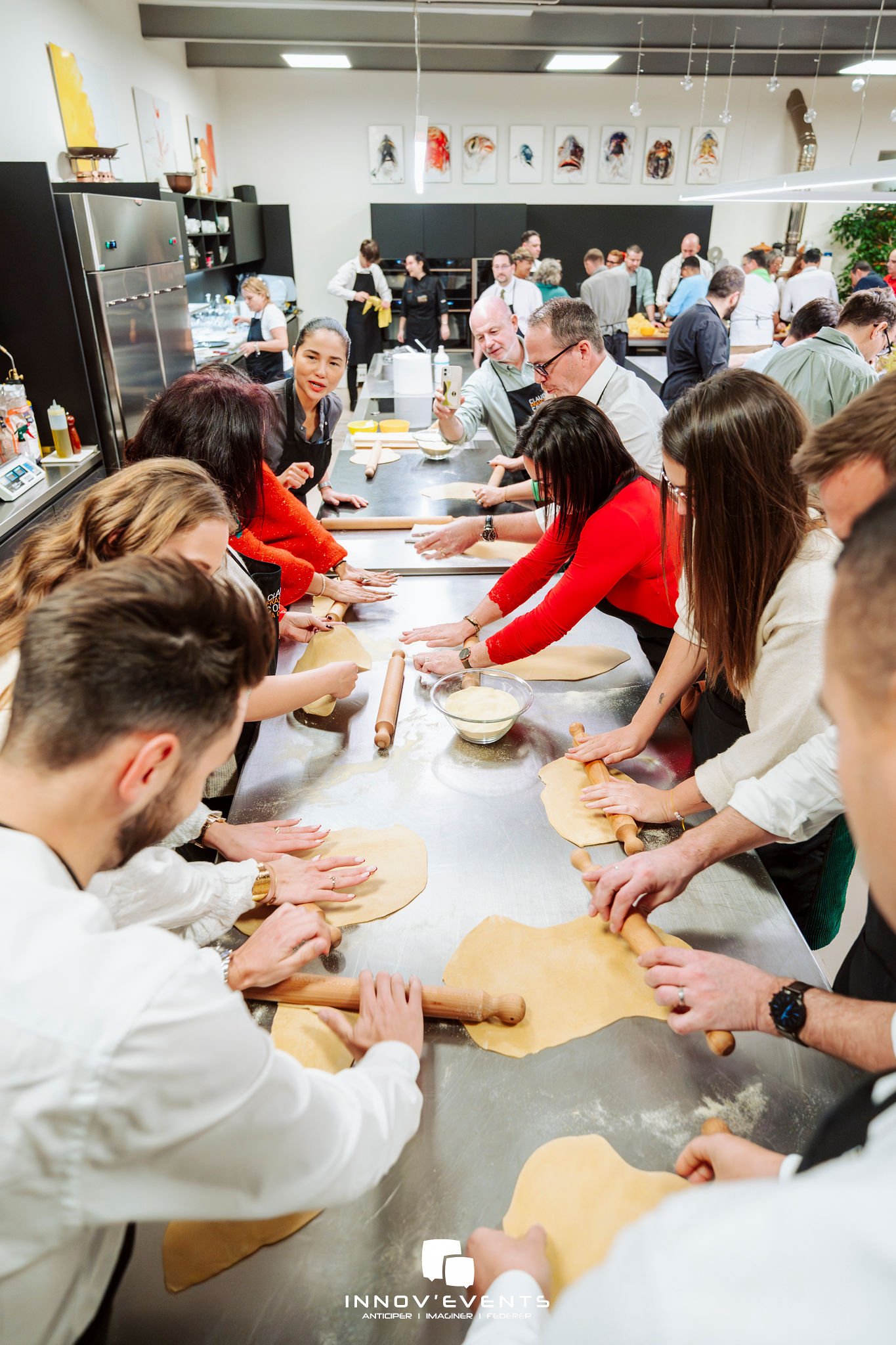
A Molecular Gastronomy Workshop in Liege works well for corporate audiences because it blends creativity with rigor. You get a format where participants must follow a protocol, test, iterate, and present results—very close to how teams operate in project environments, without turning the event into a classroom.
Executives appreciate it because the learning is visible: roles emerge quickly (planner, quality controller, presenter), and collaboration issues surface in a safe context. HR and communication teams appreciate it because the narrative is easy to document (photos, short videos, “before/after” plating, team presentations) while still being on-brand and controlled.
Cross-team collaboration under time pressure: groups must synchronize steps (foams, spherification, gels) and manage dependencies—useful for teams struggling with handovers between departments.
Structured creativity: participants learn that innovation requires method (measurement, temperature, sequence). This mirrors real corporate innovation constraints more credibly than purely playful activities.
Inclusive engagement: we design roles so non-cooks can contribute (process, plating, storytelling, quality checks). This matters in mixed groups (finance, legal, operations) where “cooking” alone could exclude some profiles.
Executive-friendly timing: a well-designed workshop delivers energy in 90 minutes and can be positioned before a dinner, after a plenary, or as a break between strategic sessions without derailing the agenda.
Brand-safe experience: the activity feels premium and technical, without the risk of “party entertainment” that can look off-tone for leadership or client-facing events.
Liege has a strong culture of engineering, logistics, and pragmatic execution. This is exactly why molecular gastronomy resonates locally: it’s culinary creativity supported by process, precision, and teamwork—values many organizations in the region recognize immediately.
What corporate teams in Liege expect from this format
On paper, a Molecular Gastronomy Workshop looks simple: a chef, some tools, a tasting moment. In the field, corporate expectations in Liege are specific, and they are often shaped by operational realities:
- Predictable timing: leadership days are dense. We build a minute-by-minute run sheet (briefing, station rotation, production, plating, tasting, wrap-up) and we staff accordingly to protect the schedule.
- Venue constraints: in the city center, access windows, loading, and noise rules are real. In corporate sites or industrial zones, the challenge is often finding suitable water points, power distribution, and adequate ventilation.
- Multilingual context: many groups include French speakers, Dutch speakers, and international colleagues. We can facilitate in English and align terminology in advance so the workshop stays fluid.
- Food safety and reputational risk: HR and Comms teams want zero surprises. We prepare allergen lists, label ingredients, and avoid risky “improvised” elements. If alcohol is involved (pairing), quantities and serving rules are controlled.
- Professional image: companies in Liege often host clients, partners, or candidates on the same day. The setup must look clean and intentional (stations, signage, aprons, waste management), not like a chaotic kitchen.
Our job is to translate these expectations into an operational plan that your internal stakeholders can validate quickly—especially when several departments must sign off (Facilities, HSE, Procurement, Legal, Communications).
Which corporate event entertainment in Liege pairs well with the workshop
A Molecular Gastronomy Workshop can stand alone, but it also integrates well into a broader agenda—especially in Liege where many companies combine strategy sessions with a social moment. The key is to keep coherence: entertainment should reinforce the tone (precision, innovation, collaboration) rather than dilute it.
Interactive animations in Liege
Team challenge format (scored): teams deliver 3 items (texture, taste balance, presentation). Jury can be executives or invited guests. Works well for 30–120 people with clear timeboxing.
Ingredient constraint roulette: each group draws a constraint (local ingredient, color palette, allergen-free). This is effective for change-management themes: same goal, different constraints.
Live voting via QR: participants vote for “best technique”, “best story”, “best plating”. Useful for communication teams needing engagement data and simple reporting.
Art animations in Liege
Sound design and lighting cues: subtle staging (not nightclub) can make the workshop feel executive-level. We coordinate with venue AV to avoid interfering with speech intelligibility.
Micro-storytelling by the facilitator: short, controlled narratives about technique and origin (e.g., why emulsions work) keep attention without turning it into a lecture.
Innovative animations in Liege
Local pairing focus: integrating regional products (e.g., seasonal fruits, syrups, or non-alcoholic pairings) reinforces a sense of place in Liege without falling into cliché.
Executive-friendly tasting sequence: 3–5 bites maximum, paced. This avoids “overfeeding” before a seated dinner and keeps the experience crisp.
Allergen-aware menu engineering: we can build a parallel station for gluten-free or lactose-free variants when HR needs inclusivity for a mixed population.
Gourmand animations in Liege
Innovation lab angle: link the techniques to your innovation culture (test-and-learn, quality gates). Especially relevant for industrial, logistics, and tech organizations around Liege.
Mini content studio: a controlled photo corner for plating shots. Communications teams get ready-to-use internal content without disrupting flow.
Optional keynote hook: a 10-minute “science of texture” intro can be used to open a leadership day, then move straight into hands-on practice.
The strongest results come when the activity aligns with your brand image and event tone: a listed company won’t run the same intensity as a fast-scaling startup, and a client event won’t tolerate the same mess level as an internal team-building. We help you decide what fits—and what to avoid—so the entertainment supports your message in Liege.
Where to host a Molecular Gastronomy Workshop in Liege
The venue determines perception and feasibility. For a Molecular Gastronomy Workshop in Liege, we look beyond style: water points, refrigeration, power, ventilation, loading access, and whether the room layout allows safe circulation. A beautiful space that cannot support temperature control will undermine the results.
| Venue type | For which objective? | Main strengths | Possible constraints |
|---|---|---|---|
| Hotel conference room in Liege | Leadership day + workshop between plenary sessions | On-site catering support, predictable AV, easy coordination with accommodation | Limited access windows for loading; restrictions on certain equipment; need to protect carpets/furniture |
| Industrial-chic event space (warehouse/loft style) | Team cohesion with a “hands-on innovation” atmosphere | Space for multiple stations, easier circulation, strong visual identity for Comms | Power distribution planning; temperature management; additional staffing for setup/cleanup |
| Corporate site (canteen or training center) | Cost control and maximum attendance on a weekday | Known security process, existing kitchen infrastructure, minimal travel time for staff | HSE rules, limited external supplier access, room may require staging to feel executive-level |
We strongly recommend a site visit (or at least a technical walkthrough call with photos and measurements). In Liege, small access constraints (stairs, narrow doors, limited parking near the venue) can change the setup plan—and you want those decisions made before event day, not during it.
How to budget a Molecular Gastronomy Workshop in Liege (4000)
Pricing depends on parameters that directly affect staffing, equipment duplication, and safety. For executive and HR stakeholders, the key is not to chase the lowest line-item but to buy predictability: the workshop must run on time, deliver consistent results, and remain brand-safe in Liege venues.
Group size and facilitation ratio: for 10–25 people, 1 lead chef + 1 assistant is often sufficient; beyond that, you need extra facilitators to avoid bottlenecks.
Number of stations and recipe complexity: spherification, foams, gels, and temperature-controlled elements require more tools and prep than a simple plating workshop.
Venue equipment: if the venue lacks refrigeration, adequate sinks, or power, we bring additional infrastructure (cooling boxes, power management, protective flooring).
Timing constraints: a workshop inserted into a tight agenda may require additional staff to speed up setup/strike and protect your meeting flow.
Dietary and allergen requirements: higher inclusivity (vegan, gluten-free, lactose-free) increases ingredient sourcing complexity and labeling needs.
Comms deliverables: if you need controlled content capture, signage, or branded elements (aprons, station totems), we include design/production and approval cycles.
From an ROI perspective, the workshop earns its cost when it supports a business objective: faster integration after a merger, improved cross-site collaboration, or a stronger employer-brand moment during recruitment. We help you define success criteria up front so the budget is defensible internally.
Why choose an event agency in Liege for this workshop
For corporate stakeholders, “local” is not a slogan—it’s risk management. When we deliver a Molecular Gastronomy Workshop in Liege, local execution knowledge reduces friction: supplier responsiveness, venue rules, access constraints, and the ability to intervene quickly if something changes.
As INNOV'events (based in Brussels), we work with reliable partners in the region and we operate with a structured production method. When you want a partner that knows the territory and can coordinate every moving part, working with an event agency in Liege ecosystem is a practical advantage for procurement, compliance, and day-of responsiveness.
- Shorter reaction time for last-minute adjustments (participant count changes, room switch, schedule compression).
- Venue and supplier familiarity to anticipate constraints: loading docks, elevator sizes, security processes, and local staffing availability.
- More reliable logistics with reduced transport risk for fragile equipment and temperature-sensitive ingredients.
- Better cost control by avoiding unnecessary travel, idle time, and redundant rentals.
From an ROI perspective, the workshop earns its cost when it supports a business objective: faster integration after a merger, improved cross-site collaboration, or a stronger employer-brand moment during recruitment. We help you define success criteria up front so the budget is defensible internally.





Examples of corporate formats delivered around Liege
In the field, companies rarely ask for “an activity”; they ask for an outcome: integrate new managers, re-energize a site, host clients without taking reputational risks, or create an internal narrative after a tough quarter. We design Molecular Gastronomy Workshop formats accordingly and adapt to the realities of Liege venues and corporate schedules.
- Leadership offsite module: 90-minute workshop between two strategic blocks, with a strict start/stop time, executive-friendly pacing, and a debrief linking technique discipline to decision-making under uncertainty.
- HR onboarding cohort: rotating stations built to force cross-team mixing (no “sit with your department” dynamic), with inclusive roles for non-cooks and a controlled photo set for internal communications.
- Client hospitality pre-dinner: shorter, more elegant tasting-driven session (3 bites), minimal mess, high facilitation presence to ensure guests are guided rather than left to improvise.
- Multi-site team day: bilingual facilitation and clear signage to avoid confusion; additional assistants to protect flow when participants have different comfort levels with culinary tasks.
What these projects have in common is operational rigor: clear responsibilities, tested recipes for the specific room conditions, and a production plan that facilities and HSE can validate before we arrive on site.
What can go wrong in Liege and how we prevent it
Underestimating equipment duplication: one siphon for 40 people creates waiting lines and disengagement. We calculate tool-to-participant ratios and bring redundancy.
Ignoring venue technical limits: insufficient power, no nearby water points, or inadequate refrigeration affects both results and safety. We run a technical checklist and adapt the menu to the site.
Allergen management done too late: collecting dietary constraints the week of the event creates risk. We request inputs early and provide an allergen map for HR validation.
Overcomplicating the science: too many techniques in one session leads to frustration and uneven outcomes. We choose a coherent sequence with quick wins, then one “hero” technique.
No run-of-show ownership: when nobody owns timing, meetings spill over and the workshop starts late. We coordinate with your project lead and protect the critical path.
Cleanup underestimated: a messy room damages the venue relationship and your image. We plan cleaning resources, waste handling, and a clear handback time.
Our role is to de-risk delivery: anticipate constraints typical in Liege, lock decisions early, and run the day with the same discipline you expect from your internal operations teams.
Why teams in Liege rebook year after year
Repeat business in corporate events is rarely emotional—it’s operational. Clients return when an agency protects their internal workload, communicates clearly, and delivers a stable result under real-world constraints. With workshops involving food and technique, this reliability matters even more.
Single point of contact from scoping to on-site delivery to reduce stakeholder noise (HR, Comms, Facilities, Procurement).
One validated run-of-show shared in advance, with decision checkpoints (menu, layout, staffing, safety, branding).
Documented safety approach: allergen tracking, labeling, and cold chain considerations presented in a way that non-specialists can approve.
Consistent participant experience: stations are designed to avoid idle time, and facilitators are trained to keep groups moving without rushing them.

Loyalty is a measurable proxy for quality: it means fewer surprises, less internal stress, and an event day that looks controlled in front of executives and guests in Liege.
How we deliver your Molecular Gastronomy Workshop in Liege
👉 Scoping call focused on outcomes in Liege
We start with a short, structured call with HR/Comms and the event owner. We confirm audience profile (executives, mixed teams, clients), desired tone (formal vs relaxed), language needs, and constraints (timing, venue shortlist, dietary requirements, brand rules). You receive a clear recap with decisions to validate—so the project does not drift.
👉 Concept and menu engineering for a corporate audience
We propose a workshop architecture (number of stations, rotation, competitive vs collaborative) and a menu that matches your objective and venue. We avoid “gimmick” recipes and prioritize techniques that deliver consistent results in a corporate setting: controlled spherification, stable foams, gels, and plating components that can be executed by non-chefs.
👉 Technical planning and venue coordination in Liege
We run a technical checklist: power distribution, water access, refrigeration, ventilation, loading access, and waste handling. We coordinate with the venue or your facilities team, define setup and strike windows, and confirm what is provided vs what we bring (tables, protective covers, induction plates, coolers, signage).
👉 Safety and participant management
We collect dietary constraints early and build an allergen map. On site, we label ingredients, brief participants on safe handling, and design stations to avoid congestion. If alcohol is included (optional pairing), we define serving quantities and make sure it stays appropriate for a corporate environment.
👉 Event-day production and timing control
We arrive with a production plan: station layout, prepped ingredients, tool kits, and a minute-by-minute schedule. A lead producer coordinates with your internal point person to protect meeting flow. Facilitators keep energy high while ensuring techniques are executed correctly—so everyone finishes with a presentable result.
👉 Wrap-up aligned with your internal communication
We close with a short debrief and (if requested) provide a lightweight recap you can reuse internally: key moments, group photos, and a summary of what participants produced. This makes the workshop usable for HR and communication teams beyond the day itself.
FAQ sur l'organisation Molecular Gastronomy Workshop à Liege
How long should a workshop last in Liege?
Most corporate groups in Liege choose 90–120 minutes. For tight agendas, 60 minutes is feasible with fewer techniques. For deeper learning and a full tasting sequence, plan 150 minutes.
How many participants per session in Liege venues?
Operationally, the sweet spot is 20–80 people per session in Liege. We can run up to 200 by increasing facilitation and duplicating stations, or by splitting into waves (e.g., 2 x 60 people).
What budget range for Liege corporate workshops?
For corporate formats in Liege, budgets typically fall between €1,500 and €9,000 depending on group size, number of stations, venue equipment, and dietary complexity. We provide a line-by-line quote so procurement can validate quickly.
Can you handle allergies and dietary needs in Liege?
Yes. We request dietary data in advance, provide an allergen map, and label ingredients on site. For common constraints (vegetarian, vegan, gluten-free, lactose-free), we can build parallel variants. The main requirement is receiving the participant list early enough—ideally 7–10 days before the event.
Do we need a kitchen for a workshop in Liege?
Not necessarily. Many Liege venues work with a standard meeting room if we have sufficient power, water access, and a way to keep ingredients cold. A kitchen helps, but we can bring supporting infrastructure (coolers, induction plates, prep tables) after a technical check.
Get a practical quote for Liege and secure your date
If you are comparing agencies, we suggest starting with operational questions: group size, timing in your agenda, venue constraints, and dietary needs. Send us those four inputs and we will respond with a clear proposal for a Molecular Gastronomy Workshop in Liege, including staffing, technical requirements, and a transparent budget.
Dates in Liege fill quickly around end-of-quarter peaks and December. Contact INNOV'events early so we can reserve the right facilitation team and confirm the venue logistics before internal approvals start stacking up.
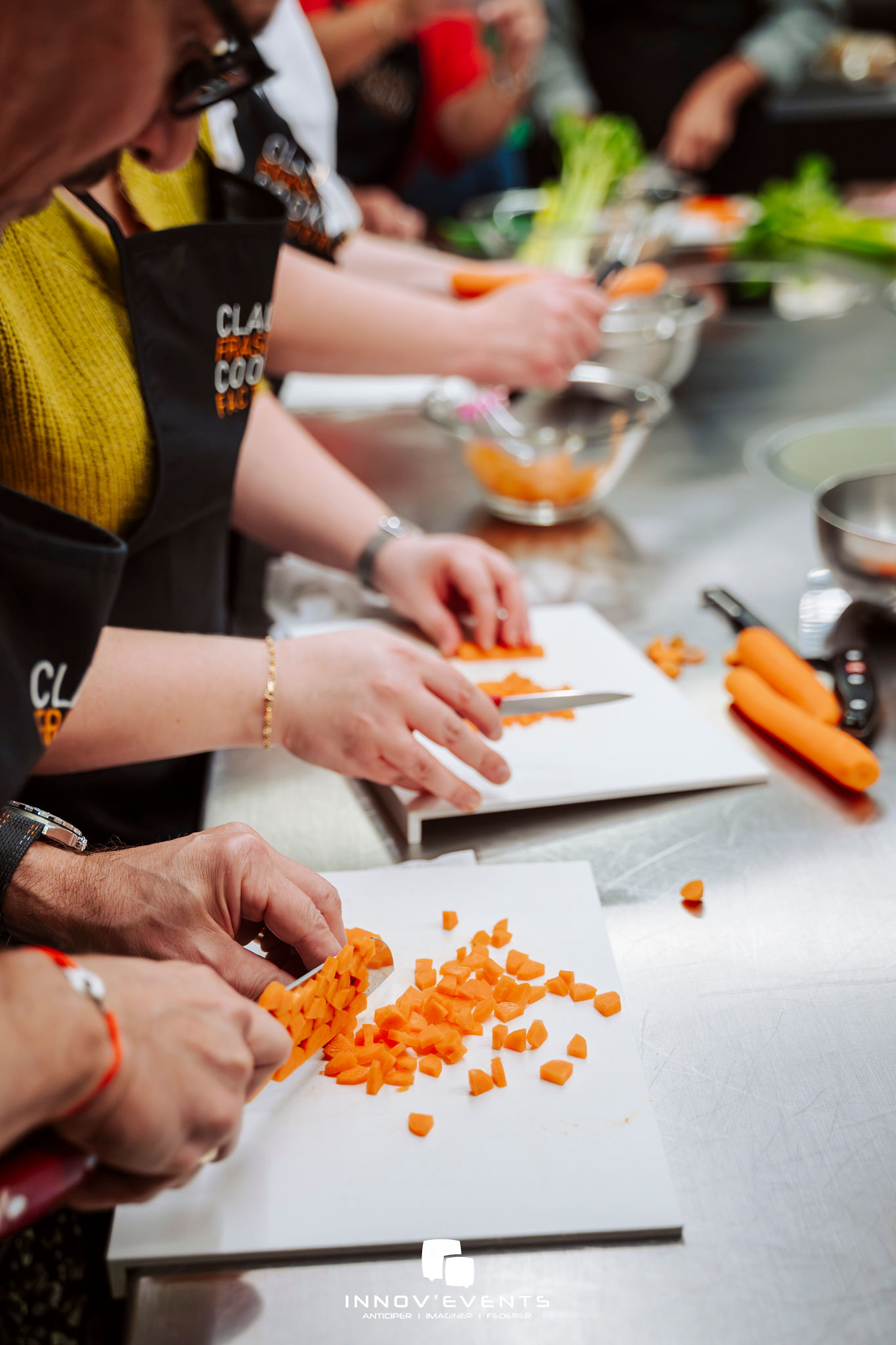
INNOV'events Liege Agency
Justin JACOB is the manager of the INNOV'events Liege office. Reach out directly by email at belgique@innov-events.be or via the contact form.
Contact the Liege agencyToutes nos prestations & animations Liege, Belgique
Découvrez nos prestations événementielles
Découvrez nos animations événementielles disponibles au Belgique
- Event Hostess in Liege
- Escape Game in Liege
- MasterChef Cooking Workshop in Liege
- Magician in Liege
- Marquee Rental in Liege
- Color Analysis Workshop in Liege
- Inflatable Games in Liege
- Valet Parking Service in Liege
- Football Simulator in Liege
- LED Furniture Rental in Liege
- Light Branding in Liege
- Unique Dining Experience in Liege
- Light Painting in Liege
- Murder Mystery Party in Liege
- Prize Contest in Liege
- Promotional Displays (POS) in Liege
- Virtual Reality in Liege
- Molecular Gastronomy Workshop in Liege
- Halloween Entertainment in Liege
- Fireworks Show in Liege
- Giant Games Challenge in Liege
- Event Host / MC in Liege
- Photo Booth Animation in Liege
- Santa Claus Entertainment in Liege
- Kids Entertainment in Liege
- Guided Tour in Liege
- Urban Rally in Liege
- Ball Pit in Liege
- Flight Simulator in Liege
- Food Truck Rental in Liege
- World Record Challenge in Liege
- Surf Simulator in Liege
- Wine Casino in Liege
- Makeover Workshop in Liege
- Perfume Creation Workshop in Liege
- Acting Workshop in Liege
- CSR Activities in Liege
- Archery in Liege
- Security Staff in Liege
- Wine Tasting in Liege
- Mime Performer in Liege
- TV Game Show in Liege
- Funfair in Liege
- Crisis Management Workshop in Liege
- Crisis Negotiation Workshop in Liege
- Arcade Games in Liege
- Indoor Skydiving Simulator in Liege
- Ski Simulator in Liege
- Racing Circuit Experience in Liege
- Introductory Flight Experience in Liege
- Tasting Experience in Liege
- Build Your Own Foosball Workshop in Liege
- 2CV Rally in Liege
- LEGO Challenge in Liege
- Casino Night in Liege
- Interpreter / Translator in Liege
- Promotional Giveaways in Liege
- Shuttle Transport in Liege