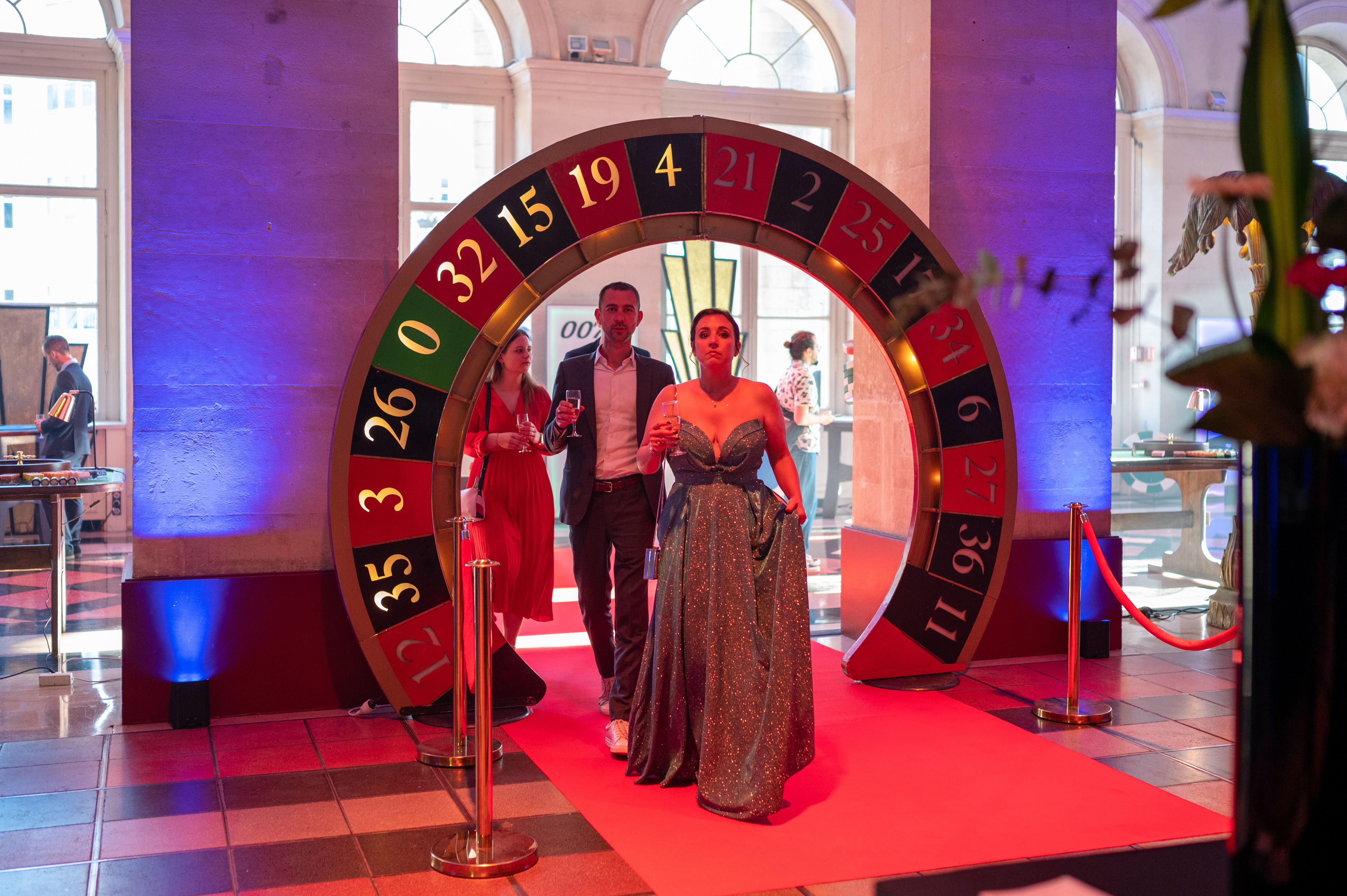
Wine Casino in Liege: a structured tasting that drives networking
INNOV'events (Brussels) delivers Wine Casino formats in Liege for 30 to 500 attendees, from executive dinners to full-company evenings. We handle concept, staffing (sommeliers/dealers), equipment, wine sourcing, timing with catering, and on-site coordination so your teams can host—not troubleshoot.
The result is a controlled, premium animation that creates conversation between departments and guests, without turning your event into a loud party or a passive tasting.
Sommaire
In a corporate evening, entertainment is not decoration: it is the mechanism that makes people circulate, talk and remember key moments. A well-run Wine Casino creates structured interactions (tables, rotations, chips, scoring) that HR and leadership can use to mix teams and partners without forcing awkward icebreakers.
In Liege, organisations often expect something “serious but warm”: clear timing, respectful noise levels, and an experience that works equally well for engineers, operators, sales, and executives. The animation must fit the venue constraints (access, power, acoustics) and align with your brand standards—especially if clients or public stakeholders are present.
We deploy our production methods locally: pre-event run sheets, supplier confirmation calls, contingency plans for glassware and temperatures, and an on-site lead who speaks the language of venues and caterers. You get one accountable partner, and a format that stays elegant even at scale in Liege.
Operational credibility for Liege corporate events
10+ years of corporate event production across Belgium, with repeat clients in HR, internal comms and executive offices.
30–500 guests is the typical effective range for a Wine Casino in Liege (we adjust table count, staffing ratio, and rotation timing accordingly).
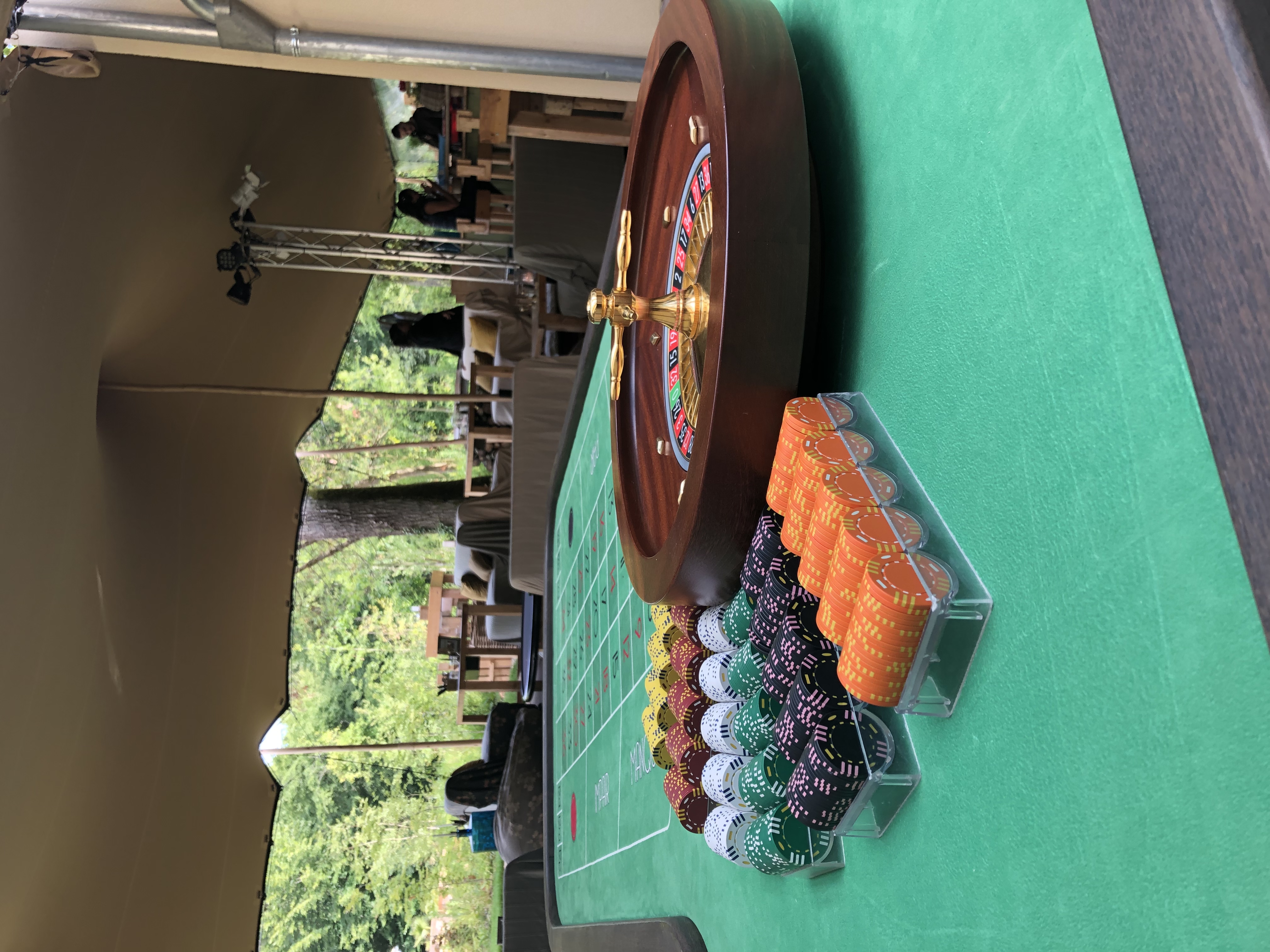
2–6 wine tables per event, with calibrated staff ratios: 1 sommelier per table + 1 floor lead per 2–3 tables to maintain pace and avoid bottlenecks.
15–25 minutes average per rotation: long enough to taste and learn, short enough to keep circulation and networking dynamic.
Liege presence: built with venues and local partners
We regularly support events in and around Liege, and we see the same pattern year after year: when an animation is cleanly integrated into the run-of-show, companies reuse it for onboarding waves, client evenings, or annual internal moments. We coordinate closely with local venues, caterers and technical suppliers because the success of a Wine Casino in Liege depends as much on timing, access and service flow as on the wines themselves.
You mentioned providing company names as references; we can integrate them into this page and, when relevant, share a comparable case format (audience profile, constraints, staffing, timeline) during a call. In practice, the most useful references are those with the same realities: mixed bilingual audiences, strict start/end times due to transport, and a need for premium execution without excess.
For decision-makers, what matters is consistency: same standards at 50 people in a boardroom and at 300 people in a reception venue. Our local delivery in Liege is built around that consistency.
 Besoin d’un devis rapide ?
Nous vous envoyons une première proposition sous 24h.
Why a Wine Casino in Liege works for leadership and HR
A Wine Casino is a pragmatic tool for engagement: it gives people a reason to move, a shared topic to discuss, and a light competitive framework that stays socially safe. For executives and HR, it is also a way to “design” interactions rather than hoping networking will happen naturally.
Controlled networking: chips and rotations create natural conversation openings, useful when you have guests from different departments, sites, or partner organisations.
Inclusive premium experience: we integrate non-alcoholic pairings and low-alcohol alternatives, so nobody is excluded while still preserving the prestige of the moment.
Message reinforcement: each table can carry a theme (values, product milestones, CSR, safety culture) without turning it into a corporate presentation. The sommelier script can be adapted to your tone.
Time-efficient: unlike a long seated tasting, the casino structure fits into 60–120 minutes and leaves space for speeches, awards, or a meal.
Risk control: measured pours, clear service rules, and a floor lead reduce the “open bar drift” that can worry management and communications teams.
Employer brand: for recruitment or retention events, it signals care in execution—people notice glassware, temperature, explanations, and how smoothly the experience flows.
Liege has a strong culture of straight talk and operational realism—especially in industrial, logistics, healthcare and public-adjacent organisations. A Wine Casino in Liege works best when it respects that culture: premium without being flashy, educational without being academic, and meticulously organised behind the scenes.
What Liege organisations expect on event day
When we produce in Liege, the constraints are often very concrete. Many companies host teams coming from multiple sites (city centre, industrial zones, neighbouring municipalities), so the schedule must respect arrival waves and transport realities. Starting late because a supplier is stuck in loading is not a detail—it impacts speeches, catering service, and the last trains or shuttle departures.
We also see mixed audiences: management, frontline staff, union or works council representatives, clients, and sometimes local institutional stakeholders. That requires a format with the right level of tone: engaging, but never “party-first”. A Wine Casino fits this well if you set rules clearly, keep sound levels controlled, and ensure hosts can circulate without being trapped at a table.
Finally, venues in Liege vary widely in layout. Some offer beautiful character but limited back-of-house; others are functional but acoustically challenging. We plan accordingly: table footprint, power needs (if digital scoring or lighting is used), glass handling, and a service path that does not cross catering staff at peak moments.
Which Wine Casino variations fit a Liege corporate audience?
Engagement comes from interaction, but executives will judge the format on whether it remains coherent with your brand and your audience. We propose several corporate event entertainment in Liege variations, each with clear use cases and constraints.
Interactive animations in Liege
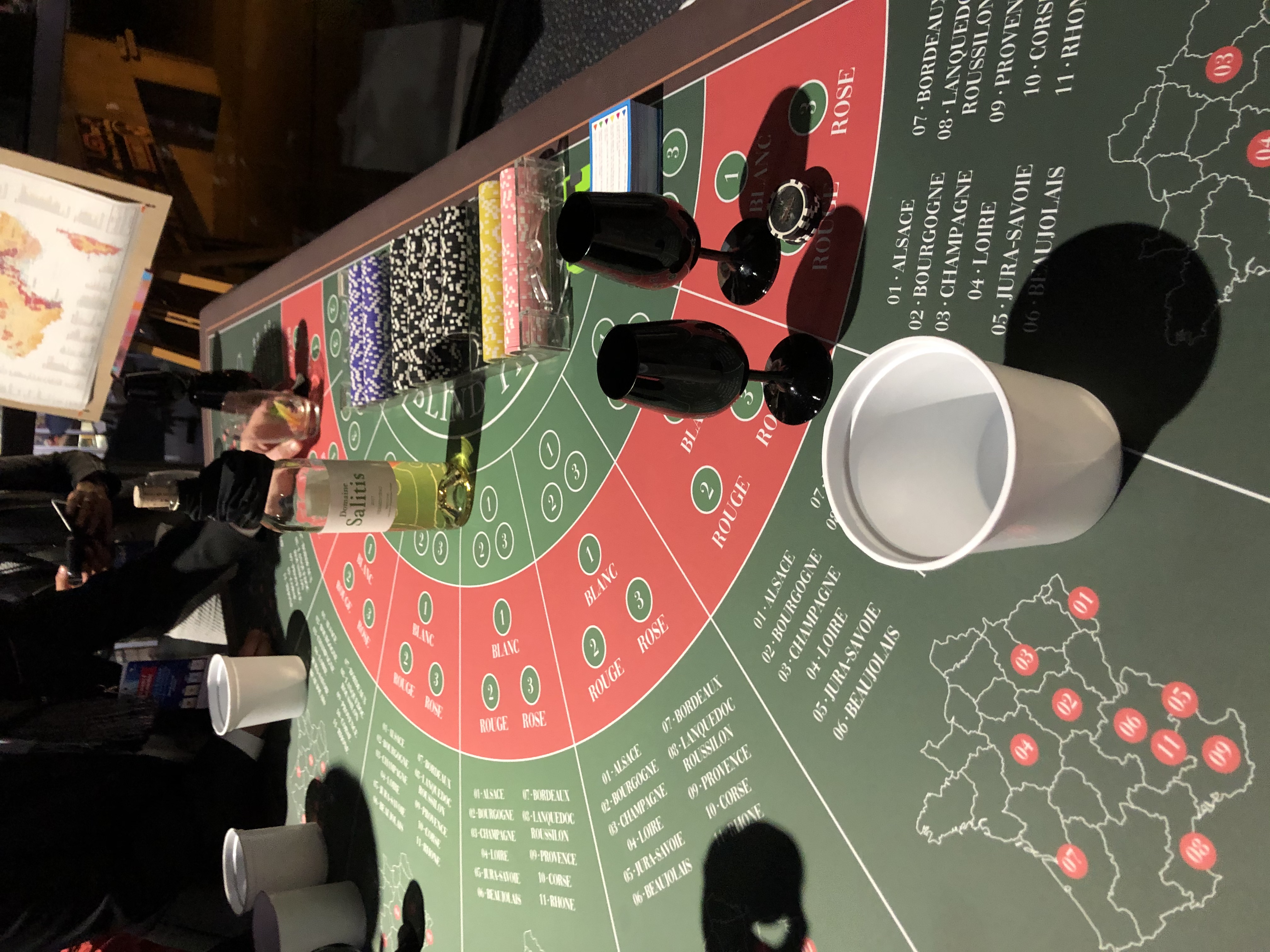
Classic chip-and-bet tables: guests receive chips, “bet” on aromas, region, vintage range, or food pairing logic. Best for mixed audiences and networking. Works well for 80–300 guests with rotations.
Blind tasting challenge: more technical, ideal for client entertainment in finance, legal, consulting, or premium B2B. Requires tighter timing and strong facilitation to stay accessible for non-experts.
Team tournament format: teams represent departments or project squads; points are aggregated. Useful for HR objectives after reorganisations or cross-site integration. We keep it friendly to avoid “winners/losers” tension.
Digital scoring (optional): QR-based scoring speeds up tallying and reduces paper. We only use it when venue connectivity and audience comfort justify it; otherwise, we keep the operation simple and robust.
Art animations in Liege
Sommelier storytelling with regional focus: not a lecture—short, punchy narratives linking wines to decision-making themes (risk, terroir, craftsmanship). Works well when you want a “premium but calm” ambiance.
Live engraving or label-personalisation: corporate-friendly artistic add-on for client gifts. Requires a dedicated station to avoid queueing and a clear gifting policy aligned with compliance.
Innovative animations in Liege
Wine & cheese casino pairing: pairing cards become the “bets”. Very effective in Liege for groups who appreciate gastronomy and want something substantial. Requires coordination with the caterer to avoid duplication with the meal.
Belgian terroir focus: including Belgian wines alongside French/Italian references can create discussion and local pride, especially with external guests visiting Liege. We keep selection credible and not gimmicky.
Low/no-alcohol pairing table: structured alternatives (fermented teas, verjus-based pairings, premium NA wines) presented with the same respect as the wine tables.
Gourmand animations in Liege
Sustainability lens table: guests bet on carbon footprint drivers (glass weight, transport, farming methods). This works when CSR is a real internal topic, not a checkbox, and when communications want a defendable narrative.
Service-speed optimisation for large groups: for 250–500 guests we use duplicated tables, simplified bet menus, and a stricter rotation cueing system to keep waiting time under control.
Whatever variation you choose, we validate it against your brand image and risk profile. A Wine Casino can look premium and controlled—or messy and over-served—depending on operational choices. Our role is to keep it aligned with the standards expected at executive level in Liege.
How to choose a venue in Liege for a Wine Casino
The venue dictates guest flow, acoustics, and service logistics—three elements that directly affect the perceived quality of a Wine Casino in Liege. We evaluate venues with a production lens: loading access, table footprint, temperature management possibilities, and how close the animation can sit to welcome drinks without blocking circulation.
| Venue type | For which objective? | Main strengths | Possible constraints |
|---|---|---|---|
Hotel meeting space / conference venue | Client evenings, executive offsites, structured timing | Predictable operations, staff used to corporate pace, easy power access | Atmosphere can feel “too business” unless staging and lighting are planned |
Industrial-chic venue / converted warehouse | Large internal events, cross-department networking | High capacity, strong brandable space, flexible layout for multiple tables | Acoustics and temperature swings; requires tighter technical planning |
Restaurant private room / gastronomic setting | Top clients, board-level dinners, premium relationship building | High service standard, natural pairing opportunities, refined perception | Limited space for rotations; must coordinate carefully with kitchen timing |
We strongly recommend a site visit (or a technical call with photos and floor plans at minimum). In Liege, small constraints like a narrow staircase, a shared loading bay, or a hard stop at a certain hour can determine whether the evening feels seamless or improvised.
What does a Wine Casino cost in Liege?
Pricing for a Wine Casino in Liege depends less on “the idea” than on production variables: wine selection level, number of tables, staffing, duration, and service conditions. We budget transparently so you can defend the spend internally and avoid last-minute add-ons.
Guest count and rotation model: a 60-person continuous format is staffed differently than a 240-person rotation with scoring and prizes.
Wine range: entry-premium vs. prestige cuvées; number of wines per table (typically 3–5), and whether you include Belgian wines.
Staffing: sommeliers/dealers, floor lead, support runner for water/glass management. Staffing is what protects flow and guest experience.
Glassware and equipment: quality glass, spittoons if required, table dressing, signage, temperature control solutions, and optional digital scoring.
Venue constraints: difficult access, limited back-of-house, long load-in distances, or strict time windows can increase labour time.
Compliance and inclusivity: non-alcoholic table, clear responsible service rules, and integration with your internal policies (especially when clients or public bodies attend).
From an ROI perspective, executives usually assess this format on two outputs: the quality of networking (did the right people speak together?) and the perceived level of care (did it reflect our standards?). A controlled Wine Casino tends to deliver both—provided the production is properly sized for your Liege audience.
Why work with an event agency in Liege for this format?
Even with a strong concept, event day is won or lost on local execution: access, supplier timing, venue rules, and quick decisions when reality differs from the plan. Working with a team that operates routinely in Liege shortens feedback loops and reduces operational risk.
INNOV'events is based in Brussels, but we deliver regularly in Wallonia and structure projects with local readiness: we pre-confirm venue constraints, anticipate traffic and load-in limitations, and rely on trusted partners for technical and hospitality needs. If you are comparing options, the key question is not “who has the nicest deck”, but “who will still be calm and effective at 18:30 when the timeline compresses”.
For broader support beyond this animation, you can also review our local capabilities as an event agency in Liege through our dedicated page.
- Fewer surprises on site: knowledge of typical venue rules, access patterns, and operational standards in the area.
- Faster coordination: shorter response time with local suppliers when adjustments are needed (glass shortage, extra table, timing shift).
- Better budget control: realistic labour and logistics estimates based on the territory, not theoretical assumptions.
- Brand protection: smoother guest experience reduces the visible “friction” that can damage perceived professionalism.
From an ROI perspective, executives usually assess this format on two outputs: the quality of networking (did the right people speak together?) and the perceived level of care (did it reflect our standards?). A controlled Wine Casino tends to deliver both—provided the production is properly sized for your Liege audience.




Examples of Liege-style constraints we manage in production
Our projects vary in size and audience, but the operational patterns repeat—especially in Liege. For instance, we often support events where the executive committee wants a premium tone while HR needs genuine interaction across hierarchy. In those cases, we set a rotation structure that ensures mixing (pre-assigned starting tables by colour group) while keeping leadership free for hosting and key conversations.
We also handle situations where catering is under pressure: late arrivals, speeches moving, or a kitchen requesting a tighter service window. A Wine Casino can flex if it is designed correctly—shorten a rotation, pause scoring, or convert one table into a free-flow station—without guests feeling the change was “damage control”.
Another common real-life constraint is policy: some companies require strict responsible service rules, or want to avoid anything that looks like gambling. We address this by framing chips as “tasting credits”, keeping language compliant, and using learning-based scoring. The concept remains engaging, and communications teams stay comfortable with the optics.
Common mistakes to avoid for a Wine Casino in Liege
Under-staffing the floor: one strong sommelier does not replace a floor lead who manages rotations, queues and micro-issues. Under-staffing is the fastest way to create waiting lines and visible stress.
Too many rules, explained too late: if instructions take 10 minutes at the start, you lose the room. We brief in 90–120 seconds, then let tables guide the rest.
Poor temperature management: warm whites or overly cold reds are noticed immediately and damage credibility, especially with client audiences.
Ignoring acoustics: in echoing spaces, guests stop listening and tables become chaotic. We adapt layout, use controlled voice projection, and avoid unnecessary music volume.
No plan for non-drinkers: if alternatives are an afterthought, some guests disengage. We integrate a credible NA experience from the start.
Misalignment with catering: placing rotations during plate service creates congestion and reduces both experiences. We coordinate timing with the caterer and venue manager.
Our job is to prevent these risks with a production approach: clear responsibilities, run-of-show discipline, and contingency planning. That is what keeps a Wine Casino in Liege executive-friendly.
Why Liege clients rebook this format with us
Repeat business is rarely about the concept; it is about the reliability of delivery. HR and communications teams come back when the agency protects their internal credibility: leadership is satisfied, guests are comfortable, and nobody had to improvise under pressure.
70–80% of our corporate activations are repeat or referral-driven (typical range observed across recent seasons, depending on event cycles).
48–72 hours is our standard window to deliver a first structured proposal (scope, staffing model, assumptions) after a qualified brief.
1 single point of contact from brief to event day, with an on-site lead empowered to decide and adjust.

Loyalty is a consequence of operational comfort. In Liege, where many organisations value pragmatism over show, that comfort is the strongest proof of quality.
Our delivery process for Liege Wine Casino events
👉 Step 1 (Liege): align on objective, audience and constraints
We run a short but precise briefing with HR/Comms/Executive sponsor: event purpose, guest profile (internal/external, seniority mix), venue short-list, timing constraints, compliance points, and tone. Output: a clear scope and a recommended format (table count, rotation model, duration).
👉 Step 2 (Liege): design the game mechanics and run-of-show
We define scoring rules, table themes, rotation rhythm, and integration points with welcome drinks, speeches and catering. Output: a draft run sheet with timing blocks, responsibilities, and a guest flow map.
👉 Step 3 (Liege): curate wines and service standards
We select wines aligned with your image and audience maturity, including NA alternatives if requested. We define pour sizes, glassware, water presence, and temperature plan. Output: selection sheet with quantities and service protocol.
👉 Step 4 (Liege): production lock and supplier coordination
We confirm venue access, loading, storage, and waste management; coordinate with caterer and technical supplier; and staff the right profiles (sommeliers, floor lead, runner). Output: confirmed production plan and call sheet.
👉 Step 5 (Liege): on-site setup, rehearsal, delivery, close
We install tables, signage and service stations, run a short team briefing, and perform a timing check. During the event, the floor lead manages rotations and guest comfort. After close, we handle pack-down and ensure the space is returned as agreed. Output: clean closeout and, if useful, a short debrief for next edition.
FAQ sur l'organisation Wine Casino à Liege
How many guests can a Wine Casino handle in Liege?
Most formats run smoothly from 30 to 500 guests in Liege. The key is table count and staffing: as a rule, plan 1 table per 40–60 guests for rotation formats, with a floor lead to prevent queues.
How long should a Wine Casino last in Liege venues?
Plan 60–120 minutes for the core animation. With welcome, speeches and transitions, it typically occupies 90–180 minutes of the overall run-of-show depending on whether dinner is seated or cocktail style.
Is a Wine Casino appropriate for corporate compliance in Liege?
Yes, if it is framed as guided tasting and responsible service. We use measured pours, provide water and food pairing options, integrate NA alternatives, and adapt wording (e.g., “tasting credits” instead of gambling language) when your policy requires it.
What budget range for a Wine Casino in Liege?
As a practical range, corporate activations in Liege often fall between €25 and €90 per person, depending on wine level, table count, staffing, duration, and equipment. We provide a line-by-line quote with clear assumptions so you can validate internally.
When should we book a Wine Casino provider in Liege?
For peak periods (September–December and May–June), secure the date 6–10 weeks ahead. For smaller groups, 3–4 weeks can work if the venue and wine selection are straightforward.
Request a Wine Casino quote for Liege
If you are planning a corporate evening in Liege, we recommend starting with a 20-minute scoping call. We will confirm feasibility (venue flow, timing, compliance), propose the right table/staffing model, and provide a clear quote with options (wine level, NA table, scoring, prizes).
The earlier we validate the venue and run-of-show, the more we can protect your budget and your brand on event day. Share your date, estimated headcount, venue (or shortlist), and the objective of the event, and we will come back with a structured proposal for your Wine Casino in Liege.
INNOV'events Liege Agency
Justin JACOB is the manager of the INNOV'events Liege office. Reach out directly by email at belgique@innov-events.be or via the contact form.
Contact the Liege agencyToutes nos prestations & animations Liege, Belgique
Découvrez nos prestations événementielles
Découvrez nos animations événementielles disponibles au Belgique
- Event Hostess in Liege
- Escape Game in Liege
- MasterChef Cooking Workshop in Liege
- Magician in Liege
- Marquee Rental in Liege
- Color Analysis Workshop in Liege
- Inflatable Games in Liege
- Valet Parking Service in Liege
- Football Simulator in Liege
- LED Furniture Rental in Liege
- Light Branding in Liege
- Unique Dining Experience in Liege
- Light Painting in Liege
- Murder Mystery Party in Liege
- Prize Contest in Liege
- Promotional Displays (POS) in Liege
- Virtual Reality in Liege
- Molecular Gastronomy Workshop in Liege
- Halloween Entertainment in Liege
- Fireworks Show in Liege
- Giant Games Challenge in Liege
- Event Host / MC in Liege
- Photo Booth Animation in Liege
- Santa Claus Entertainment in Liege
- Kids Entertainment in Liege
- Guided Tour in Liege
- Urban Rally in Liege
- Ball Pit in Liege
- Flight Simulator in Liege
- Food Truck Rental in Liege
- World Record Challenge in Liege
- Surf Simulator in Liege
- Wine Casino in Liege
- Makeover Workshop in Liege
- Perfume Creation Workshop in Liege
- Acting Workshop in Liege
- CSR Activities in Liege
- Archery in Liege
- Security Staff in Liege
- Wine Tasting in Liege
- Mime Performer in Liege
- TV Game Show in Liege
- Funfair in Liege
- Crisis Management Workshop in Liege
- Crisis Negotiation Workshop in Liege
- Arcade Games in Liege
- Indoor Skydiving Simulator in Liege
- Ski Simulator in Liege
- Racing Circuit Experience in Liege
- Introductory Flight Experience in Liege
- Tasting Experience in Liege
- Build Your Own Foosball Workshop in Liege
- 2CV Rally in Liege
- LEGO Challenge in Liege
- Casino Night in Liege
- Interpreter / Translator in Liege
- Promotional Giveaways in Liege
- Shuttle Transport in Liege