
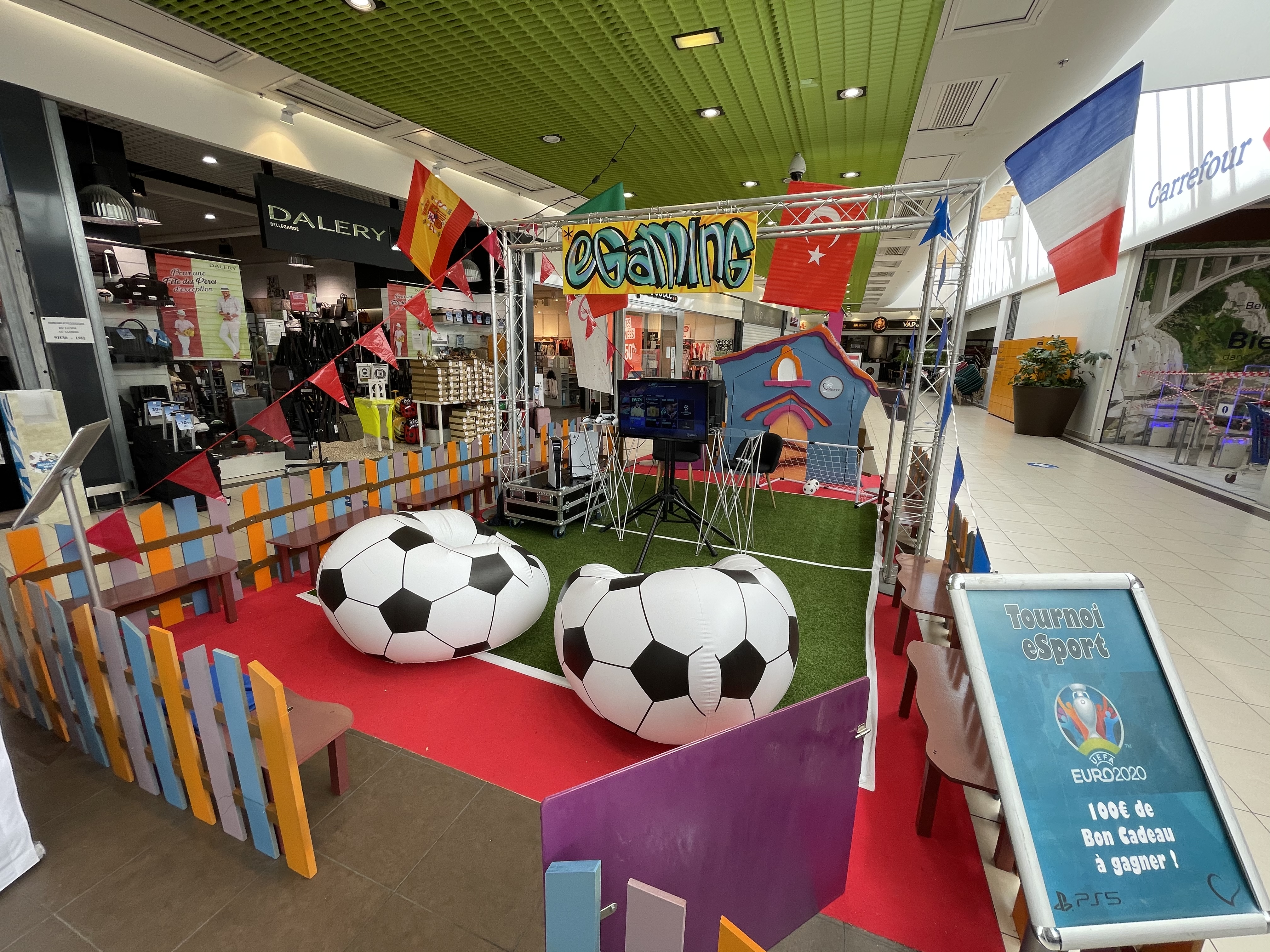
Soccer Simulator in Brussels for corporate events that actually engage teams
INNOV'events is a event agency in Brussels delivering Soccer Simulator activations for corporate events from 30 to 800 participants. We handle venue fit, logistics, staffing, safety, and run-of-show so your internal teams stay focused on guests and messaging.
Typical formats include team-building, client nights, product launches, and afterworks—anywhere you need a high-throughput activity that people understand instantly and that works in a busy schedule.
Sommaire
In a corporate event, entertainment is not “extra”—it is a tool to structure the evening, create conversation across silos, and keep energy levels stable between speeches, awards, or networking blocks. A Soccer Simulator gives you a clear hook: people try, laugh, compare scores, and naturally regroup at the bar or buffet without the awkward “what do we do now?” moments.
In Brussels, organizations often expect two things at once: professional execution (timings, safety, image) and inclusivity for mixed international teams. We design the flow so both the competitive colleagues and the “I’m just here for one kick” guests have a good experience—without forming long queues that disrupt the programme.
We are on the ground in Brussels and used to real constraints: strict load-in windows in city venues, limited elevator access, bilingual coordination, and last-minute agenda changes. Our role is to make the animation run like a small operational unit, not like a gadget dropped in a corner.
Operational benchmarks we commit to in Brussels
10+ years of corporate event production experience across Belgium, with repeat clients in the Brussels business districts.
Typical on-site staffing: 1 operator per simulator + 1 floater when throughput is critical (registrations, quick resets, guest guidance).
Throughput target: 60–120 participants/hour depending on game mode (single shot, 3-shot round, mini-tournament).
Standard load-in/out window: designed to fit 60–120 minutes when venues have tight access rules (common in central Brussels).
Companies in Brussels that rely on us year after year
We support corporate teams across Brussels—from European-facing organizations to Belgian headquarters—where event pressure is real: a CEO’s schedule shifts, a keynote overruns, or a venue imposes last-minute safety rules. Our clients come back when they need an agency that can absorb those changes without the internal event owner “firefighting” all evening.
You mentioned providing company names as references; to keep this page accurate and compliant, we only publish names once we have explicit authorization. In practice, we can share a curated list of relevant Brussels references during the quotation phase (same event size, same venue constraints, similar audience profile) and, when possible, connect you to a client who can speak about delivery quality and on-site behaviour.
Many of our collaborations renew annually for end-of-year receptions, summer gatherings, and client hospitality moments—often because the operational file is well kept: technical sheets, access plans, risk assessments, and run-of-show learnings are reused and improved rather than reinvented.
 Besoin d’un devis rapide ?
Nous vous envoyons une première proposition sous 24h.
What business outcomes can a Soccer Simulator drive in Brussels?
Executives and HR teams do not measure success in “fun”. They look for participation, brand consistency, and a programme that protects key moments (speeches, awards, client meetings). A Soccer Simulator in Brussels is effective because it creates fast engagement with minimal explanation, works across cultures, and can be managed like a timed module in your agenda.
Higher participation without forcing it: people understand the activity in 3 seconds. Even reserved guests join because the commitment is low (one shot, quick score). This matters in Brussels where audiences are often mixed—HQ staff, field teams, partners, and international colleagues.
Better networking dynamics: the simulator becomes a “social anchor” that naturally mixes departments. We often see Finance/IT/Commercial groups blending because score comparisons are a neutral conversation starter.
Clear structure for your run-of-show: you can use the activation to manage room flow—open it at arrival to prevent clustering at the entrance, pause during a keynote, then reopen as a re-energiser afterwards.
Employer brand and internal comms content: with the right setup (branded backdrop, scoreboard visuals, clear consent signage), you get usable photos/videos for internal channels without disrupting the guest experience.
Client hospitality that stays professional: for B2B events, it’s competitive but not childish. With tournament formatting, you can host short “client vs. team” matches that feel intentional rather than random.
Inclusivity and safety managed upfront: we design game modes that work for all attire (including suits and dresses), and we brief guests so the experience stays safe and comfortable.
Brussels has a pragmatic event culture: people expect efficiency, quality, and a clear purpose. When the activation is correctly integrated into timing, staffing, and brand guidelines, a Soccer Simulator is one of the most reliable ways to generate participation without compromising a corporate tone.
What Brussels companies expect from corporate entertainment
In Brussels, the decision-maker’s checklist is usually stricter than in leisure-heavy destinations. Venues can be premium and regulated; guests may include VIPs, EU/international profiles, and bilingual or multilingual teams. That translates into concrete expectations.
Access and timing discipline: many city venues have controlled loading docks, limited parking, and fixed lift availability. We plan precise load-in sequences (what arrives first, what goes upstairs, what remains at street level) to avoid losing time and missing doors-opening.
Noise and space control: entertainment must coexist with speeches, background music, catering service, and sometimes simultaneous breakouts. We define the simulator zone with clear circulation so you don’t get queue spillover at the bar or in emergency exits.
Brand image: Brussels corporate audiences quickly spot when something looks improvised. We focus on clean installation, discreet cabling, professional operator posture, and signage that matches your visual guidelines.
Compliance mindset: client teams frequently ask for proof of insurance, safety notes, and predictable behaviour on site. We prepare documentation early and align with your venue’s risk prevention requirements to avoid last-minute “can we even do this?” debates.
Which add-ons pair well with a Soccer Simulator in Brussels?
Entertainment creates engagement when it fits your audience and your event mechanics. A Soccer Simulator in Brussels is strong on instant participation; we often complement it with modules that support your communication goals: networking, employer branding, or client hospitality.
Interactive animations in Brussels
Scoreboard challenge wall: we display top scores by time slot (arrival, post-speech, late evening). This helps distribute participation and prevents everyone from queuing at the same time.
Team-based mini-tournament: ideal for departments or cross-functional teams. We keep matches short and schedule them around your key moments to avoid programme conflicts.
Branded photo corner near the simulator: one operator manages the game, another can coordinate quick photos for internal comms—useful for HR events and employer branding campaigns.
Art animations in Brussels
DJ with controlled sound levels: works well when the simulator is used as a rhythm tool. We coordinate with the DJ to lower levels during speeches and to avoid sound “competition”.
Host/MC for tournament moments: for client nights, a light-touch MC can announce finals and keep the tone corporate, not “stadium”.
Innovative animations in Brussels
Belgian snack pairing: timing matters—serve fries/mini-waffles after peak participation to avoid greasy hands on equipment and keep the simulator clean.
Mocktail bar activation: useful when your audience includes international teams and you want inclusive hospitality without focusing on alcohol.
Gourmand animations in Brussels
Data capture without friction: for internal events, we can run opt-in registration (name/department) to create a leaderboard by team—only when aligned with your privacy policy.
CSR tie-in: a “goals for a cause” mechanic (e.g., donation per goal scored) works well for Brussels-based organizations that want a concrete social angle without turning the event into a campaign speech.
Whatever you add, the key is alignment with brand image and audience maturity. In Brussels, small details—operator posture, signage tone, queue management, and integration into the run-of-show—often matter more than piling up activities.
Which Brussels venues fit a Soccer Simulator setup best?
The venue impacts how your entertainment is perceived and how smoothly it runs. With a Soccer Simulator, what matters most is: ceiling height and clear footprint, access for load-in, power availability, and circulation around the activity. In Brussels, we validate these points early to avoid last-minute compromises.
| Venue type | For which objective? | Main strengths | Possible constraints |
|---|---|---|---|
| Corporate offices (atrium, large meeting space) | Internal team-building, employer branding, end-of-quarter moments | Controlled environment, easy alignment with internal comms, minimal guest travel | Freight elevator limits, protection of floors/walls, tight load-in rules after office hours |
| Hotel conference spaces in Brussels | Client events with professional service level and predictable timing | On-site AV, catering coordination, clear operations, good contingency options | Access windows, room turnover schedules, sound constraints near other events |
| Event venues/industrial halls (Brussels region) | Large groups, tournaments, high energy formats | Space for queues and branding, higher throughput, easier zoning | Additional production needs (power distribution, signage, staffing), longer walk distances for guests |
We recommend a short site visit or at least a technical call with photos and measurements. In Brussels, access constraints and room layout decisions are often what make the difference between a smooth activation and an operational headache.
What budget range to plan for a Soccer Simulator in Brussels?
Pricing depends on your event mechanics, venue constraints, and how “hands-off” you need the delivery to be. For a Soccer Simulator in Brussels, the budget is mainly driven by staffing, transport/load-in complexity, duration, and any branding or tournament add-ons.
Duration on site: a 2–3 hour activation is not costed the same as a full-day corporate fair. Longer durations typically require breaks and a stronger staffing plan.
Throughput requirements: if you need to process 200–500 guests efficiently, you may need additional operators or a second unit to avoid queues.
Venue access and logistics: central Brussels load-in, parking restrictions, long carries, stairs, or limited lifts can increase labour time and planning effort.
Branding level: simple branding (logo on signage) vs. full visual integration (backdrop, scoreboard visuals, photo zone) changes production time and print costs.
Format choice: free-play is simpler; a managed tournament requires an MC/host function, match scheduling, score management, and clearer coordination with your run-of-show.
Compliance and documentation: some corporate and institutional clients require specific insurance certificates, method statements, or safety notes—best handled upstream.
We frame budget discussions in ROI terms: participation rate, content output for internal communication, and the operational time your internal teams save on event day. A well-run activation often replaces several smaller “filler” items and reduces programme risk.
Why choose a Brussels-based agency for a Soccer Simulator?
When the event day is under pressure, “local” is not a slogan—it is operational leverage. In Brussels, we deal weekly with venue access coordination, bilingual on-site teams, supplier timing, and the realities of city mobility. That translates into fewer unknowns for you.
We also know how corporate stakeholders work here: HR wants inclusivity and participation; Communications wants controlled brand representation; Executives want timing discipline and no reputational risk. Our role is to align those needs early and produce a plan that holds on site.
- Faster technical validation: we can visit venues quickly and confirm footprint, access, and power without relying on assumptions.
- Reliable staffing: operator quality changes the entire guest experience. We deploy teams used to corporate etiquette and timing discipline.
- Better coordination with Brussels suppliers: AV, catering, security, and venue managers—alignment avoids “everyone waits for everyone” moments.
- Contingency culture: we plan for late agenda changes, VIP timing, and access delays without making it your problem.
We frame budget discussions in ROI terms: participation rate, content output for internal communication, and the operational time your internal teams save on event day. A well-run activation often replaces several smaller “filler” items and reduces programme risk.






What we have delivered with Soccer Simulators in Brussels contexts
We have delivered Soccer Simulator activations in real corporate conditions: tight doors-opening, mixed audiences, and strict brand requirements. The common success pattern is not the machine itself—it’s the integration.
Example scenario we often manage: a company reception in Brussels with 250 guests, arrivals spread over 60 minutes, a CEO speech at T+75, and catering service in the same space. The risk is a queue that blocks circulation and creates noise during the speech. Our answer is a timed mode (3 kicks), clear queue lane, one operator managing rhythm, and a planned pause 10 minutes before the speech to “drain” the queue. After the speech, we reopen and run a quick top-10 challenge to bring energy back.
Another frequent setup: internal team-building with departments that don’t naturally mix. We create teams by cross-function, run a short tournament bracket, and use the scoreboard as a neutral point of discussion. HR typically values that the activity creates interaction without forcing extroversion.
Across these formats, we keep the same discipline: technical preparation, staffing quality, safe setup, and clear coordination with the event manager so the entertainment supports—not competes with—your message.
Common pitfalls we prevent in Brussels corporate events
Underestimating throughput: a simulator can become a bottleneck if the mode is too long. We size the format to your guest count and peak times.
Placing the activation in the wrong zone: too close to the bar or buffet creates congestion; too far makes it look abandoned. We map circulation before finalising placement.
No pause strategy during speeches: the entertainment must respect the programme. We integrate pause/relaunch moments into the run-of-show.
Insufficient operator quality: an untrained operator creates awkward guest interactions, poor rhythm, and safety issues. We use staff used to corporate codes.
Weak technical checks: power, space, floor protection, and access routes must be validated early—especially in central Brussels venues.
Brand inconsistency: mismatched signage or messy cabling undermines a premium event. We keep the setup clean and aligned with your guidelines.
Our role is to remove these risks before they show up on event day. A Soccer Simulator in Brussels should feel effortless to your guests—and predictable to you.
Why Brussels clients renew with INNOV'events
Renewal is rarely about novelty; it is about operational comfort and stakeholder trust. When HR, Communications, and an Executive Sponsor all have expectations, the agency that wins is the one that delivers consistently and documents what was learned.
Multi-year partnerships for recurring moments (annual kick-off, end-of-year reception, client hospitality), with improved run-of-show each edition.
Typical response time for feasibility questions in Brussels: 24–48 hours with clear assumptions (space, access, staffing) to support internal approvals.
On-site: one accountable lead who coordinates with venue/AV/catering so your internal event owner is not the “traffic controller”.

Loyalty is a strong signal in event production: it means the delivery matched the promise under real constraints, not just in a proposal.
How we scope and deliver a Soccer Simulator project in Brussels
👉 Step 1 — Brussels feasibility check and objective framing
We confirm guest volume, agenda constraints, and the business objective (participation, networking, employer branding, client hospitality). Then we validate practical feasibility: footprint, ceiling height, power, access route, and any venue rules. Output: a clear recommendation on format (free play vs. tournament), timing, and staffing.
👉 Step 2 — Event-day flow design for Brussels venues
We design the guest journey around arrival peaks and programme highlights: where the simulator sits, how the queue is managed, when to pause for speeches, and how to relaunch. Output: a run-of-show insert and a simple on-site operational plan your stakeholders can approve.
👉 Step 3 — Branding, comms and stakeholder alignment in Brussels
If you want branding, we align visuals with your guidelines (logo placement, tone of signage, photo consent approach). If HR is involved, we ensure inclusivity (simple rules, optional participation, safe mode). Output: validated visuals and a comms-ready description for invitations or internal channels.
👉 Step 4 — Production and on-site delivery in Brussels
We plan logistics (arrival time, parking, load-in sequence), deploy trained operators, install cleanly (cable management, safety zone), and run the activation to the agreed rhythm. We coordinate with venue, security, AV and catering to avoid conflicts. Output: predictable delivery and real-time adjustments when the agenda shifts.
👉 Step 5 — Post-event wrap-up for Brussels corporate teams
When relevant, we provide participation estimates, peak-time observations, and practical learnings (best timing, best positioning, staffing ratio). Output: a short debrief that helps you improve the next edition and supports internal reporting.
FAQ sur l'organisation Soccer Simulator à Brussels
How much space is needed in Brussels for a Soccer Simulator?
Plan a clear zone of 4 x 6 m to 5 x 8 m depending on the model and whether you add a queue lane. We also recommend keeping at least 1 m of circulation around the activity so it doesn’t block catering or emergency paths in Brussels venues.
How many guests per hour can we run in Brussels?
With a short mode (1 to 3 kicks) and a trained operator, you can typically run 60–120 participants per hour on one unit. For 300+ guests with peak arrivals, we often recommend adding staffing support or a second unit to avoid queues.
Can a Soccer Simulator be used in Brussels during speeches?
Yes, but we normally plan a pause. The professional approach is to stop play 5–10 minutes before the speech to clear the queue, then relaunch right after. This protects your key messages and keeps the room disciplined.
What budget should we expect in Brussels for one simulator?
For corporate delivery in Brussels, budgets commonly fall in the €1,200–€3,500 range for a half-day/evening, depending on access complexity, staffing, and branding options. Multi-unit or tournament formats are higher due to added personnel and coordination.
Is a Soccer Simulator suitable for mixed international teams in Brussels?
Yes. The rules are universal and we brief in English (and can support FR/NL on request). We usually propose inclusive modes: quick single-shot participation plus an optional competitive leaderboard, so both competitive and reserved profiles feel comfortable.
Request a Brussels quote with a clear operational plan
If you are comparing agencies, we suggest starting with three inputs: expected guest count, venue (or shortlist), and your programme timing (speech moments, catering flow). From there, we can propose the right Soccer Simulator in Brussels format, staffing level, and a realistic load-in plan—so you can validate internally with confidence.
Contact INNOV'events to receive a structured quote with technical assumptions, recommended game mode, and an on-site coordination approach aligned with corporate standards in Brussels.
INNOV'events Brussels Agency
Justin JACOB is the manager of the INNOV'events Brussels office. Reach out directly by email at belgique@innov-events.be or via the contact form.
Contact the Brussels agencyToutes nos prestations & animations Brussels, Belgique
Découvrez nos prestations événementielles
Découvrez nos animations événementielles disponibles au Belgique
- Event Hostess in Brussels
- Escape Game in Brussels
- MasterChef Cooking Workshop in Brussels
- Magician in Brussels
- Marquee Rental in Brussels
- Color Analysis Workshop in Brussels
- Inflatable Games in Brussels
- Valet Parking Service in Brussels
- Football Simulator in Brussels
- LED Furniture Rental in Brussels
- Light Branding in Brussels
- Unique Dining Experience in Brussels
- Light Painting in Brussels
- Murder Mystery Party in Brussels
- Prize Contest in Brussels
- Promotional Displays (POS) in Brussels
- Virtual Reality in Brussels
- Molecular Gastronomy Workshop in Brussels
- Halloween Entertainment in Brussels
- Fireworks Show in Brussels
- Giant Games Challenge in Brussels
- Event Host / MC in Brussels
- Photo Booth Animation in Brussels
- Santa Claus Entertainment in Brussels
- Kids Entertainment in Brussels
- Guided Tour in Brussels
- Urban Rally in Brussels
- Ball Pit in Brussels
- Flight Simulator in Brussels
- Food Truck Rental in Brussels
- World Record Challenge in Brussels
- Surf Simulator in Brussels
- Wine Casino in Brussels
- Makeover Workshop in Brussels
- Perfume Creation Workshop in Brussels
- Acting Workshop in Brussels
- CSR Activities in Brussels
- Archery in Brussels
- Security Staff in Brussels
- Wine Tasting in Brussels
- Mime Performer in Brussels
- TV Game Show in Brussels
- Funfair in Brussels
- Crisis Management Workshop in Brussels
- Crisis Negotiation Workshop in Brussels
- Arcade Games in Brussels
- Indoor Skydiving Simulator in Brussels
- Ski Simulator in Brussels
- Racing Circuit Experience in Brussels
- Introductory Flight Experience in Brussels
- Tasting Experience in Brussels
- Build Your Own Foosball Workshop in Brussels
- 2CV Rally in Brussels
- LEGO Challenge in Brussels
- Casino Night in Brussels
- Interpreter / Translator in Brussels
- Promotional Giveaways in Brussels
- Shuttle Transport in Brussels