Surf Simulator in Brussels to energize teams without disrupting your agenda
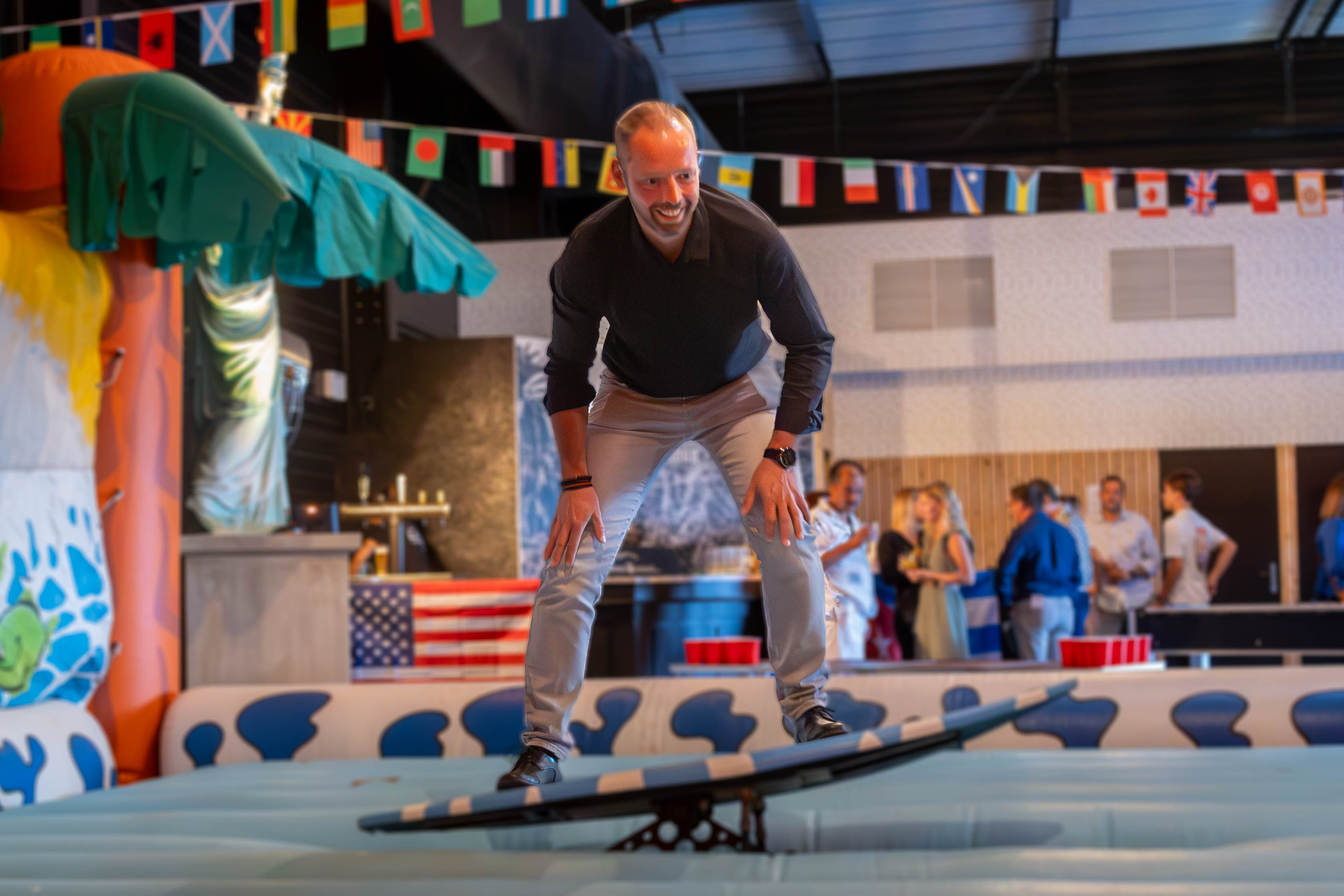
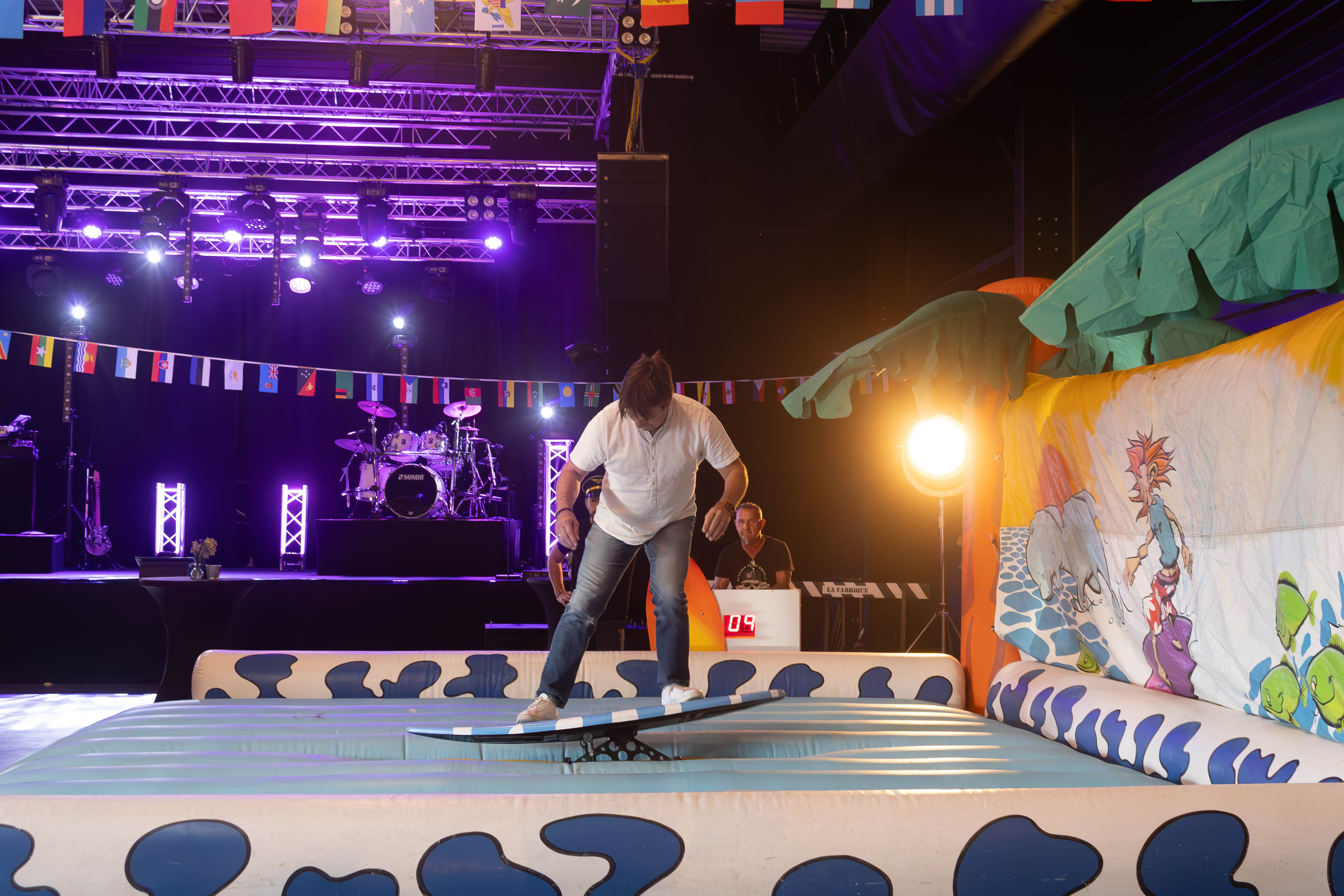
INNOV'events delivers and operates a Surf Simulator for corporate events in Brussels, typically from 50 to 800 attendees. We handle venue checks, access planning, technical setup, operator staffing, safety rules, and guest flow so your teams can focus on hosting and messaging.
Sommaire
In a corporate event, entertainment is not “extra”: it is what creates participation, photos, and shared talking points when people don’t naturally mix. A Surf Simulator is particularly effective because it is visible, easy to understand, and produces quick attempts that keep the room moving.
In Brussels, HR and Comms teams typically expect strict timing, discreet logistics (often with limited loading windows), and an animation that works for mixed profiles: multilingual audiences, international executives, and colleagues who may not want a “sport” activity but still want to take part.
As an event agency in Brussels, INNOV'events is used to coordinating with local venues, building managers, and technical suppliers across the city. We plan the run-of-show, anticipate constraints (floor loads, power, access), and deliver a controlled, professional setup that supports your brand and internal objectives.
Key numbers for Brussels decision-makers who need reliability
10+ years delivering corporate entertainment formats across Belgium, including technical animations requiring strict on-site control.
150+ corporate events/year coordinated through our Brussels operations and partner network (venues, technicians, host staff).
48-hour typical turnaround for a first feasibility check (access, space, power, safety) and an initial budget range for a Surf Simulator in Brussels.
2 operators minimum on site for safe rotations and queue management; scalable to 3–4 staff for high-throughput events.
Operational readiness: we plan with risk assessment, public liability insurance verification, and a venue-ready method statement when requested by Brussels sites.
Brussels anchoring: recurring corporate clients and local habits
We support organisations that operate daily in Brussels: headquarters teams, European-facing offices, and local subsidiaries that need events to run precisely—because the audience often includes management, clients, and international colleagues. Several teams work with us year after year when they see that the same operational discipline is applied each time: pre-checks, clear safety rules, and a smooth guest journey.
You mentioned providing company names for references; please send the list and we will integrate them transparently in this section (e.g., “yearly summer party”, “Q4 town hall activation”, “client evening in the European Quarter”). We keep references factual: what was delivered, for how many guests, under which constraints, and what impact it had on participation and internal communication.
 Besoin d’un devis rapide ?
Nous vous envoyons une première proposition sous 24h.
Why book a Surf Simulator in Brussels for HR and Comms goals?
A Surf Simulator is not only a “fun station”. In practice, it is an engagement engine: it creates movement, spontaneous encouragement, and a shared topic that makes networking easier—especially when teams do not know each other well or when hierarchies are present.
For executives, HR directors, and communication leads in Brussels, the strategic interest is clear: you invest in one visible animation that delivers participation without forcing people into a team-building workshop they didn’t ask for.
Higher participation with minimal briefing: guests understand the challenge in seconds, which matters when your agenda is tight (town hall, awards, client speeches).
Cross-team mixing without “forced networking”: you naturally create small groups around the simulator—colleagues encourage, film, comment, rotate—reducing the classic “department clusters” effect.
Employer branding content you can actually use: short, dynamic attempts work well for internal channels (Teams, intranet) and recruitment storytelling—provided it is framed with your brand tone and consent rules.
Controlled risk profile: compared to some sports animations, you can keep the experience safe with clear rules, supervised access, and a throughput adapted to your population (including senior profiles).
Measurable activation: we can track rotations/hour, peak times, participation rate vs. attendance, and capture feedback—useful when you need to justify budget decisions to finance.
Brussels is a city of meetings and agendas: people arrive between appointments, multilingual groups form quickly, and venues impose strict operating windows. A well-run Surf Simulator in Brussels fits that reality: high impact, fast onboarding, and a format that respects corporate pace.
What Brussels venues and corporate sites expect from your supplier
Running a Surf Simulator in Brussels is less about the machine and more about operations. Many venues—particularly around the European Quarter, Louise, and the Canal area—impose specific rules: fixed loading bays, time-slot deliveries, freight lift bookings, badge lists for crew, and strict noise or power constraints.
We routinely address the points that cause last-minute friction for internal teams:
- Access and delivery windows: some sites only allow loading before 10:00 or after 18:00, which impacts setup planning and staffing.
- Floor protection and surface compatibility: carpets, fragile flooring, or raised technical floors require protection layers and precise positioning.
- Power and safety: we confirm power needs, cable routing, and emergency egress so your H&S contact can sign off without “event-day surprises”.
- Multilingual facilitation: Brussels audiences are often French/Dutch/English; we brief operators to welcome, explain rules, and manage queues accordingly.
- Brand and reputational discipline: at executive-level events, entertainment must not look like a funfair; it must look like a controlled activation with clean set dressing and professional staff behavior.
These are not theoretical points: most project stress in corporate events comes from access friction, missing approvals, or poor crowd management. Our approach is to reduce that stress upfront with clear checklists and realistic throughput planning.
Which complementary animations work well in Brussels around a Surf Simulator?
A Surf Simulator often becomes the central “anchor” of the room. The best results come when you surround it with smaller, fast-engagement stations that distribute people and prevent bottlenecks—especially in Brussels venues where space can be segmented across rooms or levels.
Interactive animations in Brussels
Leaderboard & timed challenges: short attempts + scoring display (with moderation). Works well for sales kick-offs or internal campaigns where friendly competition is acceptable.
Photo + short-form video corner: a controlled angle near the simulator for quick content capture, with a consent-friendly approach (badge stickers or a clear opt-out).
Quiz station linked to your messaging: 6–8 questions about strategy, values, or product knowledge. Guests alternate between quiz and simulator, keeping attention high without long speeches.
Art animations in Brussels
DJ with corporate-friendly set: not “festival energy” but a controlled sound level that supports conversation while keeping rhythm around the simulator.
Live illustrator: executives appreciate a sophisticated layer—illustrations of “team moments” or the event theme displayed in real time near the activation.
Innovative animations in Brussels
Mocktail bar with quick service: designed to handle peak rushes; we plan menu simplicity so catering does not slow the event flow.
Brussels-focused tasting corner: a curated selection (e.g., local chocolate pairing) positioned away from the simulator to spread guest density.
Gourmand animations in Brussels
RFID or QR participation tracking: optional scan-in for challenges, useful when you want participation data for HR reporting or internal campaign metrics.
Short MC scripting: a professional host who keeps the tone corporate, announces rotations, and ensures inclusive participation (including leadership participation without pressure).
Whatever you add, the key is coherence: the simulator, host style, sound level, and visuals must match your brand. In Brussels, audiences can be particularly diverse—so we avoid anything that could feel childish or overly physical without alternatives.
Which Brussels venue types fit a Surf Simulator setup best?
Venue choice directly affects how a Surf Simulator performs: ceiling height, access, and audience circulation can make the difference between a high-energy hub and a station that becomes a queue problem. In Brussels, we also factor in loading restrictions, lift sizes, and whether the venue team is used to technical entertainment.
| Venue type | For which objective? | Main strengths | Possible constraints |
|---|---|---|---|
Corporate auditorium + adjacent foyer | Town hall + activation during breaks | Clear timing, easy audience capture, good signage options | Foyer size can be tight; strict access windows; sound management required |
Hotel ballroom (city centre) | Evening reception with structured entertainment | Professional venue teams, predictable power, controlled lighting | Carpet protection, ceiling height checks, union/house tech policies |
Industrial/event warehouse (Canal area) | High-energy brand event or summer party | Space for safe circulation, strong visual impact, flexible staging | Noise considerations, heating/cooling, additional dressing needed for corporate look |
We strongly recommend a short site visit (or a detailed technical call with venue photos and plans) before committing. In Brussels, two venues that look similar online can have very different access routes and floor rules—and those details decide whether your setup is smooth or stressful.
What does a Surf Simulator cost in Brussels and what drives the price?
The budget for a Surf Simulator in Brussels depends on duration, staffing, access complexity, and the level of branding and reporting you want. We prefer giving ranges after a feasibility check rather than a misleading “one-size” price.
As a practical reference for corporate events in Brussels, you can usually expect a professional setup (delivery, setup, operators, standard safety perimeter) to fall within €2,000–€6,500 ex. VAT, depending on the variables below.
Event duration: 2 hours vs. full evening vs. multi-day activation changes staffing and logistics.
Access constraints in Brussels buildings: long push distances, lift bookings, limited loading windows, and security checks can add crew time.
Staffing level: minimum 2 operators; add staff if you need higher throughput, bilingual welcome, or a host/MC.
Space and safety requirements: larger safety perimeter, additional barriers, floor protection, or dedicated queue management for busy receptions.
Branding and content: signage, branded backdrops, scoreboards, photo/video capture, and post-event recap assets.
Timing risk: early morning setup, late-night dismantle, or tight turnover between venue activities can require additional resources.
From an ROI perspective, the relevant question is not only cost per hour, but cost per meaningful interaction. A well-managed Surf Simulator can generate hundreds of micro-interactions (attempts, spectator engagement, shareable moments) in one evening—useful when you need participation, internal comms content, and a visible “proof point” of company culture in Brussels.
Why choose a Brussels-based partner for a Surf Simulator operation?
With technical entertainment, local execution matters. A Surf Simulator is not just “delivered”: it is installed, tested, supervised, and integrated into your venue’s operating rules. In Brussels, the operational context is specific—dense city logistics, multilingual audiences, and venues that often require formal method statements and named contacts.
As INNOV'events, we operate with local reflexes: we know which questions to ask the venue before you sign, how to book freight lifts, how to coordinate with security desks, and how to keep your internal teams out of operational firefighting.
- Faster feasibility checks: quick site calls, plan review, and realistic confirmation of footprint and access.
- Reliable local staffing: trained operators who can manage corporate audiences, not just public fairs.
- Venue relationship management: direct coordination with duty managers, house technicians, and building management.
- Better control of timing: reduced transport uncertainty, easier contingency planning, and more flexibility for last-minute schedule shifts.
From an ROI perspective, the relevant question is not only cost per hour, but cost per meaningful interaction. A well-managed Surf Simulator can generate hundreds of micro-interactions (attempts, spectator engagement, shareable moments) in one evening—useful when you need participation, internal comms content, and a visible “proof point” of company culture in Brussels.




Examples of Surf Simulator formats we deliver in Brussels
In the field, we rarely deliver the same configuration twice because the objectives and constraints differ. In Brussels, we commonly deliver three proven formats:
- Town hall + engagement break: the simulator runs during two planned breaks (e.g., 30–45 minutes each) to avoid distracting from leadership messaging. We design short rotations, clear queue signage, and a compact safety setup that fits a foyer.
- Client evening activation: we use the simulator as a “conversation starter” near the reception zone, with controlled sound and a host briefed on brand tone. The goal is not high intensity but a premium, well-managed interaction.
- Department celebration / afterwork: higher throughput, longer operating time, optional scoring/leaderboard, and more staff to keep lines moving. We plan peak moments (post-speech, post-dinner) so the simulator supports the evening rhythm.
Across these formats, what clients value most is operational predictability: clear set-up times, transparent rules, and an animation that looks professional on camera. That’s what protects your reputation internally and externally in Brussels.
Common mistakes we prevent when booking a Surf Simulator in Brussels
Underestimating access constraints: last-minute discovery that the freight lift is too small, the route crosses public areas, or delivery is only possible at specific hours.
Poor throughput planning: attempts too long, no reset rhythm, or no queue management—resulting in frustration and low participation.
Placing the simulator in the wrong zone: blocking catering lines, creating noise near speeches, or compromising emergency exits.
Not aligning with corporate audience expectations: staff who act like a public fair, unclear rules, or an overly “sports” vibe that discourages certain profiles.
Missing safety documentation: venues in Brussels increasingly request insurance details, risk assessment elements, and named responsible contacts.
Our role is to remove these risks before your internal stakeholders see them. We treat the Surf Simulator as a technical activation with a guest experience layer—because on event day, you need calm execution, not improvisation.
Why Brussels clients repeat with INNOV'events year after year
Repeat business is usually earned the hard way: by being precise on feasibility, transparent on budgets, and dependable on-site. Many corporate teams in Brussels keep the same partners because they cannot afford event-day uncertainty—especially when leadership and external guests attend.
60–70% of our annual projects involve returning clients or teams within the same group (typical range observed across our activity).
1 named project lead from briefing to event day to avoid information loss between sales and operations.
0-surprise approach: we document assumptions (access, power, timing) and confirm them before final validation.

Loyalty is not about being “nice”; it is about reducing operational risk and protecting your brand image in Brussels. That is what makes clients come back.
How we deliver a Surf Simulator in Brussels from brief to showtime
👉 Step 1 — Brussels feasibility and objective alignment
We start with your event purpose (HR engagement, client networking, internal comms content) and your constraints (agenda, audience profile, venue rules). We request practical elements: room plan, ceiling height, access route, power availability, loading times, and any venue documentation. You get a go/no-go confirmation and a first budget range for a Surf Simulator in Brussels.
👉 Step 2 — Operational design and risk control
We define the footprint, safety perimeter, staffing plan, and throughput model (attempt duration, briefing script, reset time). We coordinate with your venue contact in Brussels to confirm loading, lift bookings, and floor protection. If your organisation requires it, we provide the practical elements your H&S or compliance team will ask for (insurance confirmation, responsible contacts, operating rules).
👉 Step 3 — Event-day delivery and live management
Our crew arrives at the agreed call time, installs, tests, and runs a controlled first rotation before guests arrive. During operation, we manage queue flow, enforce rules consistently, and adapt intensity to the audience (e.g., executives first, then open rotations). At close, we dismantle within the venue’s time window and leave the space clean—because in Brussels many venues have strict hand-back expectations.
👉 Step 4 — Optional reporting for HR/Comms
If useful, we provide basic participation indicators (approx. rotations, peak times) and a short debrief on what worked operationally. For internal communication teams in Brussels, we can also align capture moments with your consent rules and your brand tone, so the content is usable rather than “random footage”.
FAQ sur l'organisation Surf Simulator à Brussels
How much space is needed in Brussels for a Surf Simulator?
Plan a clear area of 6 m x 6 m as a practical baseline, plus circulation for the queue and spectators. We confirm exact footprint after seeing your Brussels venue plan and access route.
How many guests per hour on a Surf Simulator in Brussels?
With efficient rotations, expect roughly 25–45 riders/hour. Throughput depends on attempt duration (typically 30–60 seconds), briefing time, and whether you run a leaderboard format.
Can a Surf Simulator be installed in Brussels indoor venues?
Yes, commonly. We check ceiling height, power availability, floor protection needs, and access (freight lift, corridors). Indoor setups are often preferred in Brussels for predictable guest comfort and timing.
What staffing is required for a Surf Simulator in Brussels?
We recommend a minimum of 2 operators for safe rotations and queue control. For high-attendance receptions or multilingual hosting, 3–4 staff keeps flow smooth and reduces waiting time.
How early should we book a Surf Simulator in Brussels?
For standard dates, 3–6 weeks is comfortable to secure equipment, staff, and venue approvals. For peak periods (June and September–December in Brussels), plan 6–10 weeks when possible.
Request a Brussels feasibility check and quote
If you want a Surf Simulator that looks professional, runs safely, and fits your agenda in Brussels, we suggest starting with a feasibility check. Send us your date, venue (or shortlist), time window, estimated attendance, and whether you want a challenge/leaderboard or a more premium reception format.
INNOV'events will confirm what is realistically achievable (space, access, power, staffing), provide a clear budget range, and propose an operating plan that protects your brand and your internal teams on event day.
INNOV'events Brussels Agency
Justin JACOB is the manager of the INNOV'events Brussels office. Reach out directly by email at belgique@innov-events.be or via the contact form.
Contact the Brussels agencyToutes nos prestations & animations Brussels, Belgique
Découvrez nos prestations événementielles
Découvrez nos animations événementielles disponibles au Belgique
- Event Hostess in Brussels
- Escape Game in Brussels
- MasterChef Cooking Workshop in Brussels
- Magician in Brussels
- Marquee Rental in Brussels
- Color Analysis Workshop in Brussels
- Inflatable Games in Brussels
- Valet Parking Service in Brussels
- Football Simulator in Brussels
- LED Furniture Rental in Brussels
- Light Branding in Brussels
- Unique Dining Experience in Brussels
- Light Painting in Brussels
- Murder Mystery Party in Brussels
- Prize Contest in Brussels
- Promotional Displays (POS) in Brussels
- Virtual Reality in Brussels
- Molecular Gastronomy Workshop in Brussels
- Halloween Entertainment in Brussels
- Fireworks Show in Brussels
- Giant Games Challenge in Brussels
- Event Host / MC in Brussels
- Photo Booth Animation in Brussels
- Santa Claus Entertainment in Brussels
- Kids Entertainment in Brussels
- Guided Tour in Brussels
- Urban Rally in Brussels
- Ball Pit in Brussels
- Flight Simulator in Brussels
- Food Truck Rental in Brussels
- World Record Challenge in Brussels
- Surf Simulator in Brussels
- Wine Casino in Brussels
- Makeover Workshop in Brussels
- Perfume Creation Workshop in Brussels
- Acting Workshop in Brussels
- CSR Activities in Brussels
- Archery in Brussels
- Security Staff in Brussels
- Wine Tasting in Brussels
- Mime Performer in Brussels
- TV Game Show in Brussels
- Funfair in Brussels
- Crisis Management Workshop in Brussels
- Crisis Negotiation Workshop in Brussels
- Arcade Games in Brussels
- Indoor Skydiving Simulator in Brussels
- Ski Simulator in Brussels
- Racing Circuit Experience in Brussels
- Introductory Flight Experience in Brussels
- Tasting Experience in Brussels
- Build Your Own Foosball Workshop in Brussels
- 2CV Rally in Brussels
- LEGO Challenge in Brussels
- Casino Night in Brussels
- Interpreter / Translator in Brussels
- Promotional Giveaways in Brussels
- Shuttle Transport in Brussels