Immersive Mystery Night in Brussels that keeps your teams engaged and on schedule
INNOV'events designs and runs Immersive Mystery Night formats in Brussels for 30 to 600 participants, in French, Dutch and English when needed. We handle the full chain: storyline, casting, venue fit, flow management, technical setup, and on-the-night direction.
For executives, HR and communication teams, the objective is simple: deliver a high-energy, branded experience without operational surprises, while protecting timing, safety, and your internal stakeholders’ bandwidth.
Sommaire
At a corporate event in Brussels, entertainment is not “extra”: it is what determines attention, interaction between departments, and the perceived level of care your organisation puts into people. A mystery format works because it gives structure to networking and creates shared reference points that last beyond the evening.
Local organisations expect a professional rhythm: precise start times, multilingual facilitation, discreet service standards, and respect for venue rules (sound limits, neighbours, security). They also expect the agency to manage VIP sensitivities and internal politics—without turning it into a stage show that feels off-brand.
As an event agency in Brussels with an operational team on the ground, INNOV'events works with Brussels venues, technicians and cast profiles weekly. That local coordination is what keeps a Immersive Mystery Night in Brussels smooth even when your guest list changes, trains run late, or the CEO needs a dedicated flow.
Brussels delivery capacity in a few numbers
10+ years coordinating corporate events and complex evening formats across Belgium, with recurring clients who come back for annual moments.
30–600 participants per mystery night format, with scalable mechanics (single room, multi-room, or venue-wide scenarios) adapted to your agenda.
3 languages supported on request (FR/NL/EN) for scripts, briefing materials and facilitation, aligned with the reality of Brussels audiences.
On-site direction by a senior producer (not only a host): run-of-show, backstage coordination, vendor management and escalation handling.
Brussels anchors: teams we support, and why they rebook
We regularly support organisations based in Brussels and the wider capital region—EU-facing structures, headquarters teams, and fast-moving scale-ups. In practice, many of our clients ask for the same thing year after year: a format that feels different, but remains operationally safe for internal organisers.
Our work is often requested after a “complicated year” internally: a merger, leadership changes, hybrid workforce tension, or a reorganisation that created silos. In those contexts, an Immersive Mystery Night is valuable because it can be designed around collaboration without feeling like training, while still being brand-respectful for communications teams.
We can share Brussels-based references and case notes during a call (format, attendance, venue type, timeline, and what we controlled on the day). This is typically what directors want to compare agencies on: not the story pitch, but the reliability of execution in real venues with real constraints.
 Besoin d’un devis rapide ?
Nous vous envoyons une première proposition sous 24h.
What a Brussels Immersive Mystery Night achieves beyond “team building”
In a city like Brussels, where teams are often multicultural, multi-entity and time-poor, a well-built mystery night is a managerial tool disguised as an evening. The mechanism is simple: people must exchange information, coordinate roles, and make decisions under light pressure—exactly what you want them to do at work, without making it feel like work.
Structured networking without awkwardness: the scenario forces cross-department interactions (Finance with Sales, HQ with field, newcomers with long-tenured staff) through clues and role distribution, not through “please mingle”.
Leadership visibility in a controlled way: executives can participate as players or appear at key beats (opening message, evidence reveal, awards) without being stuck for 3 hours in the same corner of the room.
Culture reinforcement with concrete anchors: we can embed your values into the mechanics (e.g., “compliance first” becomes an investigation constraint; “customer obsession” becomes the winning condition). Communications teams appreciate that it is subtle and defendable.
Onboarding accelerator for Brussels offices with frequent arrivals: by design, newcomers receive reasons to talk to 10–15 people within the first hour, which is hard to achieve in a classic cocktail format.
Low-risk energy boost compared to a party-only approach: you get engagement even with audiences who do not dance, do not drink alcohol, or prefer conversation—common in Brussels corporate mixes.
Measurable engagement if you need it: participation rate, team scoring, post-event pulse questions, and qualitative feedback by departments can be captured without turning the night into a survey exercise.
This fits the economic culture of Brussels: international stakeholders, tight agendas, and high expectations on image. The right mystery format gives you a premium feel while staying controlled, time-boxed and respectful of corporate codes.
What Brussels companies require from a mystery night supplier
In Brussels, a corporate audience rarely behaves like a single homogeneous group. You can have EU project teams, local operational staff, and international executives in the same room. That means the entertainment must be readable within 2 minutes, inclusive in tone, and adaptable in facilitation style.
We design with real local constraints in mind:
- Multilingual reality: even when the official event language is English, side conversations are FR/NL. We plan bilingual signage, simplified clue text, and facilitation that does not isolate any group.
- Venue restrictions in central Brussels: sound limits, strict end times, freight access windows, security desk procedures, and limited backstage space are common. A mystery night must be built around those parameters from day one.
- Privacy and brand exposure: some organisations cannot be “too visible” in public venues. We plan discreet check-in, controlled photography zones, and clear approvals for any branded props.
- Dietary and inclusion standards: alcohol-free options, halal/vegetarian/vegan, accessibility routes, and comfortable participation for introverts are now baseline requirements, not add-ons.
- Executive agendas: late arrivals from meetings and early departures are normal. We structure the scenario in chapters so people can join without breaking the experience for others.
These are not theoretical points; they are the details that decide whether your internal organiser feels supported—or exposed—on event day.
Which Immersive Mystery Night formats work best in Brussels venues
Entertainment creates engagement when it gives people a reason to interact and a safe framework to do so. With a Immersive Mystery Night, that framework is the investigation: roles, clues, and time-boxed missions. Below are format families we frequently deploy in Brussels, depending on your objectives and constraints.
Interactive animations in Brussels
Multi-team investigation with live scoring: ideal for 80–250 guests. Teams rotate through clue stations; we keep waiting time under control by design. Works well for afterworks and end-of-year events in Brussels where networking must remain fluid.
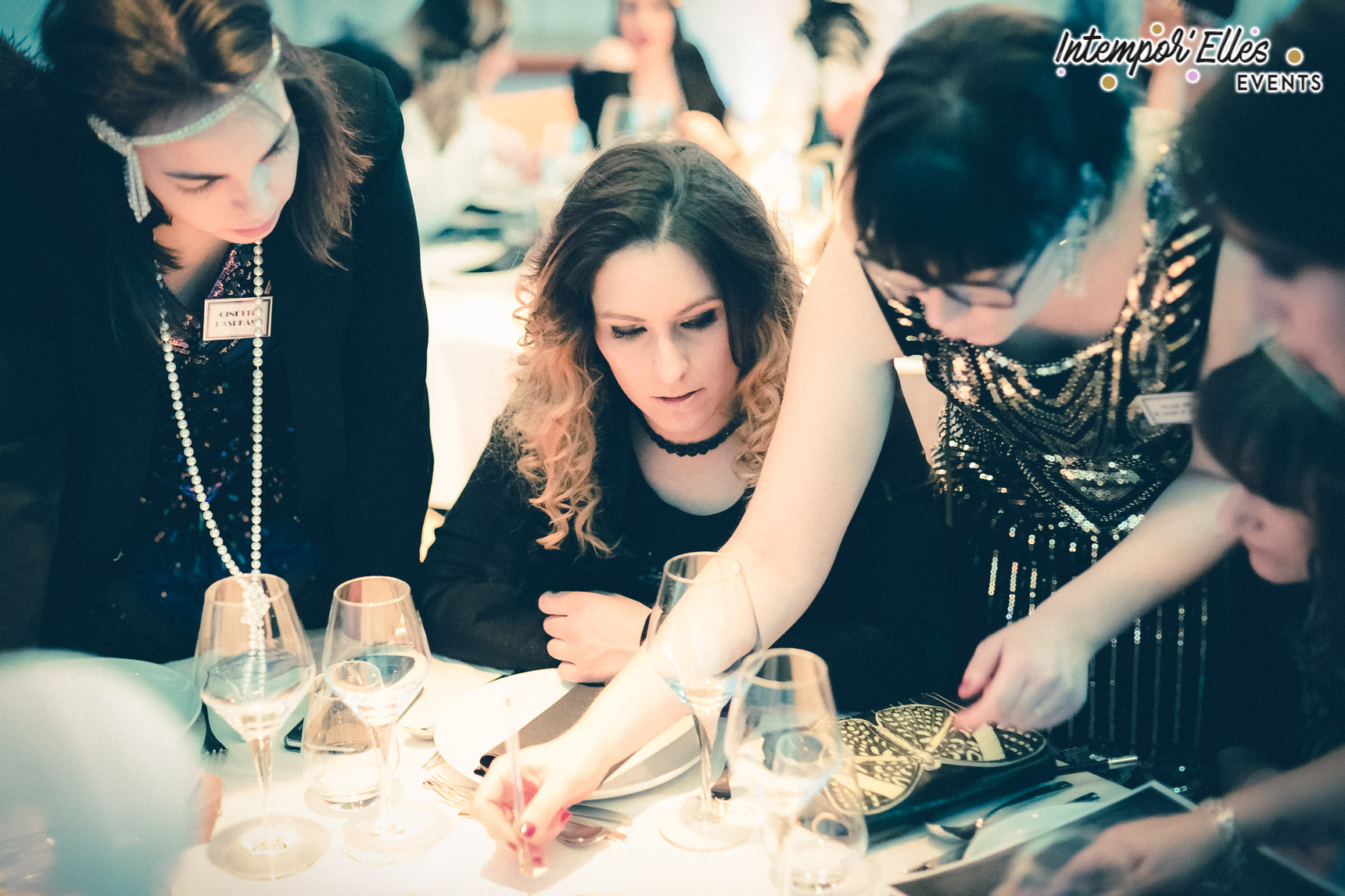
Table-based mystery during dinner: a strong option when you need a seated format (gala, awards, high protocol). Clues are delivered between courses to protect service timing and speeches.
Drop-in mystery corners for open cocktails: for very mixed crowds or when arrivals are spread across 60–90 minutes. Guests can play 10–15 minute micro-chapters without committing to a full game.
Art animations in Brussels
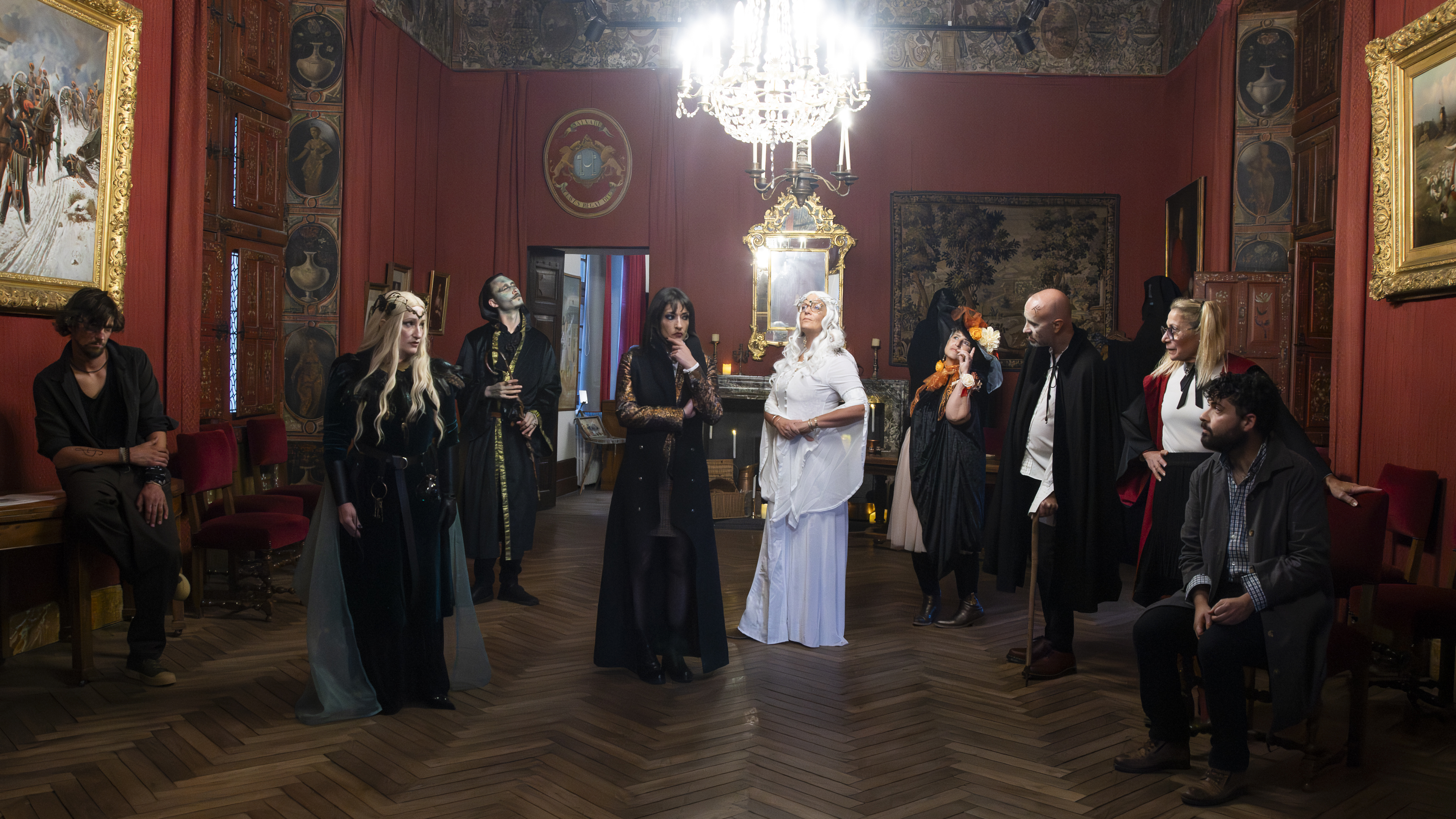
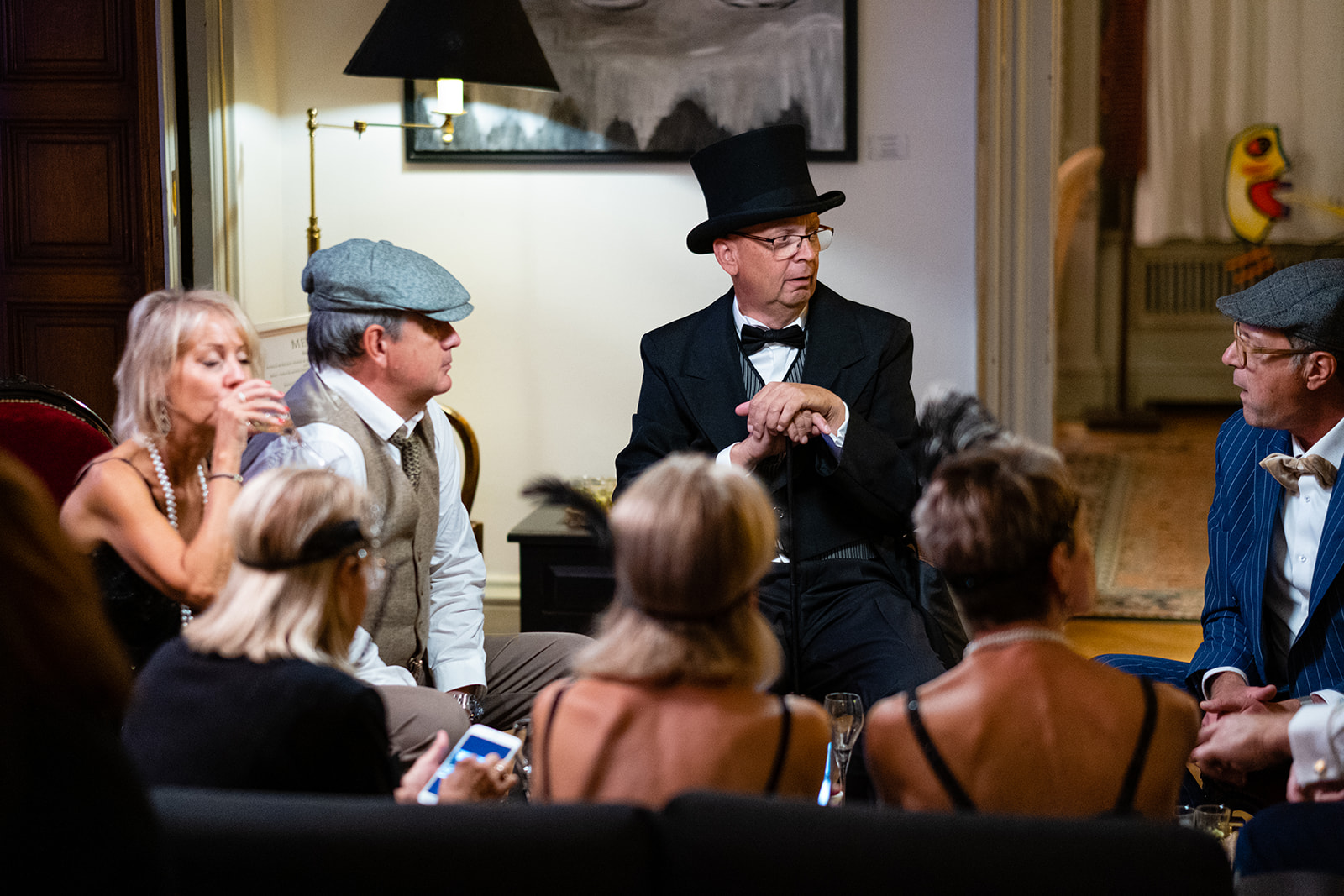
Professional actors embedded as “guests”: this is the most effective immersion lever in corporate contexts. Actors remain believable and corporate-appropriate; we avoid caricatures that make executives uncomfortable.
Directed reveal scene: a short, well-staged reveal with controlled sound and lighting can elevate the perceived value without turning the event into theatre. We keep it compatible with typical Brussels venue noise limits.
Character-led facilitation: instead of a classic host, the facilitator stays in-role to maintain immersion, while the production team ensures timing, cues, and transitions remain corporate-smooth.
Innovative animations in Brussels
Evidence tasting: pairing a clue with a bite or beverage (including alcohol-free) encourages movement and conversation. Useful for avoiding bar congestion in central Brussels locations.
Chef’s “suspect course”: one course becomes part of the narrative (e.g., ingredient list reveals a clue). We coordinate tightly with catering so service quality is never sacrificed for the game.
Chocolate or beer narrative elements inspired by Belgian culture: used carefully, without clichés—only if it fits your brand and audience mix.
Gourmand animations in Brussels
QR-assisted clue validation: guests scan to confirm evidence and receive the next step. It reduces facilitator load and is practical for 200+ groups, while remaining optional for less tech-inclined participants.
Secure “corporate intelligence” storyline: designed for organisations sensitive to compliance, data, and reputation. We can include realistic constraints (chain of custody, document versions) that resonate with Brussels-based HQ audiences.
Hybrid-friendly mechanics: for teams with a few remote colleagues, we can add a controlled remote role (e.g., analyst desk) without turning the event into a video call for everyone.
Whatever the format, alignment with brand image is not a slogan—it is about tone, pacing and visual codes. A law firm, a public institution, and a tech scale-up can all run a Immersive Mystery Night in Brussels, but the humour level, actor behaviour, and competitive intensity must match the organisation’s culture and communication standards.
How to choose a Brussels venue that supports an Immersive Mystery Night
The venue determines how immersive your mystery night can be, but also how controllable it is operationally. In Brussels, we pay special attention to access (public transport and taxis), acoustic constraints, backstage space for actors, and the ability to separate play zones from catering and speeches.
| Venue type | For which objective? | Main strengths | Possible constraints |
|---|---|---|---|
Private venue with multiple rooms (hotel/event space) | Structured investigation with chapters and smooth transitions | Reliable staff, predictable AV options, coat check flow, easier security in Brussels | Less “raw” atmosphere; strict timing and supplier rules |
Historic townhouse / mansion setting | High-end brand image, VIP-friendly mystery storyline | Natural immersion, strong wow factor without heavy decor, photogenic rooms | Access logistics, limited freight, noise/neighbour constraints |
Industrial or creative venue (converted warehouse) | Large-scale teams, energetic pacing, modern narrative | Big open spaces for clue stations, flexible staging, strong production feel | Needs more technical build (sound/light), can feel “empty” without scenography |
We strongly recommend a site visit (or at minimum a technical recce) before locking the scenario. In Brussels, two venues with the same capacity can behave very differently once you add coat check queues, bar lines, and actor circulation. The visit is where we protect your timeline and de-risk the evening.
What budget to plan for an Immersive Mystery Night in Brussels
Pricing for a Immersive Mystery Night in Brussels depends on attendance, venue complexity, number of actors, and the level of production expected by your brand. The key is to match budget lines to the risk you are willing to carry internally: the less you want to rely on improvisation, the more you need robust production and staffing.
As a realistic orientation for corporate clients in Brussels (excluding venue rental and catering), many projects fall within €6,000–€25,000. Premium multi-room experiences with higher cast counts and heavier technical/scenic build can go beyond that.
Participant count: 30–60 is usually one facilitation team and light casting; 150–300 requires multiple parallel flows to avoid waiting and disengagement.
Cast and staffing: number of professional actors, producer, stage manager, facilitators, and runners. Staffing is what protects timing and quality under pressure.
Scenario design level: from an adapted existing storyline to a company-integrated narrative with bespoke props, documents, and branded visual elements.
Venue footprint and complexity: single-room cocktail vs. multi-floor venue in central Brussels with separate zones and access rules.
Technical needs: microphones, sound cues, lighting looks, projection, and whether the venue provides in-house equipment or requires external suppliers.
Languages: bilingual or trilingual delivery impacts scripts, materials, and facilitation structure.
Timing constraints: a strict 2-hour window demands denser staffing and tighter choreography than a relaxed 4-hour evening.
We frame budget discussions around return: reduced “dead time”, higher participation, smoother networking, and less internal stress on event day. For HR and Comms, the ROI is also reputational—delivering a controlled evening in Brussels that feels premium without becoming risky or chaotic.
Why appoint a Brussels-based partner for a mystery night
For decision-makers, the local advantage is not proximity for its own sake—it is faster problem resolution, better vendor coordination, and fewer assumptions about how venues actually operate in Brussels. Mystery nights are logistics-heavy: you need precise timing, discreet backstage management, and the ability to adapt live without breaking immersion.
Being established in Brussels means we can:
- Pre-empt venue constraints (loading docks, lift sizes, neighbours, security desks) because we have dealt with them repeatedly, not “on paper”.
- Shorten decision cycles via quick site checks and last-minute adjustments when your agenda shifts—common in executive calendars.
- Mobilise reliable local resources: technicians, hosts, actors, and backup staff, reducing dependency on long travel and increasing resilience.
- Protect your internal stakeholders on the day: one accountable producer on-site who handles vendors and issues, so HR/Comms can focus on guests and leadership.
We frame budget discussions around return: reduced “dead time”, higher participation, smoother networking, and less internal stress on event day. For HR and Comms, the ROI is also reputational—delivering a controlled evening in Brussels that feels premium without becoming risky or chaotic.






What we have delivered in Brussels across different corporate contexts
In Brussels, we have adapted mystery night mechanics to very different realities: formal seated dinners with protocol, high-energy end-of-year parties, and leadership offsites where the aim was to reconnect departments after a reorganisation. The common point is operational discipline: clear run-of-show, vendor alignment, and contingency plans.
Examples of challenges we routinely manage:
- Late arrivals due to meetings near the European Quarter: we design “chapter entry points” so guests can join without being lost and without punishing teams who arrived on time.
- Mixed seniority levels: we avoid games that put junior staff “on stage” against their will; participation remains voluntary but naturally encouraged through roles that fit different personalities.
- Brand sensitivity for organisations under public scrutiny: we keep the narrative elegant and compliant, with controlled humour and clear approval gates for props and messaging.
- High pressure on internal organisers: we provide checklists, briefing scripts, and an on-site command structure so your team is not forced into ad-hoc decisions during the evening.
This is the difference between a fun concept and an executive-ready delivery: the event must work with real people, in a real Brussels venue, on a real timeline.
Common risks we prevent on mystery nights in Brussels
Underestimating flow: too few clue stations leads to queues and disengagement, especially in cocktail formats. We calculate throughput like a service operation, not like a game night.
Overcomplicated rules: if guests need 10 minutes to understand, you lose the room. We keep mechanics simple and depth in the story, not in instructions.
Actors without corporate codes: an actor can be talented and still be wrong for a corporate environment. We cast for discretion, adaptability, and tone control.
Ignoring multilingual dynamics: “English only” often creates micro-groups. We plan tools that keep people together without forcing unnatural behaviour.
Misalignment with catering: games that disrupt service create frustration and damage perceived quality. We design around catering constraints, not against them.
No contingency plan: missing props, tech glitches, or a blocked room must not stop the experience. We build redundancy into key game elements.
Our role is to carry these operational risks for you. In Brussels, the margin for improvisation is smaller because venues run on strict schedules and guests are time-sensitive. We plan accordingly and manage the night with production discipline.
Why Brussels clients renew with INNOV'events
When a client rebooks, it is rarely because the “story was nice”. It is because the evening was controlled: timings respected, leadership satisfied, and internal organisers not left alone with vendors and last-minute decisions. In Brussels, that reliability is what protects your reputation internally.
Recurring annual formats: many clients ask us to keep the same structure (what works operationally) while refreshing the narrative and visuals each year.
Operational documentation: run-of-show, staffing plan, venue coordination notes and stakeholder briefings are kept and reused, saving time for HR and Comms.
Supplier consistency: stable local teams (actors/tech) reduce variability and make quality predictable across editions in Brussels.

Loyalty is a consequence of execution. If you need a partner who treats a Immersive Mystery Night like an event operation—rather than a concept—INNOV'events is built for that.
Our Brussels production process from brief to showtime
👉 Step 1 (Brussels): brief alignment and constraint mapping
We start with a 30–45 minute working call with HR/Comms and, when possible, the event owner. We confirm objectives (networking, culture, onboarding, leadership message), attendance ranges, language mix, and non-negotiables (timings, brand rules, sensitivities). We also map constraints specific to Brussels: venue location, access windows, security, and guest arrival patterns.
👉 Step 2 (1000): format selection and scenario architecture
We propose 1–2 format architectures (e.g., cocktail rotation, dinner-based mystery, multi-room investigation) with pros/cons for your audience. We then lock the operational skeleton: chapters, clue station count, actor beats, and the integration points for speeches and service.
👉 Step 3 (Brussels): venue recce and technical integration
We conduct a site visit or technical recce: circulation paths, sound zones, lighting options, backstage space, and any restrictions that will influence immersion. We coordinate with venue staff and caterer to align timing, room resets, and service rhythm. This step is where we prevent day-of friction.
👉 Step 4 (1000): production build and stakeholder approvals
We produce scripts, props, team materials, and optional branded elements (document design, signage style, scoring visuals). If your organisation requires approvals, we set a clear validation path with deadlines so nothing is decided at the last minute. We also prepare internal briefing notes for hosts, executives, and reception.
👉 Step 5 (Brussels): on-site setup, rehearsal, and live direction
On event day, we manage setup, actor briefing, technical checks, and the rehearsal of key cues (opening, reveal, awards). During the event, a senior producer runs the show: guest flow, timing, escalation handling, and coordination with venue/catering/AV. We keep immersion intact while protecting your schedule.
👉 Step 6 (1000): debrief and rebooking-ready documentation
Within a few days, we share a concise debrief: what worked, any friction points, participation observations, and recommendations for the next edition. For recurring Brussels clients, we keep the operational file updated so future planning is faster and less demanding for your teams.
FAQ sur l'organisation Immersive Mystery Night à Brussels
How long should an Immersive Mystery Night in Brussels last?
Most corporate formats in Brussels run 2 to 3.5 hours for the game layer, often within a 4 to 5-hour overall evening (welcome + catering + speeches). We structure it in chapters so late arrivals can join and you can keep a firm end time.
What is a realistic budget range in Brussels for 120 people?
For 120 participants in Brussels, plan most often €9,000–€18,000 excluding venue and catering, depending on actor count, technical needs, and whether the scenario includes bespoke branded props. We can provide two options: a robust “core” delivery and a more premium production level.
Can you run the mystery night in Brussels in FR/NL/EN?
Yes. In Brussels, we regularly deliver in French, Dutch and English. The practical approach is usually: bilingual facilitation + simplified clue design, with key materials available in multiple languages to keep teams mixed rather than split by language.
Which Brussels venues work best for an immersive mystery format?
The best venues in Brussels are those that allow clear circulation and at least one separate space for actor/backstage logistics. Multi-room event spaces and certain historic houses work very well; single open rooms can work too, but require more careful station design to avoid queues and noise overlap.
How far in advance to book a Brussels Immersive Mystery Night?
For Brussels, we recommend 6–10 weeks for a standard production and 10–16 weeks if you need a premium venue, higher cast, or strong brand integration. Shorter timelines are possible, but venue availability and approvals become the limiting factors.
Request a Brussels quote with an execution plan, not just a concept
If you are comparing agencies, we suggest a pragmatic next step: share your date window, estimated headcount, language mix, and venue status (booked or not). We will respond with a clear proposal for a Immersive Mystery Night in Brussels: recommended format, staffing, timeline, and budget range—so you can validate feasibility internally.
Planning early is not about adding complexity; it is about reducing risk. The sooner we lock venue constraints and run-of-show, the easier it is for HR, communications and leadership to stay focused on guests rather than logistics. Contact INNOV'events to schedule a short working call and receive a Brussels-ready plan.
INNOV'events Brussels Agency
Justin JACOB is the manager of the INNOV'events Brussels office. Reach out directly by email at belgique@innov-events.be or via the contact form.
Contact the Brussels agencyToutes nos prestations & animations Brussels, Belgique
Découvrez nos prestations événementielles
Découvrez nos animations événementielles disponibles au Belgique
- Event Hostess in Brussels
- Escape Game in Brussels
- MasterChef Cooking Workshop in Brussels
- Magician in Brussels
- Marquee Rental in Brussels
- Color Analysis Workshop in Brussels
- Inflatable Games in Brussels
- Valet Parking Service in Brussels
- Football Simulator in Brussels
- LED Furniture Rental in Brussels
- Light Branding in Brussels
- Unique Dining Experience in Brussels
- Light Painting in Brussels
- Murder Mystery Party in Brussels
- Prize Contest in Brussels
- Promotional Displays (POS) in Brussels
- Virtual Reality in Brussels
- Molecular Gastronomy Workshop in Brussels
- Halloween Entertainment in Brussels
- Fireworks Show in Brussels
- Giant Games Challenge in Brussels
- Event Host / MC in Brussels
- Photo Booth Animation in Brussels
- Santa Claus Entertainment in Brussels
- Kids Entertainment in Brussels
- Guided Tour in Brussels
- Urban Rally in Brussels
- Ball Pit in Brussels
- Flight Simulator in Brussels
- Food Truck Rental in Brussels
- World Record Challenge in Brussels
- Surf Simulator in Brussels
- Wine Casino in Brussels
- Makeover Workshop in Brussels
- Perfume Creation Workshop in Brussels
- Acting Workshop in Brussels
- CSR Activities in Brussels
- Archery in Brussels
- Security Staff in Brussels
- Wine Tasting in Brussels
- Mime Performer in Brussels
- TV Game Show in Brussels
- Funfair in Brussels
- Crisis Management Workshop in Brussels
- Crisis Negotiation Workshop in Brussels
- Arcade Games in Brussels
- Indoor Skydiving Simulator in Brussels
- Ski Simulator in Brussels
- Racing Circuit Experience in Brussels
- Introductory Flight Experience in Brussels
- Tasting Experience in Brussels
- Build Your Own Foosball Workshop in Brussels
- 2CV Rally in Brussels
- LEGO Challenge in Brussels
- Casino Night in Brussels
- Interpreter / Translator in Brussels
- Promotional Giveaways in Brussels
- Shuttle Transport in Brussels